


The Satanic Rebellion: Background to the Tribulation
Part 4:
by Dr. Robert D. Luginbill



Introduction:
Satan's Rebellion and Fall
I. Strangers in the Devil's Realm
1. Sojourners in the devil's
world
2. The vanity of life
3. The hostility of the world
4. The battlefield
5. The enemy
II. Satan's Position after the Fall
III. Satan's Order of Battle
1. The current heavenly truce
2. The
Kingdom of God versus the kingdom of Satan
3. The organization of
holy angels (including titles, ranks and functions)
4. The
organization of fallen angels (including titles, ranks and functions)
5. God's employment of
evil spirits
6. Angelic combat
7. Believers versus Unbelievers
IV. Satan's Tactical Doctrine
1. Satanic
Lie #1: "I don't need God"
2. Satanic Lie
#2: "I am like God"
3. Satanic Lie
#3: "God needs me"
4. The integrated Satanic
world-system:
a. Religion
and the occult
b. Politics and
society
c. Economics and
technology
5. The believer's perspective
V. Satan's Tactical Methodology
1. Names for the devil
2. Demon
Influence: the Tactics of Temptation
3. Demon attack
4. Demon possession
5. Accusation of believers
6. Resistance
Introduction: The world that Adam and Eve entered after their expulsion from the garden of Eden could not have been more different from the perfect environment they had so recently taken for granted. Instead of abundant prosperity, ready at hand, they had entered a world of limitation, shortage and scarcity. Instead of a world where all their needs were instantly provided for without any effort on their part, back-breaking toil was now necessary for survival, and uncertainty for the future entered into the equation. Life was now a matter of pain, sweat, tears and trouble. Our first parents would also now experience for the first time the full gamut of destructive and sinful emotions, including fear, jealousy and hostility. The domestic tranquility that had reigned in Eden as a matter of course would now be infected by anger, frustration, bitterness and resentment. Before too many years had passed, Adam and Eve would even come to see one of their own children murder his brother. And finally, in crowning futility, when they had lived out their finite years, the ground would receive them back to itself as the Lord God had proclaimed. Death would put an end to all they had worked and striven for in the sorrowful interim.
But God did not leave them orphans on the earth, completely bereft of all hope and of Himself. In the same judgment that rendered our first parents mortal, God also promised them the Seed who would one day crush the head of the serpent who had deceived them. Christ's sacrifice was also foreshadowed in coats of skin with which He graciously clothed them, replacing the garments born of their own efforts with symbols of the coming One who would one day die in their place (discussed in Part 3). Thus before they even left the garden of Eden, God had given Adam and Eve a new tree of life to replace the one they had forsaken: that is, the cross of Jesus Christ (foreshadowed in the animal skins and in the prophecy of the Seed). Like their descendants after them, Adam and Eve were thus given the opportunity to regain the spiritual relationship with God lost at the fall. He Himself would make the promised sacrifice that would blot out sin and destroy the advantage the devil had gained, crushing Satan's head first at the cross and making a final end of him at the conclusion of history. It only remained for our first parents to accept our Lord's generous offer of boundless grace, trusting in Him for their deliverance from the inevitability of the grave, the unavoidable reality which had now become life's central issue.
From a spiritual point of view, life remains essentially the
same for us today as it was when our first parents trekked out of Eden some six thousand
years ago. The critical issue for every human being is identical now to what it was then:
we must all choose whether or not to accept through faith God's solution to the problem of
sin and death (in the person of His Son Jesus Christ). And just as Adam and Eve were left
in the world beyond the point of faith, so also we today are not immediately transferred
to our heavenly home after salvation, but remain here in the world to prove our faith, to
grow in it, and to help others do the same. But this world is no Eden. As followers of God
and believers in Jesus Christ, we can be forgiven for feeling ill at ease in this present
world where we scarcely even seem to belong, for it is not a place where the knowledge of
God abounds and the will of God is always done. On the contrary, this parlous world
through which we pass lies largely under the influence of the evil one (1Jn.5:19).
I. Strangers in the Devil's Realm
1. Sojourners in the Devil's World: Though no doubt relieved that the Lord God had not visited upon them a swift and fiery judgment, Adam and Eve would have been anything but comforted by the harsh realities of the new world east of Eden into which they were forced following their eviction from the garden. This, assuredly, was no paradise. Life was no longer wonderful, especially in contrast to the bounty so recently lost. Everything was now flawed, and strangely unsatisfying. The pain, the privation, the decay and corruption – and more than the anything else the absence of God – must have driven home the contrast to Eden.
Unlike our first parents, we do not possess the experience of a perfect Eden as a vivid point of comparison to this imperfect world we now inhabit. But despite the fact that familiarity tends to inure one to hardships, this unforgiving world of trouble and tears has a tendency from time to time to slice through even the most deep-rooted Stoicism, and through even the most fortunate circumstances, reminding us all that this is not a paradise designed by God for our happiness and pleasure. On the contrary, this is the devil's world.
That Satan's world of deep unhappiness is essentially corrupt is a truism evident at life's every turn. Everything decays. Nothing good lasts. Sin and evil are ubiquitous. And not too far down the road in every individual life lies the grave, the reward and legacy awaiting us all, no matter how blissful or disappointing our lives have been in the interim. Only God is truly meaningful here on earth, if we would but search for Him. Only Jesus Christ offers a solution to the futility of life and the inevitability of death, if only we would believe in Him. Only on the other side of this life is there true meaning, true fulfilment, true and lasting happiness, when we are at last re-united with the God who loved us enough to sacrifice His Son on our behalf, if only we have chosen Him in this present life over the deceptive vanities of the devil's world. Until that time, like our first parents Adam and Eve before us, we have been left in this strange and alien world where the blinding reality of God is largely obscured from view, revealed almost exclusively in His Word to those who seek Him out. Until that time, we wait for something better as homeless wanderers in a world which finds our perspective and our hope worthless, even idiotic. But by our faith and the actions that faith produces, we show the world that we are not of it, do not love it, and acknowledge that we have no true part in it – except for the God who is the focus and the object of our love all the days of our sojourning here in the devil's inhospitable desert (cf. 1Chron.29:15; Ps.23:1-6; 39:12; 63:1; 84:5-7; 119:19; Heb.11:37-38; 11:13-16; 13:13-14; 1Pet.1:1; 2:11).
Whom have I in heaven but you? And earth has nothing I desire besides you.
Psalm 73:25 NIV
2. The Vanity of Life: In His judgment upon Adam and
Eve, God laid down the fundamental calculus of human life outside of the garden: that we
must earn our bread through sweat and toil throughout our short lives and afterwards
return to dust (Gen.3:16-19). The curse of a life filled with difficulties followed by an
inevitable death will only be removed when God has brought history itself to an end
(Rev.22:3). In the meantime, the cycle of painful birth, thistles and thorns, and return
to the ground from whence we were originally taken is destined to repeat for us, one and
all.
"Utter futility! Utter futility!" says the teacher, "Everything is futility!"
Ecclesiastes 1:2
Many men strive for things that cannot be achieved, for even with prodigious effort, achievement is not really within the power of Man to control:
The race is not to the swift, or the battle to the strong, nor does food come to the wise, or wealth to the brilliant, or favor to the learned, but time and chance happen to them all.
Ecclesiastes 9:11 NIV
And of those who do achieve what they have set their hopes on, many of them will lose what they have striven for, since everything in this life is ephemeral (cf. Is.40:6-8; Matt.6:19-21; Lk.12:14-21; 12:33; Jas.1:10-11; 5:2-3; 1Pet.1:24; 2Pet.3:10-13; 1Jn.2:15-17):
Moreover, no man knows when his hour will come: As fish are caught in a cruel net, or birds are taken in a snare, so men are trapped by evil times that fall unexpectedly upon them.
Ecclesiastes 9:12 NIV
And of those who do manage to retain what they have striven for all the days of their lives, death will ultimately bereave them of all their precious accomplishments. For death, in particular, makes a mockery of all human achievement:
What profit will a man have if he gains the whole world but loses his life?
Matthew 16:26
Since the ultimate loss of life is the common heritage of all mankind, unless some solution can be found to the overarching problem of our physical mortality, even achievement on a level unsurpassed in human history is essentially meaningless. Indeed, one may even make the argument, that the greater the achievement, the greater the futility, on account of the correspondingly greater loss involved at death. Along with life, the poor lose only their poverty in death, but the rich, successful person loses the things esteemed most in this vain, secular world. Death thus renders all secular achievements essentially pointless:
Do not be overawed when a man grows rich, when the splendor of his house increases; for he will take nothing with him when he dies, his splendor will not descend with him.
Psalm 49:16-17 NIV
Nothing we do is truly original (Eccl.1:10). Nothing we do will ultimately be remembered (Eccl.1:11). Despite all our efforts, death will snatch away from us all we have gained in this life "though we had named lands after ourselves" (Ps.49:11b), and we will be oblivious to the fate of our prized possessions after our departure (Eccl.2:17-21). Nothing is secure. Nothing is forever.
It is in this context that our Lord commanded us to look beyond the hollow rewards of this life to the true rewards, eternal in the heavens, which come from God:
Even apart from this divine perspective, moreover, the essential vanity of human effort and the ephemeral nature of life is difficult to ignore or deny (for anyone conducting an honest appraisal; cf. Is.40:6; Lk.12:14-21; 12:33; Jas.1:10-11; 5:2; 1Pet.1:24; 2Pet.3:10-13):
Man is a mere phantom as he goes to and fro: He bustles about, but only in vain; he heaps up wealth, not knowing who will get it.
Psalm 39:6 NIV
At no time in history has this truth been more clearly perspicuous than in our modern world of technology, affluence and leisure time, where the phenomena of apathy, depression and suicide are all in the process of increasing exponentially. That modern advances (which are supposed to be a blessing to human life) are found to be correlated instead with reactions of hopelessness may seem contradictory from the secular viewpoint. From the biblical viewpoint, however, the correlation seems perfectly reasonable. Apart from God, life is hopeless; therefore to the degree that mankind is relieved of the daily necessities (which for most of history have occupied human existence), one should expect this hopelessness to shine through with ever greater clarity. What is surprising from the biblical point of view is that this pall of futility does not hang even heavier over the unbelieving world (a phenomenon to be attributed to the spiritual blindness which sets in once God is rejected).
While Satan uses a variety of techniques to control the human race, it is fair to say that to the extent life's futility motivates mankind to seek eternal solutions to the hopelessness of temporal life, to that extent it is clearly in the devil's interest to direct humanity's activities into other channels (as best he can). And, indeed, much human effort over the millennia has been directed toward solving, mitigating or flat out denying the essential truth of the meaninglessness of life apart from God (see section IV below). Indeed, mankind has made a science of discovering interesting amusements and diversions to try and take the sting out of life – in vain. For the sin we have inherited from Adam guarantees that the sting of death will continue to loom large for all who ever choose to take a sober, realistic look at the true dynamics of life (1Cor.15:54-57).
Oh the ineffable wisdom of God's judgment upon Adam and Eve! Giving them pain and toil in addition to an ultimate physical death was the best possible encouragement to look beyond this life for solutions. The promise of the woman's Seed (Christ) and the sacrifice for sin He would provide (foreshadowed in the coats of skin) were eagerly received and believed, at least in part because the contrast of the good life in Eden with the complete futility and hardship of life outside was so stark. God has not left us as orphans in this cruel world. Quite the contrary. He has made provision for our complete restoration to Himself through faith in the One who died for us, our Lord and Savior Jesus Christ. The hardships of this life, and the essential pointlessness of it apart from God, are, in truth, a part of His grace, for they lovingly and effectively divert our gaze from the bitter life around us – if only for a brief, necessary moment – that we might seek something better.
Examined from the point of view of mortality, life (apart from God) is futile, pointless, and vain. Death destroys all progress, all accomplishment, all wealth. And no amount of progress, accomplishment or wealth can ward off death. Furthermore, as the days lengthen, all remembrance of the dead is eventually extinguished, so that the myth of "living on" in the memories of men, or in the "collective consciousness of the human experience" is pure gossamer, a fantasy that dissolves with the slightest touch. Not that it would or could provide any comfort for the dead if they were to be remembered for generations to come – for all the world to see, by the world's own empirical standard, their lamp has gone out and they are no more:
Anyone who is among the living has hope – even a live dog is better off than a dead lion! For the living know that they will die, but the dead know nothing; they have no further reward, and even the memory of them is forgotten. Their love, their hate and their jealousy have long since vanished; never again will they have a part in anything that happens under the sun.
Ecclesiastes 9:4-6 NIV
Whatever shred of remembrance there is for the dead, it benefits them not a whit. Funerals and memorials are for the living. Life for the living, moreover, when examined from this same point of view (i.e., mortality), and contrasted with the perfect environment of Eden, is a terribly frustrating experience. For there is no truly compelling purpose for all the effort that goes on under the sun. All Man's labors are ultimately to put food in his mouth, but that mouth can never be filled nor its appetite satisfied (Eccl.6:7). Whatever men strive for, enduring toil and pain, will not satisfy – only the unattained and the unattainable are truly attractive. And even they turn to dust before the eyes if the gaze is prolonged but a moment. If money is the object of desire, there will never be enough of it; if wealth is the objective, there is never enough to satisfy (Eccl.5:10). If you hoard wealth, it is useless to you; if you spend it for your enjoyment, you no longer possess it (Eccl.5:11). And if through toil and pain and effort wealth is achieved, it vexes the sleep of the rich, while the laborer sleeps sweetly after a simple meal (Eccl.5:12).
Toil and pain and effort – the new calculus of life after Eden demands it. Without such sweat and labor we would not eat. But no matter how long and hard and successful the work, it cannot ward off death forever, nor can it even provide lasting satisfaction. In light of the ultimate futility of life, both taken as a whole and viewed in terms of the pointlessness of effort beyond the bare necessity of survival, it is understandable that mankind has historically devoted itself to the principle of diversion, a principle that explains almost all human behavior of a non-spiritual nature:
Let us eat and drink, for tomorrow we shall die.
1st Corinthians 15:32b
The secular conclusion above (presented by Paul as a perfectly logical modus operandi in the absence of any hope of eternal life) is a succinct way of stating the principle. If death be inevitable, and if life be an essentially dull and pointless continuum of toil and pain, what better way to "get through" than to devote oneself to diversions (of one sort or another). Work and accomplishment can serve effectively in this capacity as well. Anything that distracts from the overall vanity of life fulfills the diversion principle.
Between birth and death, we human beings have nothing but time, time which must be served on this earth under the Genesis curse. We fill the time with work, with relationships, and with various pleasures and pursuits. We fill the time, we waste the time, we strive desperately not to be at loose ends with our time, lest the realization of life's vanity dawn and bear heavily down upon us. To the extent that the effort produced by our time-filling, time-wasting activities is directed at all, it is inevitably directed toward the impossible goal of making ourselves happy (whether directly or indirectly). Whether a man toils a lifetime in the depths of the earth searching for treasure, or spends his days at the corner pub, happiness is the ultimate objective, and who can say which man is the greater fool? In the latter case, happiness stops almost instantaneously with "last call"; in the former, great success will only bring an end to the diversion of toil and bring on the realization that riches do not produce happiness (dispelling the illusion that motivated the distracting toil in the first place).
Do we not enjoy our pleasures? Certainly we do. Much of human ingenuity since Man's expulsion from the garden has been devoted to the science of amusement. And in our modern western world of high technology and super-abundance, pleasures and diversions are available on a scale never imagined millennia ago. Never before has there been so much prosperity, and never has there been so much depression. The more we human beings have pursued happiness, the more unhappy we have become. The harder we have toiled for it, the more easily it has eluded us. The less pressing the necessities of life have become, the more despondent we have become. For the toil of work, the Genesis curse, is the one thing that is capable of effectively distracting us from the grinding realization that life is pointless. Work alone (along with the taking in of sustenance which work makes possible) is the one necessary element in life, and so provides a satisfying distraction unmatched by all other pursuits of happiness:
Then I realized that it is good and proper for a man to eat and drink, and to find satisfaction in his toilsome labor under the sun during the few days of life God has given him – for this is his lot. Moreover, when God gives any man wealth and possessions, and enables him to enjoy (lit. eat) them, to accept his lot and be happy in his work – this is a gift of God. He seldom reflects on the days of his life, because God keeps him occupied with gladness of heart.
Ecclesiastes 5:18-21 NIV
But as the last verse above indicates, work too is essentially a diversion. Challenging, time-consuming, satisfying, work distracts the mind from reflection about the futility of life. The days pass productively (if pointlessly) so that the issue of vanity and futility never weighs heavily upon the heart. Without God then, the best mankind can hope for during these meaningless days under the sun is a challenging profession that occupies the energies, provides creature comforts, and a state of mind oblivious to the logic of mortality. The best that one can hope for, therefore, is to be like the animals, who pursue and enjoy sustenance and creature comforts, without being conscious of the approach of death:
I also thought, "As for men, God tests them so that they may see that they are like the animals. Man's fate is like that of the animals; the same fate awaits them both: As one dies, so dies the other. All have the same breath; man has no advantage over the animal. Everything is meaningless. All go to the same place; all come from dust and to dust all return. Who knows if the spirit of man rises upward and if the spirit of the animal goes down into the earth?" So I saw that there is nothing better for a man than to enjoy his work, because that is his lot. For who can bring him to see what will happen after him?
Ecclesiastes 3:18-22 NIV
From the Christian point of view, life is indeed tremendously significant. Only in life can we choose to follow Jesus Christ. And in the matchless grace and wisdom of God, the very vanity of life turns us to God by removing all other solutions; only in Him is there meaning and truth.
As Christians, it is all the more important for us to understand and appreciate the vanity of life, any aspect of life, which is not related to God. As Christians, we have come to God through Jesus Christ; we have as our mission the responsibility of growing in Him every day, and of helping others to turn to Christ and do likewise. How important it is for us who have recognized the pointlessness of secular life (and have opted to follow Jesus instead of the desires which the world esteems), how important it is for us not to "return to Egypt in our hearts" (Acts 7:39), not to let the cravings for the "good life" we have rejected for Christ's sake regain control over us (as that first generation of the Exodus did to their grievous harm: Ps.78 & 106; 1Cor.10:1-5; Heb.3:16-17; Jude 1:5). This life is a desert which must be crossed, but on the other side is a land flowing with milk and honey, a land where our Lord Himself dwells. On our journey there, there will be trials and tribulations (2Tim.3:12), but God will never fail to refresh and revive and satisfy the heart which rests in Him:
Keep your lives free from the love of money and be content with what you have, because God has said, "Never will I leave you; never will I forsake you".
Hebrews 13:5 NIV
It is important for us as Christians to maintain our sense of proportion, our orientation, our true priorities, given that we affirm our heavenly citizenship to be more valuable to us than all worldly wealth:
As Christians, we still live here in the devil's world. Our Lord has a purpose for leaving us here, and was entirely cognizant of the dangers to our spiritual health here on earth, dangers which we continue to face every day (Jn.17:15). Even as we make our way through the world, it is critical that we maintain our Christian orientation and momentum, and not return to the values, the priorities, the lusts and desires which the world exalts in place of God (Rom.12:2; 1Pet.4;3; 2Pet.2:20-22). In order to survive in the world, Christians too need to work and eat (legitimate sources of secular pleasure and satisfaction); Christians are not enjoined from family relationships, or indeed from many potentially non-sinful activities in which the world engages for relaxation and entertainment; but Christians do need to recognize the fleeting and inconsequential nature of any and all activities not directly related to their primary relationship, their membership in the family of God the Father through faith in His Son Jesus Christ our Lord. The world, especially the modern, western world, is full of distractions that have the potential of becoming obstacles to our spiritual progress, idols, in effect, that may harm our relationship with God.
Satan has incorporated into his system of world rulership as many material distractions as possible (see section IV below for details). Affluence, the increase and spread of wealth, communication and technology are factors which, from one point of view, are very beneficial to the devil's control of mankind. For one thing, fear is a major element in Satan's manipulation of humanity, and to the extent that men enjoy and rely on such things for their happiness and security, to that degree the fear of losing them produces a sort of bondage which the devil is quick to exploit (cf. Heb.2:14-15 for the principle).
In order to prevent our enslavement to the delights of this world (as well as to its necessities), an area Satan knows only too well how to manipulate against us, we need to have a full and sober appreciation of what the world really is. We need to be very aware of the world's essential vanity and of the pointlessness of its distractions and diversions. We need to be able to keep the pressures and exigencies of life (as well as its pleasures and delights) in proper perspective. God is what is important in this world, and He will never abandon us. Knowing Him and serving Him is why we are here. Everything else is mere context. We are neither asked nor commanded to get through life without taking any joy or pleasure in worldly things. And we certainly will not pass through the human experience without worldly pressures and problems (especially as Christians). But it is all these largely extraneous matters which we must compartmentalize, and not God. We dare not put God "in a box", giving priority to everything the world sees as important (but which from the Christian point of view is ultimately inconsequential), and neglecting the One who made us, who bought us, and whom we claim is our Master. Whenever we allow the "weeds" of life to grow high, and fail to tend our faith, we endanger our spiritual growth. Necessary weeds, good weeds, bad weeds, whatever blocks out the sunlight of God's truth, must be kept cut back if we are to fulfill the mission God has given us (cf. the parable of the sower in Matt.13; Mk.4; Lk.8).(1)
Ironically, believers have a tendency to do better spiritually in times of severe testing than in times of ease and plenty (cf. Deut.8:10-20). One "weed" which can be particularly dangerous to the Christian perspective is the prosperity weed. In these last days it is especially important for Christians to avoid a pair of assumptions which are equally dangerous:
1) that affluence is necessarily a sign that God is blessing us, and therefore, if we are wealthy, that we must be doing just fine in our spiritual lives. God does provide material blessings, occasionally of an exceptional nature. He did bless Abraham and David with affluence, for example, though John the baptist and our Lord certainly did not live lives of material luxury. It is well to consider that in the history of the world, many unbelievers have experienced exceptional material wealth. It would be a mistake, therefore, to assume that affluence is any indication of spiritual maturity. To make but one further point on this subject, we who are blessed to live in this country (and consequently enjoy a higher material standard of living than most of the rest of the world) are not automatically "better" Christians than our brothers and sisters in other parts of the world where life is harder in this respect.
2) that the result of spiritual growth and a prosperous relationship with God is necessarily material wealth (i.e., the "prosperity gospel"). In fact, the opposite effect is certainly not without precedent, that is, the spiritually mature encountering greater testing on this score (e.g., consider Job's trials, or Elijah's privations).
Morbid over-emphasis on material prosperity has always been an occupational hazard of the human race in general, and, the closer we come to the end of history, the more we can expect this issue to increase as a threat to Christian spiritual growth. During this last era of the Church, the Laodicean era, there is destined to be an ever increasing tendency toward equating wealth and affluence with spiritual success (Rev.3:14-22). God is our source of all our blessing, material prosperity included. But the false assumption of spiritual maturity and spiritual safety based solely upon material possessions is extremely dangerous. This is true for many reasons, not the least of which is an all too natural tendency to become complacent in the Christian walk, assuming spiritual maturity on the basis of material prosperity:(2)
After all, the idea that the world is a wonderful place, filled with all sorts of delights which we have been put here expressly for the purpose of enjoying, is decidedly un-Christian. This is not the garden of Eden, but rather the devil's world (at present), and we need to order our perspective and our priorities accordingly. Material prosperity, even when it truly originates from God, is a far cry from true spiritual wealth, and can very easily induce a false sense of spiritual security. As Christians, we need to take care to esteem the genuine "gold" our Lord and Master dispenses, that is, His word of truth, and remember that excessive concentration on the ephemeral gold of this world to the detriment of the truth of the word of God (upon which our relationship with Him is based) is both perilous and ultimately pointless. The issue is all the more significant in our materially prosperous world here in the last days of the Church, for prosperity in the realm of material possessions (which are admittedly essential for human life) often has the undesirable side-effect of breeding spiritual complacency. Affluence, however, is not spirituality. And if success in the material realm should cause us to neglect our commitment to God and to His Word, it is well worth asking whether such prosperity has indeed been a blessing.
Untroubled lives of ease in the midst of abundance are neither the norm nor the objective of the Christian life. The closer we walk with God, the more we can expect that walk to be opposed by Satan and his angels:
Indeed, all who are willing to live a godly life in Christ Jesus will be persecuted.
2nd Timothy 3:12
Satanic opposition, then, should be expected by growing believers. Even when the advancing believer finds himself in the midst of material prosperity, it should not be assumed that the devil will allow that person's Christian walk to go unchallenged:
Thus, Christian maturity and continued spiritual progress may or may not be accompanied by affluence (although the passage above refers to the "affluence" of being part of Christ's Church), but they will certainly be accompanied by trials and tribulations:
Opposition from the world to our spiritual progress is the rule, not the exception, and it is largely through our successful response to such tests that we come to appreciate the truth of the divine point of view about the world – that its rewards (and so also their loss or absence) are of small consequence in comparison to the rewards of eternity, blessings that will never fade and will never be taken away:
Thus material prosperity in this present world is ultimately of little true account to those who have chosen to follow Jesus Christ. For in our trials and tribulations, whether we have material abundance or no, we have chosen to put our Master's priorities first; we have chosen God and His Son over the material prosperity which this world proclaims as its god:
For the unbeliever, the issue is likewise a simple one. Having rejected God (and often even having denied His existence), he is forced to place an incorrect emphasis and inordinate importance on this present world. Such blindness, such self-delusion, such suppression of the truth about God necessarily elevates the world and its present ruler into the realm of "god" in the unbeliever's eyes:
This is the point at which spiritual degeneration begins for the unbeliever. As the passage above makes plain, everyone comes to appreciate the existence of the Creator, in most cases early in life; the fact that the majority of people in the history of the world have gone on to reject Him, replace Him in their thinking with other objects, and deny His existence altogether, does not change the truth of this principle. Once God has been rejected, some substitute will of necessity be accepted in place of the ultimate truth (2Pet.2:21-22; and cf. Matt.7:6).
This process of substituting worldly concerns for God is the inevitable path of unbelief. And it is important for Christians to have no illusions in this regard, lest we share in any way in the downward spiral that comes from choosing the vanity of this world over our relationship with God in Christ:
Hardness, blindness and self-delusion are inevitable results of rejecting truth and turning away from God.(3) And once the "god of this world" has thus blinded the mind of the unbeliever (2Cor.4:4), the quest for God is quickly replaced by the quest for happiness. We have it from Solomon, the wisest man who ever lived (apart from our Lord) that no avenue of human activity, no amount of success or accumulation of wealth can ever bring true happiness, for all such "chasing after the wind" is ultimately pointless (Eccl. chap.1-2). The great irony of the unbeliever's search for pseudo-happiness it that once God has been rejected, life really is pointless and futile, even from the standpoint of true, spiritual happiness (which has been rejected along with God). Contradictorily, however, this "guaranteed futility" only serves to intensify the unbeliever's struggle to achieve happiness and security in this ephemeral life (cf. Matt.6:32).
There is some twisted logic in the vain pursuit of temporal security and pseudo-happiness that characterizes the unbeliever's lifestyle. For one thing, all the effort and striving involved in attempting to achieve these two illusory objectives do serve to cloud the issue of mortality. The question of death, after all, is one which is very uncomfortable for any unbeliever to inspect too closely or too often (apart from the aid of one of the many lies about death which the devil has spread over the millennia; see section IV below). Excessive introspection of the mortality issue (though justified by the circumstances of life for those who have not found resolution in Christ) is just too much for most people to take. And so it is that although our extremely limited life-span and the exceptionally fragile nature of our existence is without a doubt the most pressing concern for any given individual, it is largely (and foolishly) ignored. Death is an uncomfortable topic, especially for those who have not found eternal life in Jesus Christ. But death makes a mockery of all for which the unbeliever strives. What good are achievements, what good is wealth, if in a few short days, or months, or years, death rips you away from them? Even assuming a stable world (also an uncertain proposition), nothing can last because we don't last. It is sadly ironic that the madcap rush for wealth, fame, glory, pleasure and possessions often serves to distract the unbeliever from the central truth of life outside of the garden: all these things are vain, because we shall all return to dust in the blink of an eye. The godless pursuit of pseudo-happiness (and false security) can never take the sting out of death, but for all those who are manically involved in it, it does provide distraction from death's approach. The unbeliever, after all, has every reason to fear death, more so than he may know. We should not be surprised, therefore, to find him engaged in a frantic cycle of activity, accepting any and all substitutes to blind his eyes to the reality of death's grim approach. The unbeliever, in short, although mortal, behaves as if he were immortal, and that is the essence of his folly. He stores up wealth, as if he will be around to enjoy it forever; he seeks glory, fame and achievement, as if it will not fade with his impending demise; he indulges himself in all pleasures, as if the grave will not put his enjoyment of them to an end. The Bible counsels the unbeliever to enjoy his work and daily bread as necessities which are also legitimate pleasures (Eccl.2:24-25; 3:12-13; 3:22; 9:7-10); in so doing, the days of his life slip by without an excessive contemplation of death, and without the frantic and pointless search for pseudo-happiness and false security. The best that the unbeliever can hope for, therefore, is to lack self-consciousness in the area of mortality, much in the same way as the animals, hunting for food and enjoying what God has provided, never giving a thought to the day of death (Eccl.5:18-21).
But for all those who seek after solutions apart from God, the devil has a lie that, like some super-addictive drug, grasps its victims tight and seldom releases its prey. The devil's lie is that happiness can be achieved in this world apart from God, and that, with enough effort, security can be vouchsafed for such gains. Sufficient space has already been expended to establish the principle that death makes a complete mockery of this lie from the outset (for any and all who are willing to make a truthful appraisal of the essential calculus of human life in this world outside of Eden). This fact, however, has not prevented a majority of humanity from falling into the pseudo-happiness, pseudo-security trap. Having rejected the truth of God, most people in the history of the world have gladly embraced the myth of true happiness capable of enduring. The exact incarnation of this "myth-happiness" takes many forms, of course, and is sought in a multitude of ways, but, inevitably, it is never really achieved. It always remains vaguely future, no matter how wealthy, or famous, or successful, or powerful a person manages to become in this short life: "I'll be happy if only I get/do/experience _________ ." Filling in this blank merely opens up the way for other blanks that need to be filled in for the elusive, never-actually-achieved myth-happiness to be attained. The fact that human beings who have sought happiness apart from God seldom if ever seem to wake up to this progression of the never-ending finish line for a happiness they can never seem to catch is a measure of just how powerful the narcotic of myth-happiness truly is.
The reality, however, is that a personal Eden cannot be achieved here in the devil's world. There is, as discussed above, a measure of satisfaction and security to be had in the simple, non-self-conscious approach to life of involving oneself in one's work, ones's family, and one's daily sustenance (Ps.127:3-5; Prov.5:18; Eccl.9:7-10). For believers who put God at the center of their lives, of course, there is (as we have seen and will revisit below) abundant joy to be had in a life lived in the light of Christ, in anticipation of the glories of eternity (Phil.4:4; Jas.1:2-4). But from the purely secular perspective, all joy must of necessity be related to this life alone, the godless myth that has ever enslaved the world.
This heathen quest for "myth-happiness", that is, satisfaction in life apart from God, is vain for two primary reasons: 1) apart from God, very little can truly satisfy; 2) apart from God, security can never be guaranteed. Beyond the simple, God-given pleasures of family, labor and food, the attainment of successive plateaus of wealth, fame, power or pleasure may entertain for a brief moment, but like a feast to a man with a full belly, they quickly lose their appeal, thus spurring the myth-happiness faithful on to the next level of dubious achievement as the cycle progresses on its never-ending way:
The second point mentioned above, that is, the inability of the secular man to attain security for himself, his accomplishments and his possessions, is equally trenchant, for it drives home the essential fact of the futility of myth-happiness, even to the degree that it may be thought to be attained. Fame must be added to or it fades, yielding the irony that achieving a pinnacle of notoriety merely sets one up for a fall: what has been gained can be all too easily lost. The same is true of power and wealth – there is nothing a man can do to ensure that either will endure with absolute certainty. A brief survey of the history of the world will show definitively that wars, depressions, revolutions, climactic catastrophes (to name but a few of the more prominent and general sources of instability) have deposed many a ruler and impoverished many a millionaire.
Moreover, no man knows when his hour will come: As fish are caught in a cruel net, or birds are taken in a snare, so men are trapped by evil times that fall unexpectedly upon them.
Ecclesiastes 9:12 NIV
Whoever loves money, never has money enough; whoever loves wealth is never satisfied with his income. This too (i.e., struggling for wealth) is meaningless.
Ecclesiastes 5:10 NIV
The sleep of the laborer is sweet, whether he eats little or much, but the abundance of the rich man permits him no sleep. I have seen a grievous evil under the sun: wealth hoarded to the harm of its owner, or wealth lost through some misfortune, so that when he has a son, there is nothing left for him.
Ecclesiastes 5:12-14 NIVA man's riches may ransom his life, but a poor man hears no threat.
Proverbs 13:8 NIV
Pleasure is even more ephemeral than wealth. Like mist, it cannot quite be grasped and held, and so the ability to repeat it is virtually impossible to ensure, even in the near term. That is not to say, of course, that mankind has not devoted an inordinate amount of its collective energies to devising ever more exotic and entertaining diversions, but this is in itself an argument for the biblical position that earthly pleasures (again, beyond the simple, godly ones) cannot really provide true happiness or real inner satisfaction. For if they could, one would think that our present, western world should be the happiest in history, inasmuch as devising and marketing entertainment has never before been carried to the heights we are now experiencing. But the reality is that we have also never before seen so many people so completely bankrupt in the spirit, so completely unsatisfied just as soon as the entertainment of the moment has passed. There has never been a place or a time characterized by so much depression, so many suicides, or such an intensive rush to push this pseudo-enjoyment of the world to ever new extremes – certainly not because people are building happiness upon irrepressible happiness, but rather because every successive round of invention leaves them just as empty the last.
All man's efforts are for his mouth, yet his appetite is never satisfied.
Ecclesiastes 6:7 NIV
And whether it is pleasure or wealth or power or fame or any other avenue of pursuing happiness in this life apart from the truth of Jesus Christ, death ultimately will mock them all:
Naked a man comes from his mother's womb, and as he comes, so he departs. He takes nothing from his labor that he can carry in his hand.
Ecclesiastes 5:15 NIV
For all his wealth, a man will not abide [on earth forever]. He is like the beasts that perish.
Psalm 49:12
Without the confident hope of life after death, what is the point of living long and prospering when afterwards one dies? Can a long life and the experience of material prosperity really soften the blow of death for the unbeliever when it finally arrives? It may do so for the living who feel less grief for someone who has died peacefully in a good old age and in a prosperous state, but does past experience, however blissful, really make the loss of everything an easier pill to swallow? While the average unbeliever generally makes a habit of ignoring the possibility of his own death (until it comes suddenly upon him), one thing is sure: no amount of achievement or wealth can forestall the inevitable:
But while human beings are only too willing to accept the idea of the mortality of others, a sense of personal immortality, or, more correctly put, an ability to procrastinate mentally until the very moment of death, is the rule when one examines one's own life. Just as "somebody else's troubles" cause little anxiety, so the eventuality of death is always in another man's court, until the actual termination of life (at which point contemplation and re-examination is, needless to say, too late). Great wealth may help to postpone the inevitable (at least people seem to think that it can), but no matter what fastidious care we are able to take of our lives and persons, the delay achieved will ever be laughably insignificant (Matt.6:27). So despite the fact that our ephemeral nature is the prime lesson of life, human beings persist in running after wealth and accomplishments until some mythic, personal Eden be achieved, ever hedging in their gains and themselves, as if the brief moment would or could last forever. But in the absence of the hope of the resurrection, the hope of myth-happiness achieved and preserved continues to be the holy-grail of the unbelieving life, that, and the equally vain hope that grasping the brass ring for a few short moments will somehow take away the sting of death.
Attaining the goals and desires the world esteems may act as a narcotic to the painful and ephemeral nature of life, but, like all narcotics, striving and accomplishment have an even more significant dark side. As wealth and achievement grow, so does worry (cf. Matt.13:22). Worldly progress is, because of the nature of the world, vulnerable to loss, and even when very carefully and intelligently hedged, will never lose its essential fragility. This factor makes all who have bought into the struggle for myth-happiness (especially those who have experienced some measure of success) even more sensitive to the possibility of loss. The principle that "losing it is worse than never having it in the first place" creates an enslavement effect, a dependency that is every bit as great as narcotic dependency. Fear of loss comes to control the life of the successful to an even more intense degree than desire for gain motivates those who are still striving for the worldly success.(4) Combined with increasing myth-happiness "tolerance" (the principle that, as with narcotics, the effect of every new gain and achievement tends to wear off with increasing frequency), fear of loss helps to ensure a constantly accelerating cycle of futility.(5)
When these essential realities of life are faced honestly, it is easy to conclude with Solomon that "everything is wearisome, more so than a man can express" (Eccl.1:8a). Nothing is new (Eccl.1:9-10). Nothing lasts. If you build a bridge, it will eventually fall down; if you save a life, you have not staved off death forever. What delights and thrills you today cannot sustain you tomorrow, and the anticipation of new excitements inevitably surpasses the reality once achieved. There is no gain or accomplishment (beyond the necessities of life) that has not been ultimately motivated by the jealousy and envy of the gain and accomplishments of others (Eccl.4:4; cf. Prov.14:30b): if gold and diamonds were as plentiful as dirt so that anyone could possess them, then no one would value them or lust after them; it is not uncommon to hear complaints about old and outmoded devices (cars, computers, etc.), though the very possession of such things when first introduced was wildly coveted. How quickly the thrill of ownership and the joy of experience fades, only to be immediately replaced by the covetousness of some other possession or entertainment. And although the newspapers are daily filled to overflowing with the detailed accounts of the unhappiness of the rich, powerful and famous, such cautionary tales do not deter mankind one whit from pursuing headlong the same futile course: somehow we would be different if only we could have what they have.
On and on, in never-ending cycle, the more knowledge we amass, the more miserable we become (Eccl.1:18); the more doctors and medical technology, the more suffering; the more wealth in the world, the more poverty (cf. Eccl.5:11); the more information available, the more ignorance reigns. As material prosperity increases and technology advances, as peace and security expand, the more complacent we become and the more easily the essential pointlessness and vanity of life can be ignored. And, bereft of God and His divine perspective, the unbeliever rarely "gets it", rolling on instead, as if backward into the future, while the days slip away, only superficially accepting the ultimate reality of mortality, not really facing it, filling the days with whatever the menu of life has to offer, whatever best distracts from the inexorable approach of the day of death.
Everyone dies. The statement is banal – and yet profound. This essential truth of human life, the common legacy we have received as a result of Adam's sin, has implications and ramifications that the world tries hard to ignore. Mankind in general over the millennia has hardened its heart against this simple truth, spending the balance of its precious time in complete denial of life's fundamental principle of mortality. In this point, the unbeliever is not much better off than an animal, for what good is his consciousness of his own mortality beyond supplying him ahead of time with the horrible news of his inevitable fate? Adam and Eve changed the rules, unalterably so. Before the fall, whatever pleasure they took could be repeated; whatever work they accomplished would endure; whatever accomplishments they enjoyed would last forever and could be enjoyed forever. Not so their progeny. Whatever we do, acquire or accomplish will ultimately turn to dust, and we will certainly precede our deeds into the grave long before.
There is a profound sense in which the mockery death makes of us all (and of all we do) is part of God's inestimable grace. Had God executed sentence against our first parents immediately in Genesis chapter three, there would have been no opportunity for repentance. On the other hand, if He had allowed them to continue to partake of the tree of life in their sinful state, there would have been no impetus to turn to Him. Only a limited life-span could provide both opportunity and motivation to repent and seize God's gracious provision of salvation and eternal life through faith in Jesus Christ.
Life outside of the garden is meant to be difficult; it is meant to be frustrating. For while it is all too possible for men to harden their hearts to the approach of death, for at least one brief moment in every life, God makes Himself known, that He might be sought and found as the only solution to the futility of life and the inevitability of death (Job 37:6; Ps.19:1-4a; Acts 17:26-28; Rom.1:18-22).
Cognizance of God, cognizance of the ephemeral nature of life (a sure indication of the sin for which mortality is the judgment), and cognizance of, even a yearning for eternity in the hearts of us all, are a combination of blessings to which the whole human race is heir, the proper response to which will ever lead us to God and the immortality we crave through the resurrection of our Lord Jesus Christ.
From the Christian perspective, life is an entirely different matter, because it has purpose. Our time in this world is neither pointless nor futile, for we remain here in the devil's world as servants of God, as followers of Christ. Having recognized our mortality and sinfulness, having acknowledged God and turned to Him through Jesus Christ our Lord, we know that for us immortality lies directly behind the mortality the world sees (or chooses to ignore); we know that for us rather than there being no ultimate point to anything we do, there is instead great significance to everything we do. For as believers in Jesus, we remain here as instruments of God, as members of the body of Christ, in order to do His will, that others may likewise turn to Him through Christ and likewise grow in spirit through His Word day by day:
Don't you know that your body is a temple of the Holy Spirit who is in you (whom you have from God), and that you don't belong to yourselves? You were bought at a price. So glorify God with your body.
1st Corinthians 6:19-20
Believers are certainly not exempt from the dual universal curse of a lifetime of work followed by an inevitable death. Indeed, for the believer, the world is even less a garden of Eden than it is for the unbeliever on account of the devil's strenuous opposition to our spiritual advance. However, in contrast to the unbeliever, he who has placed his faith in Jesus Christ can rest assured that his life is not futile, but is instead endowed with the most profound significance. For us, therefore, happiness in the accomplishment of life's daily necessities is not merely an escape from the grim reality of pointlessness. When we enjoy work, food and family, we are not burying our heads in the sand, denying the underlying realities of life, but are instead living life in the light of our equally inevitable eternal life, knowing with certainty that, for us, death will not mean the end, but rather only the true beginning.
This is only part of the picture. For it is not only that the vanity, futility, pointlessness and true meaningless of the unbeliever's life is turned completely upside-down by our reception of eternal life through faith in Jesus Christ, but we are also ushered into a new sphere of life, where our joy as believers has the potential of outshining any happiness the unbeliever has ever imagined. God is light and life, true joy and bliss. In Him, as part of Him, as members of His Son's body and as vessels filled with His Spirit, every good thing we see and touch, every legitimate thing we think and say and do, can be about Him, and can bring exceeding joy, even in the midst of trouble and sorrow. The more we grow, the closer we walk with Him, the more abundantly the seed of His Word is sown in our hearts, the more we can find an inner peace and joy, an all-conquering quiet happiness, that transcends the experiences of the world, whether mundane, or horrible, or pseudo-delightful.(6)
Peace I leave with you, my peace I give unto you; not as the world giveth, give I [it] unto you.
John 14:27a KJV
Rejoice in the Lord all the time! I will say it again, rejoice!
Philippians 4:4
The happiness we Christians can experience here in the devil's world, though profound, is nevertheless quite different from the effortless bliss Adam and Eve enjoyed in the garden of Eden. Like the woman in childbirth, we anticipate the blessing to come in spite of our present pain, filled with the confidence that the experience of life, though at times excruciating, will yet give way to transcendent joy when our hope is fulfilled (Jn.16:21; cf. Is.54:1; 60:1). The Christian life is therefore "addition", not "subtraction"; that is to say, we too suffer all the trials and tribulations that are the heritage of mankind, plus the devil's opposition; and, on the other hand, we too can enjoy the simple pleasures of work, food and family (though without the nagging reality of ultimate pointlessness), plus the hope of everlasting life, eternal reward, resurrection, and an eternity with our Lord. The Christian life is thus neither asceticism nor hedonism. We are not here to totally withdraw from the world (1Cor.5:9-10), nor are we here to make full use of it (1Cor.7:29-31). We are here as God's servants, as God's representatives, and because of His grace and His goodness, we can always find solace in Him, refuge and restoration, hope and happiness in the midst of the pain and sorrow that pulse through Satan's world (Matt.5:3-12; Lk.6:20-23):
Make us glad for as many days as you have afflicted us, for as many years as we have seen trouble.
Psalm 90:15 NIV
The Christian life is a long journey through a trying wilderness (Acts 14:22). Like Israelites in the desert, we are marching on towards our own promised land, in full certainty that on the other side of Jordan lies a land flowing with milk and honey. Instead of a literal desert, however, we are trekking through the devil's world, where the snakes, scorpions, hardships and ambushes often take on more subtle forms. But despite the difficulties, we can enjoy the journey, living day by day in the light of our eternal future, confident in God's provision for us throughout the short time of our sojourning here in enemy territory, and looking forward with assurance toward that future day of resurrection and reward.
The day by day perspective, though scriptural, can, admittedly, be difficult to maintain (Matt.6:34). It is all too easy for us to "over-plan" (often mere worrying) and thus lose the divine perspective of what is going on here on earth (cf. Jas.4:13-17). God, after all, counts little difference between a day and a millennium (Ps.90:4; 2Pet.3:8-9), because nothing is impossible for Him, nothing is time-dependent. This world and its tawdry forms, we must never forget, are in the process of passing away:
For this world in its present form is passing away.
1st Corinthians 7:31b NIV
The world and its lust are passing away.
1st John 2:17
Therefore we need at all costs to gain and retain the sojourner mentality that puts our primary mental focus upon God, upon being with Him and our Lord Jesus Christ forever, not allowing ourselves to slip into the unbeliever's pattern of morbid fascination and dangerous interaction with Satan's cosmos. We need to follow day by day in the footsteps of Abraham, who looked beyond what his eyes could see to a glorious future that even now has yet to be fulfilled:
To follow in these wanderers' footsteps, we need to continue to grow through the truth of God's Word every day (hearing it, learning it, believing it, and living it), grow toward the ideal of making every day, every punch count. God has not only given us the command to do so. He has also given us the means and the motivation. For we are marching forward toward the Kingdom of Heaven in the power of the Spirit He has poured out upon us, toward a reward, a resurrection, and an eternal relationship with Him that will infinitely surpass anything that could ever be gained in this life.
Walk wisely in regard to those outside [the body of Christ], redeeming your time.
Colossians 4:5
From time to time, we all stray from this steep and narrow path. We sin, we fail, we fall; but we are called to wash not to wallow, to grow closer to God, not to keep Him at a distance. Our sin nature is in fact our adversary's greatest ally. The "lust of the flesh and the lust of the eyes and the boastful pride of life" that percolate through our corrupt bodies are ever present opponents that attract us to the meaningless things of life and will, if not mastered, draw us into the same life of vanity and futility we have escaped through God's grace in Jesus Christ (cf. 2Pet.2:20-22; 1Jn.2:16). As Christians, we are not here in this life to love the world, but to love God; we are not here to mold ourselves after the world, but after God:
As believers, we still have to live here in the devil's world in order to fulfill the purpose God has for our lives. Like all human beings, we feel the pull of myth-happiness, the lie that tells us there can be satisfaction apart from God on the other side of our multifarious lust. But with God's help, through the truth of His Word and the anointing of His Holy Spirit, we have ample resources, both the knowledge and the power, to resist the lie (Jn.8:31-32; Gal.5:16-17). Such behavior is completely unintelligible to the unbelievers among whom we move (1Pet.4:4). But the devil understands: we are true servants of the God he has defied, and his blood enemies by nature. For this reason alone, we will never, can never be at home here on earth as long as Satan exercises any measure of control. As long as this earth is in any sense "the devil's world", all who have sworn their allegiance to Jesus Christ will find it to be enemy territory.
3. The Hostility of the World: From the moment we turn away from the hollow manner of life handed down from generation to generation (1Pet.1:18), and turn instead to the living God through faith in His Son Jesus Christ, we are reconciled to Him, and at the same time alienated from the world. There can be no middle ground. Either we are friends of God, or friends of the world (Jas.4:4). Satan has done his best to structure the kingdom he tenuously controls and its mode of operation so as to invite compromise and involvement in the activities and values he sponsors. But God is holy. God is righteous. God is absolute, and the issues He puts before us (of accepting salvation first, and following Jesus Christ ever afterward) are equally absolute. To be sure, Christians sin, Christians stumble, Christians fail; but our imperfect obedience does not change the fact that God's standards are unbending, unsullied and perfect in every way:
This world, often referred to in the New Testament by the Greek word kosmos (κόσμος, cf. "cosmos"), is and has been since the fall of Adam and Eve a place by nature antithetical to godly values and godly lives.(7) In no small part for this very reason, scripture often refers to the physical earth, its population, and its present system of diabolical governance under the all encompassing moniker of "the cosmos", that is to say, "the world". For "the world" sums up not only geographic planet earth with its human population, but also the entire system of satanic influence with which the devil has been manipulating mankind since the first day our original parents fell into sin. This scriptural designation is both fitting and important, because it is truly impossible to separate one from the other, and extremely dangerous for Christians to try. Only God can sever the monstrous tie between the devil's system of influence and administration (called in this study "Satan's world-system") from the anthropological-geological earth. Sever the two He will, but through His own might in Jesus Christ when He returns to crush Satan under His feet (Rev.20:1-10). Until that future time, everything the world is represents a threat to those who believe in Christ, to those who follow God and not the devil. Christians ignore to their peril this reality of the world's essential evil and hostility towards them.
It is true that Satan's rule is not absolute; he operates under certain divinely imposed restraints as we shall see below – otherwise he would long ago have wiped the earth clean of all truth and of all who believe the truth. Even considering the fact that God is far from uninvolved in what transpires here on earth, we should not underestimate the pervasiveness and the power of Satan's policies, for the term "the world" is essentially a description and summation of these policies. As a system designed and administered by the devil, the world is uncompromisingly and irretrievably hostile to God, to truth, and to all who believe. The implications of this truth for believers especially are profound. Not only can there be no compromise with a world-system established and administered by the devil, but it is also impossible for such a system to be "fixed" or "repaired" in any way. The world as we know it will never be, can never be a place without sin and without evil, not only because it is populated by sinful people, the majority of whom refuse to acknowledge its original Creator and Sovereign, but also and even more significantly because the world is Satan's operation (within, of course, the confines set by God). Any and all efforts undertaken by mankind to create a "more humane" world, therefore, are ipso facto not only doomed to failure, but actually play directly into the devil's hand. The world, moreover, as the devil's system, is inherently hostile to truth and to those who acknowledge the truth. Satan's system is actually designed to encourage atheistic attempts at improving the cosmos. And Satan himself is constantly fomenting and furthering such false quests in order to capture as many unwitting victims as possible.
The devil's world will never be healed; the devil's system will never be successful in creating a perfect environment apart from God, in "recreating Eden". Indeed, Satan's kosmos is really not designed to do so at all – it is to the contrary constructed to appear to have the betterment of humanity as a prime objective, in order to further the devil's plans of enslaving and misleading as many people as possible. While masquerading as a kingdom of light, Satan's world is entirely a kingdom of darkness, and so the scriptures describe it, making abundantly clear the distinction between God's world to come and the present cosmos of evil (Acts 26:18).
For men of this sort are false apostles, workers of guile, masquerading as apostles of Christ. And it is no wonder, for Satan himself masquerades as an angel of light.
2nd Corinthians 11:13-14
[God the Father], who rescued us from the power of darkness and delivered us into the kingdom of His beloved Son.
Colossians 1:13
The theme of light and darkness in the Bible is critical to understanding and appreciating to what an absolute degree the world is not only vain and pointless, but utterly evil. For just as the original cosmos, a place of brilliant light, was plunged into literal darkness at Satan's fall (see part II of this series), so, following the fall of our first parents (with which the devil had much to do: see part III of this series), this present world became morally dark, and irremediably so. Following the fall of mankind and expulsion from Eden, our world was plunged into spiritual darkness (cf. Rom.5:12 "sin entered the kosmos"). As a result, this evil world is now the devil's "kingdom of darkness", and in it there is no "light" whatsoever apart from God. In biblical terms, light is a very clear and potent metaphor for truth and holiness, while darkness, on the other hand, is an equally powerful symbol of the lie and of all that is sinful and repugnant to God. Nothing good can come out of such utter darkness; the only hope for the world was that light would somehow reenter it through the grace of God. In His grace, God has always made the light of truth visible and available to mankind, even in the midst of Satan's light-less world, and this light of truth has always been embodied in His Son:
Jesus Christ is the true light of the world, the embodiment of all truth, the living Word of God, the One who illuminates the sinful darkness with blinding, holy light.
In this regard, Christ is clearly pictured as invading an enemy kingdom, a kingdom where evil and darkness reign. He is "sent" as the world's Savior (1Jn.4:14); He "comes into the world" as the true light (Jn.1:9-10); He "conquers the world" (Jn.16:33), and ultimately "triumphs" (Rev.5:5). The Bible's symbolism of Christ as diametrically opposed to the world we now inhabit is striking and unyielding: light to darkness. The implications of this symbolism are important, for they reinforce and validate what we have been saying from the beginning of this section (and this study): life without God is truly meaningless, and little wonder, for the world in which we live this life is dark and evil – only in God through the true light of the world, Jesus Christ, can we escape the darkness.
It should come as no surprise, then, that all who become "light in the Lord" (Eph.5:8) have from the point of salvation forward little in common with the world in which they walk. As was stressed above, we believers in Christ are no longer "of the world" (Jn.17:14-16), but are sojourners and aliens in a strange and hostile environment. The corollary to this principle is equally true and equally compelling: just as we have chosen God over the world, so the world has little use for us who have rejected it (Jn.15:18-20). The fact that the present kosmos is under the devil's influence makes this eventuality the more understandable (1Jn.5:19). As soon as we stop playing according to Satan's rules, we are no longer his subjects, but only interlopers in his realm. Thus we lose all further consideration on the part of the world and its ruler. By choosing Christ, we gain our lives, but lose the world, thus incurring its undying hostility (Matt.16:26):
This hostility on the part of the world towards believers is complete and absolute. As those who reflect the light of God's truth (2Cor.3:18), believers naturally stir the resentment of those whose deeds are evil, those who love darkness and hate the light (Jn.3:19-20; 1Jn.3:12). No one challenged the world and its evil more than did the true light, Jesus Christ. And there can be no greater example of the fact that the world as a system of evil is incurable than what the devil's kingdom did to our Lord and Master. Though He was the true light of the world, the One who not only told the truth but was the truth, the One who came into the world to save all those in the world who would turn to Him, He was nevertheless crucified by the world (cf. Acts 3:13; 13:27-28; Rom.3:11; 1Cor.2:8; 2:14-15; 2Cor.4:3-4; 1Jn.3:1). As the Light of the world, He naturally incurred the world's hostility, because He exposed the world for its utter and unrepentant evil:
As His followers, we Christians are targets of the same hostility, when we walk as He walked. For in so doing we reflect His light in an ungrateful world:
A world steeped in sin, populated for the most part by people who want no part of God (cf. Eph.2:1-3), and ruled by the devil will never be a "comfortable" or "friendly" place for those who choose to follow Jesus Christ. Of this we must be sure. There is perhaps no greater mistake a believer can make than to assume that he or she can ever have any true peace with this world and its diabolical sovereign (Jas.4:4; 1Jn.2:15-17). This is one reason why peace and prosperity are potentially harmful to the believer's spiritual equilibrium. For the devil is at work in "good times" too. Indeed, he does some of his most effective work on such occasions. Followers of Christ need to remember that the world is not an essentially "friendly" place where bad things happen only from time to time. Rather, it is an entire cosmos of evil where darkness reigns, a mad beast that can never be tamed, only destroyed (as God shall eventually do: cf. 2Pet.3:10-12). Our gratitude is indeed due to God that in our time we have been the beneficiaries of much divine restraint, but during the Great Tribulation (that future eschatological event to which this series is an introduction), the true nature of the world and of him who currently rules it will become manifest to all. Until that time, we Christians should be ever vigilant not to allow "good times" to blind us to the true nature of our relationship to the world. We are journeying through enemy territory, as did our Lord (1Jn.4:17b). God is our life, our love, but the world does not know Him (Jn.17:25). Therefore it does not understand us, sees us as weak and foolish (1Cor.1:28-29; cf. 1Cor.3:18-19), and is even resentful of us (Jn.15:18-19; 17:14; 1Jn.3:13). We are not "of" this present evil world (Jn.17:14-16), but in Christ have been delivered from it (Gal.1:4; Col.1:13), and crucified to it (and it to us: Rom.6:2-4; 7:4-6; Gal.6:14; Col.2:20). As citizens of the kingdom of heaven and as ambassadors of Christ, we still remain in it (Jn.17:15; cf. 2Cor.5:20; Phil.3:20; 1Pet.2:11), but are not to be conformed to it (Rom.12:2). From God's point of view, the world is filled with spiritual pollution and moral corruption (2Pet.1:4; 2:20; Jas.1:27); as long as we are in it, we will have trials and tribulations (Jn.16:33), but through Him we will overcome the world (1Jn.4:4; 5:4-5) and come to judge it (1Cor.6:2).
Though we once walked as the world did (Eph.2:1-3), as soldiers of Christ we now walk in the way He has shown us, confident that this present, morally ugly form of the world will not long endure (1Cor.7:31), and determined to turn away from its evil, ever looking instead to the true Light that is our life.
While you have the Light, believe in the Light, that you may become sons of light.
John 12:36
4. The Battlefield: As believers, we are sojourners in a
world in which we can never truly belong, a world of vanity and of largely meaningless
pursuits, a world that is by nature hostile to us, a world whose wounds will never be
healed until Christ returns, a world of darkness where the truth of the Word of God (and
those who believe it) provide the only light until the coming of the one true Light on
that future day. But there is another dimension to be considered beyond our alienation to
the world, beyond its essential futility, and beyond the enmity between it and us: the
world is also a battlefield where the struggle between Satan's present kingdom and the
coming kingdom of heaven continues to be played out in deadly earnest (as has been the
case since the devil's fall).
So far then from being capable in any way of essential betterment or rehabilitation, the world is a combat zone where the devil and his minions, visible and invisible, are waging war against the plan of God. Therefore, we who have chosen for God through Jesus Christ are all combatants in this largely unseen conflict, like it or not, perceive it or not. We are living out this temporary life of the flesh on a battlefield, and cannot separate the two. We may choose to be poor soldiers in the fight; we may seek to avoid the fray as far as possible; we may (as many have done in the past and even more are predicted to do in the future) go "A.W.O.L." from our Lord or even desert to the enemy. But the fact remains, no matter how we choose to respond to it, that this world is the prime battlefield of the struggle between God and the devil, and this truth has more to do with the texture, course and purpose of our individual Christian lives than the things our eyes can see, than the things the world tells us are really important.
Endure hardship with me like a good soldier of Christ Jesus.
2nd Timothy 2:3 (cf. Philem.1:2)
Satan has never and will never lose sight of his objective to hinder and oppose in every conceivable way the plan of God for salvation (which, as we have seen in the previous three parts of this series, necessarily entails his replacement). The devil's strategy and tactics will be considered later in this study and in the final installment of this series, but it will suffice for our purposes here to note that as soldiers in the army of the Son of God, we believers are of no inconsiderable interest to Satan.(8)
We are more than interlopers in Satan's realm. We are chosen by God, choosers of Him, and eventual replacements for the devil's followers. We are sons of God whose continued existence here is a testimony to the power and faithfulness of God and a continual reproach to the devil. We are soldiers of truth, who seek to know, to live, and to proclaim the truth, soldiers whose very presence here on earth contradicts the devil's lies and threatens to undermine all that he seeks to accomplish. For nothing shatters the power of darkness like light.
It is therefore foolish to assume that we believers can somehow remain aloof from the unseen conflict that rages around us, especially since Satan's system can be seen in full operation throughout the world (if only we would open our eyes to look). Moreover, the devil and his forces, both human and angelic, are operating with the clear and discernible objective of opposing the kingdom of heaven with all possible means, and will be doing so with an increasingly desperate sense of purpose as the ultimate day of reckoning draws ever nearer.
Woe to the earth and the sea, for the devil has come to down to you, having [great] anger, because he knows that he has [only] a short time [remaining].
Revelation 12:12
But when the Son of Man returns, will He find faith on the earth?
Luke 18:8b
We may not always have a precise understanding of the enemy's specific tactical objectives in all the complicated web of human (and angelic) affairs – after all, our intelligence as to the particulars of individual situations is necessarily limited. But scripture does make clear that we believers are primary targets of all the devil's martial assets, and that we are to order our lives accordingly. Failing to understand the dangers the world really poses, failing to maintain a conscious alertness as to our role as Christians in it, or, worst of all, falling into the devil's most insidious and effective trap of trying to improve "cosmos diabolicus",(9) are mistakes that can put our entire Christian walk, our entire faith at risk.(10) We have enlisted in the army of Jesus Christ, and until He calls us home, or the final trumpet blows, we have a fight on our hands here in the enemy's territory:
Fight the good fight of faith.
1st Timothy 6:12a
I have fought the good fight. I have completed my course. I have kept the faith.
2nd Timothy 4:7
When our life in the world is viewed in this light, we can see Satan's cosmos entirely for what it is: a battlefield wherein our adversary the devil has established many hostile fortifications, land-mines and booby-traps. It is a dangerous place garrisoned by his forces of darkness, an area under hostile fire wherein we are combatants. It cannot be emphasized often enough that the world is therefore not "fixable" any more than a combat zone can be "fixed" in any way before the enemy who disputes its control has been utterly defeated. At the second advent, Jesus Christ will return in glory to completely vanquish the forces of Satan, human and angelic. Until that day, as long as we campaign here on the devil's earth, we must fight our battles on the spiritual plain with the "sword of the Spirit", the Word of God (Eph.6:17):
After the fall, when our first parents accepted God's gracious offer of salvation, they "hit the beach", so to speak, becoming, in effect, invaders of the devil's realm. From this time forward, the devil would hold as his enemies any and all who would choose to follow God, to think and act contrary to the manipulative system of lies that Satan has developed to keep as much of humanity as possible enslaved to his will. Amid the set-backs, the trials and the tears, amid the harsh realities of life as Christians in the middle of the devil's realm, it is tremendously important that we learn this essential principle of Christian soldiering: whatever happens, you must not take things personally. As Jesus told us in very plain language, the world opposed Him, and so it will oppose all who belong to Him as well (Jn.15:18-19). This struggle for control of the earth, for the salvation of those who walk in darkness, for the spiritual advance and growth of all who follow Christ, this struggle is not about us individually; this struggle is about Jesus Christ. Despite the economic and technological "prosperity" that characterizes our present day and age, from a spiritual point of view we live in some of the toughest times the Church has ever experienced. The devil's system has never been so close to dominating world thinking and controlling world culture; and never since the tower of Babel has Satan been closer to forging a world-wide uni-culture (based on his intricate and multifarious lies). Everything that is in any way connected to the truth is under increasingly heavy assault from the forces of cosmos diabolicus. Under such trying circumstances, it is absolutely imperative that we who believe the truth, who love the truth, who serve and seek the truth, not take the devil's assaults on us personally.(11) Because of the nature of the world as a battlefield in the conflict in which we are now embroiled and our status as followers of Jesus Christ, we must expect tribulation to be the rule, not the exception:
[They were] strengthening the hearts of the disciples, and encouraging them to remain in the faith, and saying "We must pass through many tribulations to reach the Kingdom of God".
Acts 14:22
Indeed, all who are willing to live a godly life in Christ Jesus will be persecuted.
2nd Timothy 3:12
This "sharing of the sufferings of Christ" (cf. Rom.8:17; 2Cor.1:5-7; Phil.3:10; Col.1:24; 1Pet.4:13) is only occasionally the result of overt and obvious persecution for being Christian. More often than not, it comes instead from invisible, demonic sources or through human agencies in ways that are not overtly connected to attacking us for our Christianity per se. Satan has many minions, many means of turning up the heat on all who are determined to follow Christ in the midst of his kingdom and despite his lies:
As believers in Christ, followers of Christ, ambassadors for Christ, indeed "members of Christ's household" (as the name Christian indicates), we need to understand that the resistance, attacks and persecution we receive from our adversary the devil are not personal, any more than enemy artillery fire on a strictly human battlefield is meant for any one soldier in particular. Now the fact that Satan's attempts to discourage us, seduce us and even to destroy us are not personal do not make them any less deadly. The point is, like soldiers in combat, we need to be able to react to the "shot and shell" in an impersonal, highly professional way. We simply cannot afford to allow our morale to be seriously damaged or even destroyed by the devil's inevitable assaults. We are not unique. As the passage from 1st Peter quoted above teaches very plainly, all believers are subject to the same type of treatment. Satanic opposition is, quite frankly, a normal and continual part of the Christian life. Certainly, these assaults will take a variety of forms; certainly, they will differ greatly from time to time, from place to place, and from individual to individual. But the fact of their occurrence is a given. As long as we march across this battlefield, we are going to be subject to enemy fire, of greater concentration and intensity to the degree we increase in the effectiveness of our Christian lives (growing spiritually and helping others to do likewise).
This struggle is not about us, but we cannot avoid being completely involved in it as long as we hold our position on planet earth. With the crucifixion, resurrection, ascension and session of our prince leader Jesus Christ (Heb.2:10; 12:2), the devil has lost his last opportunity to attack our Lord directly. We are the next best thing. And while (as we shall see in sections IV and V below) we are hardly the exclusive targets of satanic operations in this world, we believers are nevertheless special "targets of opportunity", whom the devil delights in tripping up, then accusing in the presence of God (Rev.12:10). When we are being "hit" by set-backs, suffering, even disaster, we, as potentially very emotional creatures, need to remember this principle of "not taking things personally". Like Job, we don't know, can't know now the exact purpose that our individual episodes of suffering have in the plan of God; and like the unseen chariots that Elisha revealed, we can't see the forces that God is deploying in our defense and support. Our job is to continue to advance up the hill God has given us to assault; we should expect the enemy to fire back (why wouldn't he?). What we cannot afford to do is to become disoriented by the experience and take this satanic opposition personally, "as if some strange thing were happening to us" (1Pet.4:12-13), or as if we were the first to fall under the devil's fire (1Pet.5:8-9).
This is, admittedly, a difficult perspective to maintain, but a very important one nevertheless. Most notable in scripture in this regard is the example of Job, who – after enduring tremendous and tremendously unexpected suffering with a patience that was destined to become proverbial – finally made the mistake of taking the experience personally in the end (as a result of the cold comfort doled out by his supposed friends). We can certainly understand Job's reaction, his vehement "Why me, God?", but we must also acknowledge that God has preserved his story for us for a very important reason: whenever we find ourselves under grinding, unexplained and unexplainable pressures, we need to be extremely careful not to blame God (1Cor.10:11-13). When we groan, and moan, and complain about our lot, we are not far different from the soldier who is convinced that trench foot was invented by the enemy just to plague him, or that his adversaries who are shelling his position have him in particular in mind. Such notions are ridiculous. But how much more ridiculous is it for believers who profess to trust God, who claim to know something about His mercy and grace, to whine and complain that "God isn't listening to me!" or ask "Why did God let this happen to me?" Job didn't realize that the intense suffering he was forced to undergo was in fact an incredible compliment. For God had in fact singled him out from all the believers of his day to reproach the devil:
Like Job, we too are in the dark about the particulars of the unseen conflict that rages around us. We know so very little about what is happening in heaven or in the invisible angelic realm here on earth that it is incredibly foolish (not to mention wrong) for us to ascribe our problems and difficulties to some indifference on God's part – the very God who sacrificed His own Son to save us from hell. He did the most for us then; will He not also take heed of all our other problems as well (Heb.13:5-6, and cf. Rom.5:8)? We may know intellectually that He provides for us and protects us, we may also have believed this essential principle, but it is certainly a different matter to apply this truth when we fall under intensive enemy fire. It is all too easy to become focused on ourselves and our problems (massive and seemingly insoluble though they may seem), and forget why we are here and for whom we are here; it is all too easy to take our suffering personally, and, if we are not careful, once we head down this slippery slope, to blame God. We are here for Him, for His Son, our Lord Jesus Christ; we are here to serve God. We have pledged our lives to Him. Indeed, we claim to wait in eager anticipation of the next life, the eternal life that we have been promised by the Father and the Son which has been pledged to us through the indwelling Holy Spirit (Eph.1:13-14). Death, the inevitability that makes a mockery of life on this earth without God, no longer has any terrors for us, or so we say. For to us to die is gain (Phil.1:21), a blessed entrance into the real, eternal life we yearn for, into an everlasting fellowship with God the Father and Jesus Christ our Lord, into reward, refreshment and ultimate resurrection. If the worst that the devil and his world can do to us is to hasten our exit from this life of tears into the next with all its joy and glory, then why do we often behave as if this world and our residence in it will go on forever? We claim to be willing to give up our lives for Him; should we then blame Him the minute things seem to be going contrary to our personal plans?
Between this life and the next, we are here to serve God in whatever way He desires. There has never been a problem or a disaster or a heartache that He has not known about – long before the earth was made; and there has never been any situation that He has not made provision for – long before Man walked the earth. He is perfect; His plan is perfect; His provision is perfect. These are simply facts – to those who believe. God could have taken us home to Himself immediately at the point of our entrance into His family through faith in Jesus Christ, but He has left us here, in the devil's world, on this battlefield called earth, to soldier on according to the Word with which we have been entrusted. The world being what it is (as we have seen), and given the implacable nature of our adversary the devil, opposition, resistance and suffering are not the exception for Christians, but the norm. One of the biggest mistakes we can make as we proceed on this journey, this mission, is to forget where we are (the world), why we are here (to serve God), and what our Christian growth will cost (intensifying opposition from the adversary). The last thing we can afford in this dangerous and hostile place and in the face of such a wily opponent is to take the devil's harassment personally.
We are not here to do our own will, or to follow our own course, or to choose our own life apart from what God would have us do. Whenever our thinking begins to be dominated by personal concerns to such a degree that we lose perspective about our place in God's plan, our spiritual life is bound to suffer. We have of necessity many ties with the world (family, business, etc.). This is all the more reason to strive to keep God first in our thinking, our conversation, and the actual living of our lives, approaching the distractions of life (whether harassment or enticement) with the proper, professional Christian point of view.
I say this not to put a noose around your neck, but for your own good, [that you may live] for the Lord in a proper, steadfast and undistracted way.
1st Corinthians 7:35
It is all too easy, all too natural for us take our "eyes off the ball", to become distracted in this world from the real reason we have been left here, from the real Person we are here to serve. It is all too easy to become distracted from the Word of God and the truths it contains – even in the accomplishment of otherwise valid tasks. Martha became so distracted by her legitimate service that she not only neglected our Lord's teaching of the Word of God, but tried to draw her sister into the same mistake (Lk.10:38-42). We can't afford to let anything distract us from God or from our only means of knowing Him and drawing nearer to Him, the Word of God. Life makes many demands upon us, but if the appropriate functions of life draw us away from what is really important in this life, what is the point? The entire purpose behind all legitimate Christian service in the first place is to make possible the reception of the Word of God for the initial development of the unbeliever's and consequent deepening of our fellow believers' relationship with Him.
The more distracted we allow ourselves to become from the true issues of life, the more likely we are to lose sight of the battlefield, the objectives of this war we are waging, and our commander in chief, Jesus Christ. Satan appreciates this fact very well. The devil, moreover, is adept at making us squirm. He has a large "file" on every believer, you can be sure. He knows your most vulnerable individual "pressure points" (as would anyone with even average intelligence who could secretly follow you around for any length of time). Whatever Satan has "tried" on you that has worked, be sure that he will use it again and again (at least until it stops working). In addition to subtle ambushes, Satan is also well versed in the direct assault, body-blows that in the common experience of mankind hit us all with tremendous force (e.g., disease and disaster). Yes, because of the nature of the conflict in which we are engaged, God "lets things happen" to all of us. If He did not, it would be like taking the tree of the knowledge of good and evil right out of the garden; it would have the effect of removing our free will from the equation; it would give us little opportunity to prove to the world and the devil, and to demonstrate to God, that we really do esteem Him more than anything in this life. After all, God desires, "genuine worshipers" (Jn.4:23-24). Without the continued choice to exercise our will in a negative way too, the validity of the positive choice to follow Jesus Christ could not be affirmed. God does "let things happen", but we must never forget that all things happen for a purpose, His purpose, for His glory, and for our ultimate good:
You planned evil against me, but God planned it out for good.
Genesis 50:20a
In fact, then, we have nothing at all to fear, and no cause for worry, since God is our Rock. We must not, therefore, react to adverse circumstances by taking things so personally that we forget the circumstances of our sojourn on this earth and begin to doubt our God. No matter how bad things get, God has not forgotten us nor forsaken us (Matt.6:25-34; Heb.13:5-6). God's character is perfect in every way, and when we consider who and what He is from any aspect of that character, we are forced to admit that such a loving and gracious and faithful God could only have our best interests at heart, could only be operating beyond the ken of our limited human perception to work out everything for our ultimate good.(12) God knows what is best for us and always has. He knew all that would happen to us in our lives, having in fact planned it all out in eternity past – for the best. He has also already provided for us and all our needs. As to the great care He has for us, nothing could demonstrate this more clearly than the provision He made for our sinfulness, our rebellion, our evil: He sent His only Son to die for us. God cares for us, loves us more than anything else in the world, and there is absolutely nothing in this world which can separate us from the love of God that is in Christ Jesus (Rom.8:38-39). Is there really anything else we need to know? Not if we believe it, believe in who and what He is, believe in what He has done for us in sacrificing Jesus Christ for us. But these essential realities, facts of faith that the world rejects, have to be more real to us than anything our eyes can see. Indeed they are more real, but Christians have to affirm their reality by faith in every skirmish of every day as we make our way across this battlefield we call the world.
All this takes faith, and the building up of our faith requires in turn the diligent, daily intake of God's Word consistently applied to life in order to grow. Only through the continuation of this irreplaceable process do the realities of heaven begin to become more real than the ephemeral "realities" our eyes behold. But once we have grown to this perspective, we may honestly say as Job did "the Lord gives and the Lord takes away; blessed be the Name of the Lord" (Job 1:21). As soldiers of Jesus Christ, we will be opposed by the devil, but if we stand our ground the victory will be ours (Jas.4:7). As soldiers of Jesus Christ, we will be tested, but God will never allow the pressure to intensify beyond what we can actually bear (1Cor.10:13). As soldiers of Jesus Christ, we will know sorrow and suffering, but God will never leave us without superabundant comfort (Jn.16:7; 2Cor.1:3-7). As soldiers of Jesus Christ, when our race is finally run, we shall be able to look back on this short life and say with the apostle Paul that though in every way we were oppressed, we were not completely distressed, that though we were without lavish means, we were not left totally without them, that though we were persecuted, we were not left completely in the lurch, and that though we were thrown down, we were not destroyed (2Cor.4:8-9). When we came forth into this world, it was not the garden of Eden we found, but a battlefield where our enemy the devil held sway. May it be said of us all that in this life we served honorably – even with distinction – the One who enlisted us into His service by His own blood.
5. The Enemy: It is no accident that life, once
perfect, has become vain and meaningless; our first parents, while undeniably guilty, were
manipulated into their sinful behavior by the devil, the event that brought about God's
just judgment of mortality. It is no accident that the world is hostile to everyone and to
everything that is in any way related to or in any way acknowledges the truth of God's
Word; the devil is currently exercising no small modicum of influence over this world, and
he has constructed a system of world rulership that takes very effective advantage of
humanity's plight (taking maximum advantage of the sin nature which resides in each and
every one of us). It is no accident that we Christians are special targets of the world's
hostility and the devil's ire. He is anything but a disinterested party. For, despite his
claims (Lk.4:5-7), the world is not his exclusive domain. God has never left Himself
without witness upon it (Acts 14:17). And indeed, God has already won it back for all
intents and purposes through the victory of Jesus Christ – it only remains for Him to
retake possession of it at His return (Jn.16:33; 1Cor.15:57). During these last days,
therefore, Satan finds himself effectively and increasingly "boxed in" by God.
His days are numbered. Following the cross, the plan of God is now moving inexorably ahead
toward the final disposition of Satan and his followers. Their complete replacement in the
family of God and their final eviction from the world is now not far distant. Thus the
devil, whose only real strategy has always been a series of reactive attempts to frustrate
God's plan, finds his options dwindling by the day as his time becomes ever shorter. It
should come as no surprise, therefore, that his wrath towards us, towards all who take
God's part, should be intensifying to a corresponding degree (cf. Rev.12:12).
This series is designed to provide important background information to the final events of history as outlined in scripture. The final chapter of this present earth and our role here in the waning days of the present age can only be fully understood in light of Satan's rebellion and the manner in which it has played out in human history. As representatives, as soldiers and surrogates of Christ on earth, we can expect to bear the brunt of Satan's wrath. As the devil's prime targets, it behooves us to understand his techniques, in so far as scripture addresses this important subject. So it is to the study of the devil's system of world administration (and manipulation) that we now turn. As good soldiers of Jesus Christ, we need not only to be aware of the conflict in which we are engaged and the battlefield on which we now fight, but we also must understand what the Bible has to tell us about the organization, the doctrine, the methods and the tactics of our adversary.
II. Satan's Position after the Fall
In the previous installments of this series, we have seen how, following Satan's rebellion and fall, the Lord God recreated the earth and placed Adam in charge of the new Eden. However, through his own sin and fall, Adam forfeited his position of rulership over the earth and was expelled from paradise.(13) Many scriptures affirm for us the fact that the devil is now the new ruler of planet earth (e.g., Lk.4:6; Jn.12:31; 14:30; 16:11; 2Cor.4:4; Eph.2:2; 1Jn.4:4; 5:19). Even more passages (many of which will be discussed in sections III, IV and V below) detail his considerable influence upon mankind. However, the issue of Satan's specific, "official" position is not quite so simple. For God has never "officially" relinquished any control over the earth, and has certainly never appointed the devil as its ruler (as God most definitely and explicitly had done with Adam: Gen.1:26-28; Ps.8:5-8; cf. Heb.2:5-9).
One incident that helps to illustrate the complicated position of the present rulership of planet earth is the devil's temptation of Christ in the wilderness. During this temptation of our Lord, Satan claimed to be able to deliver rulership of the world to Him (at the price of Christ's worship of the devil, an arrogantly insane notion: cf. Lk.4:6). A brief analysis of a further passage recorded in the gospel of Mark will be of use in sorting out the precise status of the devil in this regard and will help to explain the extent to which he does control life on this planet.
Besides being a pithy and effective refutation of the scribes' slanderous accusation against Him, Jesus' response quoted above contains several important basic revelations about the status and position of the devil after the expulsion of Adam and Eve from the garden of Eden. First of all, Jesus' statements give us authoritative evidence that the devil is active in the furtherance of systematic demon possession (which is actually occurring) on earth. Secondly, the points of reference used by our Lord in this parable suggest that the devil does indeed possess a responsive organization (that is, a "kingdom") along with some sort of ruling elite beholding to him (that is, a "house"). Thirdly, Jesus' argument suggests that the devil's continued control of this organization (and so of its control of earth) is dependent upon a sustained and judicious use of the forces available to him so that he can't afford to use them unwisely (that is, by "dividing" them). Fourth, loss of control will mean not only loss of rule but personal jeopardy (for then he would be "done for"). Finally, God, through the person and ministry of Jesus Christ, is seen here directly assaulting the devil's ability to control his realm (by casting out Satan's demons).
Thus the devil's control of earth is neither official, nor absolute, nor indefinite. Expanding our investigation beyond the passage cited above yields the following observations:
1. Satan was allowed to play the role of tempter in the garden of Eden: In the previous part of this series, we considered in detail the devil's temptation of Eve and his instigation of the fall of mankind in Eden. Satan was not only allowed to observe these new creatures destined to replace him and his followers, but also to provide them with false information. Picking his target and lies carefully, Satan took full advantage of his opportunity to subvert mankind and was successful in inducing our first parents to choose foolishly against God.(14)
2. Adam forfeited his God-given rulership of Eden/earth at the fall: Adam and Eve's subsequent expulsion from the garden of Eden and their subjection to the curse of mortality were not the only negative consequence of their actions. Adam also lost his position as undisputed regent of the Lord's re-created earth, serving under the delegated authority of God.(15)
3. By instigating the fall of Man, Satan has usurped the rulership of earth: As we have seen, Adam's right to rule earth in God's place was given to him by the Lord (Gen.1:26-28; Ps.8:5-8; cf. Heb.2:5-9). Scripture records no such grant to the devil. Indeed, even Satan himself supports the proposition that the measure of control he does currently exercise over the world has come about only as a result of Adam's forfeiture and fall. While in the process of attempting to persuade Christ to "worship him", the devil showed our Lord all the kingdoms of the world and proclaimed . . .
The Greek verb paradidomi (παραδίδωμι, “surrender”) in this passage indicates that Satan's reign over the earth was not wrested from God or awarded to the devil, but was rather relinquished by Adam, abandoned, abdicated, given over by default, or "surrendered". The devil, therefore, has temporarily usurped or "snagged" dominion over planet earth. To put the matter in legal terms, Satan's rulership of the earth is based only a de facto control – his reign has never been and will never be a de jure one.
4. Satan is now allowed a wider range of influence over mankind: The sphere within which the devil now operates on earth is much larger than was the case in the garden of Eden. Instead of a single tree to test the hearts of mankind, we now face an entire world filled with multifarious temptations. And instead of the limited lying influence of the devil (in possession of Eve's shining serpent), satanic lies and influences are ubiquitous in this world we inhabit, ranging from the patently obvious to the almost invisibly subtle. The limited avenue of opportunity in the garden of Eden proved to be sufficient for Satan to instigate humanity's corporate fall in Adam. Small wonder then that with exponentially greater access to mankind and a freer reign to exercise his influence that the world "lies in his [sphere of influence]" (1Jn.5:19). The devil also has an extraordinary advantage in his quest to lead humanity astray: the sin nature that now resides in the flesh of all of Adam and Eve's descendants (Christ being the sole exception).(16) For the "lust of the flesh, the lust of the eyes and the boastful pride of life" (1Jn.2:16), universal manifestations of mankind's collective heart, are tailor-made for satanic exploitation. Indeed, it is not too much to say that the devil has kept our sinful tendencies in mind in constructing his world-wide system of temptation, deception and control. It should come as no surprise, then, that the world is the terrible place that it is, given the evil resident in the heart of Man, and Satan's ability and opportunity to exploit that evil.
5. The limits of Satan's control over the world: The devil's dominion over the world is in some ways analogous to a hostile power's temporary control of territory conquered during a protracted war. As in the case of the Nazi occupation of France, conquest did not eliminate resistance, and the occupation did not last forever. In like fashion, Satan's rulership of the earth is temporary, and must be maintained by force and vigilance. But analogies only take us so far. It is important at this point, therefore, to consider in some detail the nature of the limitations and restraints upon the devil's control of the world, vast and terrible though it is.
In the first place, Satan's control over earth is restricted by the will of God. The devil can do that which and only that which God allows him to do. Much as he clearly would have liked to, Satan was not permitted to lay a finger upon Job until God expressly gave His consent, and, despite his unique sufferings, Job never was completely destroyed, because God would not allow it (Job 1:1ff; 2:1ff; 42:12ff.). Satan's request to "sift [Peter and the disciples] like wheat" was denied in response to a prayer on their behalf by our Lord (Lk.22:31-32), and there are at least two New Testament cases of rebellious believers being "handed over to Satan", plainly indicating that the withdrawal of God's protection had to be sought by apostolic intercession before the devil could have free rein with them (1Cor.5:5; 1Tim.1:20; cf. Ps.78:49; 109:6). These and many other passages and considerations (as we shall see in sections IV & V below) demonstrate very clearly that the devil's range of action in the world is not absolute, and that this is especially true where God's followers are concerned.
A prime reason for Satan's malevolent will being restricted by God's gracious will is our free will. As we saw via lengthy consideration in the three preceding installments of this series, the existence of mankind cannot be fully understood without reference to Satan's rebellion against God. A primary purpose for our creation was and continues to be God's replacement in the family of God of unwilling fallen angels with willing human beings.(17) Much to his surprise, Satan's successful seduction of our first parents did not head off this inevitable eventuality – it merely changed the circumstances and timing of the filling up of the full number of willing worshipers from the ranks of human kind.(18) It goes without saying that if humanity could be eliminated from the earth, or be subjected to a degree of manipulation so severe that the exercise of a free will choice for God would be impossible, God's plan (not to mention our eternal future) would have been in jeopardy. Therefore while God allows the devil to operate within a wide range of latitude in this world which Satan claims as his own, his sphere of operations is not absolute, and is unquestionably more restricted in the case of those of us who have chosen to become followers of God than it is in the case of those who have chosen to become followers of Satan.
An important point to notice at this juncture is that the current mess in which the world finds itself is the result of two factors: 1) mankind's sinfulness and mortality (incurred by mankind of mankind's own free will in the persons of our first parents), and 2) the devil's current rulership and influence. Blaming God in any way for the troubles and disasters we see or experience is therefore not only terribly wrong but actually puts things completely backwards: God is the One who has given us a second chance – salvation through Jesus Christ – and without God's gracious restraint, mankind would long ago have been exterminated; if the devil didn't destroy us, we would have killed ourselves off.(19) The fact that we have any opportunity to exercise free will at all, any latitude for choice, is because of God's grace. Saying "how could God let this happen?", therefore, is foolish, for it betrays a complete lack of understanding about the true situation on planet earth since Adam's fall and Satan's usurpation of earthly rule.(20) Rather, we should say "thank you, God, for preserving us in the face of all this sin and evil". For the reality of the world's current diabolic status quo is that sin, evil and disaster are the norm that should be expected, whereas deliverance and blessing are the exceptional provisions of a gracious, beneficent and forgiving God. Despite our natural sinfulness and despite the sin and evil we commit, with the sacrifice of His only Son, God has provided for the salvation of all who respond to His gracious offer, and is in the process of winning back this world for Himself in its entirety, a process that will enter its final stage when Satan's "head is crushed" at Christ's return.
To return to Satan's present control of the world, it is interesting (and informative) to note that the Bible never actually proclaims him "ruler of the earth". This fact is significant. The devil is "ruler of the cosmos (i.e., world: Jn.12:31; 14:30; 16:11 )", but his rule is not one of physical, material occupation in the sense of an invading army visibly and corporeally on the scene, holding sway on the earth. A simple visual inspection of our surroundings confirms this obvious fact. Satan's rule over the world of mankind is instead exercised largely through human beings, by means of demonic influence and possession.(21) This point helps to explain a number of passages that deal with the devil's current rulership of the world:
Thus the devil's kingdom is predominately an immaterial (or "spiritual") one,
"hovering over" the human kingdoms of the world, and using demonic influence of
varying degrees to produce the desired effects. Mankind is still "in charge" of
physical planet earth in a sense (cf. Ps.8:4-8; 115:16), but is far inferior in power and
intelligence to angelic beings. Left to our own devices, we could no more hope to get the
better of a spiritual encounter than we would from a material one (should the devil be
allowed to attack us in this way). But God has graciously laid down very specific
boundaries that preserve our existence and ability to exercise free will in this life, in
spite of the massive power of the devil's forces. True enough, there have been exceptions
to the general rules of engagement which do not allow demons to become visible or assume a
quasi-material form, but for the most part (and especially at this present time), Satan must be
content with administering his "kingdom" by means of influence, possession, and
whatever occasional material interference God will allow.(22)
The devil's primary method of control, therefore, is to persuade us to do his
will. Given our naturally sinful tendencies, his clever use of deception, and
the vast forces at his disposal, it should not be difficult to understand that
it is only because of God's gracious protection that the world does not in fact
find itself under the influence of evil to an even larger degree.
Indeed, even with these significant restraints upon the scope of his conduct, it is altogether likely that Satan would have made rather short work of the human race if left entirely to his own considerable devices. But thanks to the grace of God once again, mankind has been blessed with additional safeguards that have acted as brakes upon demonic influence, and so have helped to limit the devil's control of the world.
6. The conscience as a restrainer of satanic influence: The first of these safeguards, common (at least initially) to all human beings, is today most often termed "the conscience". As we have seen, subsequent to eating of the tree of the knowledge of good and evil, Adam and Eve acquired an expanded internal, mental and emotional sensitivity that was capable of distinguishing between right and wrong, between good and evil.(23) God graciously constructed the necessary test of their obedience in such a way that disobedience would provide them with this essential internal compass, a mechanism without which moral navigation through a satanic world would be impossible, especially for persons in a sinful state. Once the protection of the perfect environment of Eden had been removed, with the entire world transformed into one big tree of testing, as it were, an "internal guidance system" became necessary gear for the human race. For while in the garden there was only one, very straight-forward test about which the Lord God had given specific instruction, the devil's world would be full of all manner of tests and temptations, ranging from the completely obvious to the quite subtle. Without some way of judging the rightness and wrongness of our actions (both potential and completed), we human beings would be completely at the devil's mercy, master of deception that he is. Eating of the tree of the knowledge of good and evil resulted in our first parents acquiring just such an expanded ability, and they have since physically passed this capability down to all of their offspring (Rom.2:12-16).
The conscience, therefore, is a universal, God-given aspect of our common human nature capable of evaluating the goodness (and evil) of the phenomena we encounter in this world, and is especially concerned with our own behavior. It is not really a separate organ, but a facet of the heart (the inner person as a complete combination of body and spirit). The word conscience per se never occurs in the Old Testament. That is understandable given the more earthy, less conceptual nature of expression in the ancient Hebrew culture and language as compared to that of ancient Greek (the language and cultural milieu of the New Testament). The absence of the concept-noun "conscience" in the Old Testament, however, does not mean the absence of the concept. That much is surely obvious from the very existence of the tree of the knowledge of good and evil, from the consequences of Adam and Eve's partaking of its fruit, and from the effect of the fall on human behavior ever since: we not only "do wrong" as a result of the sin now inherent in our mortal bodies, but we also know when we do wrong, at least until the conscience is so seared that its function is lost or even perverted (cf. 1Tim.4:2):
But afterwards, David's heart smote him on account of the fact that he had cut off the hem of Saul's robe.
1st Samuel 24:5
The New American Standard version actually translates the more literal rendering above as "[his] conscience bothered him", a fine translation for it correctly estimates that this is indeed what had happened, as well as the way in which we would express the feeling in our day. The fact that we (and the Greeks) have a specialized vocabulary word for this important feature of our nature does not in any way indicate either that the people of Old Testament times lacked a "conscience" (as we would call it), or (even more importantly) that they failed to appreciate the inner guidance regarding right and wrong that the conscience provides.
The etymology of our English word "conscience" is helpful to note, partly because it precisely parallels the Greek word for conscience as it occurs in the New Testament (syneidesis), and partly because in both cases the derivation of the words points to their real life function. The English word comes from Latin, being derived from the root meaning "know" (scientia <scio) and the prefix meaning "with" (con <cum). In the Greek word, eidesis (from oida) and syn bear the same meanings respectively. And "knowing-with" really is what the conscience does; we have knowledge and consciousness of what is done, of what we contemplate, and of what we do. But the conscience evaluates these things from the perspective of truth; it knows too (from a more important moral point of view), and shares that knowledge with us.
Needless to say, then, the more truth we possess in our hearts, the more we are attuned to it and the more we are committed to responding to it, the more effective and accurate a guide our conscience will be. All people are endowed with an innate sense of right and wrong, a conscience, capable of pointing them in the right direction (and warning them against the wrong one). After attaining maturity, the commission of evil, criminal, and sinful behavior requires us first to break through this God-given internal barrier to wrong conduct (Deut.1:39; Is.7:15-16). However, whether this facet of the heart becomes more sensitive and more precisely related to God's true view of right and wrong over time or, on the other hand, becomes complacent or even "seared" to the point of ineffectiveness is entirely related to each individual person's relationship to truth, whether that truth be found in the Bible (for believers pursuing God's "good"), or in the tangible indicators of right and wrong that God has provided for all mankind (societal customs, civil and criminal laws, incidents of outrageous behavior that teach by negative example, etc.). In practical terms, then, we can only "let our conscience be our guide" with impunity if we have taken pains to keep it pure and to adjust it to God's true standards.
While applying oneself to the truth of the Word of God strengthens the conscience, ignoring and rejecting its guidance leads to "the hardening of the heart" or as it is otherwise called "the searing of the conscience" (1Tim.4:2).(24) This is essentially the squelching of God's truth as it resides in one's heart. Initially, the conscience resists being stifled, but with persistent sinful and lawless behavior, the conscience weakens, becoming virtually ineffective in extreme cases.
This only have I found: God made mankind upright, but men have gone in search of many schemes.
Ecclesiastes 7:29 NIV
Truth is always the issue. As human beings, we are born with an innate ability to distinguish between right and wrong, between good and evil. This ability (our conscience) can be dulled over time, and not only through personal acts of sin. Often we are persuaded by the evil around us (the wisdom of the world) to adopt false standards in place of what we originally "knew in our hearts" was wrong. In the absence of the truth of the Bible, this process is very often the rule rather than the exception. Highly sophisticated, well-educated, influential opinion makers often make the best purveyors of evil in modern society, stroking the arrogance of a less cultivated audience (a point we shall revisit in detail in section IV below): no matter if the cause be world peace or the end of poverty or any number of noble-sounding motives, at the end of the day there is still war, there is still poverty, and only the cause of evil has been advanced.
But whether the issue is overt sinfulness or subtle, humanistic deception, before evil can find a comfortable home in our hearts, the conscience must first be suppressed. As sinners by nature, we are predisposed toward wrong, but thanks to God's gracious provision (initially through the tree of the knowledge of good and evil and subsequently by inheritance from our first parents) we are also born with an inner compass which, until we willfully de-magnetize it, will point in the general direction of the good, and which, if we conscientiously calibrate it with God's truth, is capable of giving us very clear and specific guidance. Conscience, then, is a universal barrier in the hearts of all human beings that must broken down before the devil can exert his influence and will.
7. Law and nationalism as restrainers of satanic influence: In addition to the internal check that conscience provides on the devil's manipulation of mankind, God also limits Satan's control of human affairs by law (cf. Rom.2:14-15; 13:1-5; Tit.3:1; 1Pet.2:13-17), by nationalism (cf. Gen.11:6; Deut.32:8; Job 12:23; Ps.74:17; Jer.18:7-10; Acts 17:26-28), and by direct divine intervention (e.g., any of the myriad occasions of the Lord's direct annihilation of Israel's enemies). Often administered by the Holy Spirit and elect angels (though occasionally described as being under the Lord's direct supervision: cf. Ezek.32:3ff.), God's direct intervention into human affairs so as to hinder the devil's operations is covered in Part V of this series (see also sections IV and V below).(25) Since God's destruction of the tower of Babel (cf. Gen.11:6), law and nationalism have been and continue to be the two major visible barriers that keep Satan from complete world domination.
Law is an outgrowth of conscience, a society-wide codification of our collective impulses to protect what is right and restrain what is wrong, built on tradition, experience and experimentation, but always for the general purpose of good – not that any system of law has ever been perfect (with the sole exception of the law handed down to Moses by God Himself). Imperfect human beings produce imperfect systems of governance, but the fact of orderly, generally good-oriented legal authority is definitely from God in every legitimate case (i.e., where crime is outlawed and punished, while good behavior is protected and rewarded):
Abuses are as inevitable as the sinfulness of human beings who administer the legal system in any given country at any given time. However, the fact that no organized society has ever lacked some system for punishing and preventing gross evil (as manifest, for example, in the universal punishment of murder and theft, and the universal protection of marriage and children), even if this only exists in a tradition administered patriarchally, is a clear indication of mankind's common, original conscience projecting general notions of good and evil.
Nationalism also acts as a serious check on the devil's earthly operations.(26) This can be seen clearly enough by considering the horrendously evil state of affairs into which the entire world had fallen prior to the great flood. A universal society, with an identical culture and language (as the antediluvian world was) is much easier for the devil to control and manipulate: as in the case of a single biological entity, as soon as any virus invades it, the disease quickly spreads and infects the entire organism. A one-world state thus offers no more resistance to gross forms of evil, once initially penetrated. A multi-national world, however, is more resistant to Satan's influences, precisely because of its diversity. Communism, or Nazism, or sexual libertinism, or what have you, must be introduced and promoted in every country individually, giving time and space for resistance to whatever new strain of evil the devil is currently promulgating.
This last passage makes clear that nationalism has been important, not only in the preservation of human life on earth, but also in the greater purpose for which mankind has always needed to be preserved: to seek and find God through Jesus Christ our Lord. Satan styles himself "ruler of the world", and so he is – but not without limitations. He prides himself on the power and authority he has usurped (from Adam at the fall) and the consequent dominion he exercises over the world (cf. Job 1:7; 2:2). And although the "equal" status he desires to lay claim to along with God is certainly an arrogant overestimation (not to mention temporary in every aspect), his power and influence are nonetheless extensive and real. Revelation 13:2, for example, tells us that during the Great Tribulation, the devil will lend antichrist the "power, throne, and great authority" to which Satan is now heir. The visible world-wide kingdom of darkness that will result should be indication enough of the extensive invisible scope of Satan's present realm. In the meantime, before that last, satanic, one-world state emerges, part of the devil's platform is to undermine nationalism in favor of internationalism (in order to remove this important barrier to his operations as far as possible). God is ultimately the One in control of the history of the nations (cf. Is.10:5-7; 10:15; Jer.10:7; Dan.2:21), but the devil does his best to undermine the barriers that keep them separate (within God's permissive will):
8. Satan is now on the defensive: The devil's hold on his kingdom is thus far from complete or automatic. Retention of control requires Satan and his followers to act aggressively in opposition to God's plan (even though such action will ultimately be futile). Continuing to blind unbelievers to the truth and control them as far as possible for evil on the one hand, and to kill, destroy, or at least discredit and neutralize believers to the greatest extent possible on the other, remain essential priorities in order for the devil to maintain his grasp on the world. For besides being limited, the devil's hold on the world is also temporary. Though Adam's disobedience gave Satan the opportunity to usurp much of this world's authority and so become the de facto "ruler of this world", the obedience of the Last Adam, Jesus Christ, has effected and confirmed the salvation of those who have chosen (and will choose) for God (in place of the devil and his minions who chose against Him).
God's plan for the defeat and replacement of the devil through Jesus Christ has been rolling irrepressibly forward ever since Adam and Eve departed from the garden. Moreover, since the Kingdom of God became imminent with the arrival of our Lord Jesus Christ in human form (without diminution of His deity), the devil has stepped up his operations (Matt.11:12), and these will find their most intense expression during the Great Tribulation when he is finally excluded from the heavens, once and for all (Rev.12:7-17).
Thus this has never been an uncontested struggle, and, indeed, Satan's ultimate defeat at the hands of Jesus Christ was prophesied by God before human history outside of Eden began:
Christ's "head-on" or mortal attack on Satan and his kingdom began at the cross and will be effectively completed at the Second Advent when the Son of God returns to regain complete, direct control of the earth for Man on behalf of God as the God-Man. Even until that time, moreover, Christ is nonetheless the de jure authority over all the earth (Ps.110:1; cf. Ps.82:8; Jn.5:27; 1Cor.15:27):
Christ's parable of the growing seed (Mk.4:26ff.), and mustard seed (Mk.4:30ff.) depict the spread of the militant Kingdom of Heaven here on earth, a veritable invasion of the devil's realm in the person of believers who are not of this world or subjects of Satan in any way, but are instead by the blood of the Lamb citizens of the Kingdom of Heaven (Jn.17:16; Eph.2:19; Phil.3:20; 1Pet.2:9 & 11).
The imminence of the Kingdom of Heaven means also the concomitant imminence of the devil's removal. Christ came to "destroy the works of the devil" (1Jn.3:8b; cf. Heb.2:14), and even before His sacrifice at the cross spoke of Satan's impending fall from heaven (Lk.10:18), a prospect made even more secure by His triumph on the cross (Col.2:15). This assurance that our adversary the devil is on the point of defeat is a part of normal Christian encouragement (Rom.16:20). It is also a fulfillment of God's judgments against Satan dating back to his original fall:
Concerning judgment, because the ruler of this world has been condemned [already].
John 16:11
Now that Christ's victory is secure, we await only the completion of the calling out of the full number of Christ's Church (and the prophesied events of the last days), until Satan will be completely expelled:
Now is the judgment of this world. Now will the prince of this world be driven out.
John 12:31
Until the devil is removed from the world (and sin removed from mankind) the world will never be a truly "good" place (cf. Matt.12:29). Indeed, even after a thousand years of Christ's personal rule, Satan will be allowed one last attempt on mankind, and will in comparatively short order bring about the rebellion of a large portion of the earth's population against our Savior's perfect regime (Rev.20). This will be the last time sin and Satan team up. From this point on God will create a new heaven and a new earth "in which righteousness dwells", where there is no more devil and no more sin nature (mankind existing at that time only in a resurrected, perfected state). No, God is not going to "fix up" this present world, but will instead create a new, perfect one, where every trace of sin and evil have been burned away forevermore:
On that blessed future day, we descendants of the first Adam who have in this world trusted in the Last Adam (our Lord Jesus Christ), we who have a share in Him will also share in the new, blessed world to come, replacing Satan and his followers in a restored, complete family of God. When Christ shall have defeated the devil once and for all, and turned His Kingdom over to the Father (cf. 1Cor.15:28; Rev.21:1ff), then God's reign on the new earth will begin at last, never to be challenged again.
Having now discussed the true nature of this world (section I) and the extent of the devil's authority in it (section II), we now turn to a discussion of Satan's forces (section III), his overall strategy for controlling the world (section IV), and the tactics he employs in doing so (section V).
"Order of Battle" is a military term generally used to denote the force structure of a particular combatant in any given military campaign. The term is appropriate for our discussion of the devil's forces, given that angels in general are organized into "hosts" (i.e., "armies", the Hebrew word צבא, tsabha': e.g., compare Judg.9:29 with 1Ki.22:19), and that God's angelic forces will one day "do battle" with and defeat Satan's angelic forces (Rev.12:7-17).
Possibly the most effective way to discuss the devil's forces is to examine them in conjunction with the elect angels. After all, Satan's angels may be fallen, but they are still angels. There is no indication from scripture that their physical appearance or abilities or their essential nature has changed in any way from the time of their original creation – only their relationship to God has changed, for they rejected Him to follow their current "lord".
1. The Current Heavenly Truce: In the middle of the Great Tribulation, God will cast the devil and his angels from heaven once and for all (Rev.12:7-17). Until that time, however, such conflict as there is between the angelic forces of God and Satan respectively seems to be taking place exclusively on the earth. For example, the elect angels appear before God at certain appointed times (the so-called "assembly of the holy ones", i.e., of the angels; cf. Job 15:8; 38:7; Ps.29:1ff.; Jer.23:18 & 22):
But there is evidence that the fallen angels too present themselves at certain appointed times before God in company with the elect angels, and, one may infer, after the same organizational pattern that obtained before their fall (cf. 1Ki.22:19-22; Job 2:1; Zech.3:1):
Now the day came when the sons of God (i.e., all the angels, elect and fallen; cf. Gen.6:4) came to assemble themselves in the presence of God. And Satan also came into their midst.
Job 1:6
The continued assembly on the part of Satan and his rebel angels indicates what may be gathered from a number of other passages of scripture, namely that there exists in the angelic realm a certain obedience of necessity on the part of the devil and his followers toward God (cf. Jas.2:19; 1Pet.3:19-20; 2Pet.2:4; Jude 6). This is not in any way a choosing for God from the heart, but rather an enforced response (along the lines of the restrictive rules of engagement that govern the limits of demonic activity on earth: cf. Job 1:12 & 2:6).
The fact that the devil and his forces continue to abide by these mandatory restrictions and commands indicates that they are well aware of the awesome might and irresistible power of God. As was pointed out in the first part of this series, Satan has pinned his (false) hopes for the future not on overpowering God (an impossibility about which the devil has no illusions), but rather, through subtle attacks upon mankind (of which the temptation of Adam and Eve is the first and in many ways clearest example), on placing God in some impossible ethical dilemma vis-à-vis humanity which will necessitate God's unconditional forgiveness of his rebellion. Such an outcome, however, is equally preposterous, since God's holiness and righteousness can never be compromised. As He foretold as early as the judgment in Eden, God would and did solve all of our insoluble problems at the cross. It is typical of the devil, however, to appreciate the raw power of God, but to underestimate His boundless wisdom and impeccable character.
It may be worthwhile here to make a brief observation off the point. Would it not be grand if all Christians shared to even some small degree the devil's conviction of God's immeasurable power and ability? All too often we forget or fail to apply the principles of God's omniscience, omnipresence and omnipotence, which, if we truly do believe them, are most effective in reassuring us of the fact that nothing is impossible for God Almighty (no matter that our eyes cannot now see these realities and that we must for the present rely on the vision of our faith). After all, God made all that we see through Jesus Christ (Heb.1:2); nothing we see would endure if He were not continuing to sustain it through Jesus Christ (Heb.1:3); and the day will come when He will remake it all on the day of Jesus Christ (2Pet.3:10-13).(27)
2. The Kingdom of God vs. the Kingdom of Satan: God's Kingdom has existed since the original creation. Furthermore, the fact that it is not at this time materially and physically visible on earth does not in any way diminish its spiritual role, either in the past, or in its even more significant present role (as witnessed to in the person of all those who are citizens of the Kingdom though here on earth, that is, believers in Jesus Christ in whom Christ dwells). The physical reestablishment of God's worldwide Kingdom on earth, prophesied until John the baptist (who first heralded its coming: Matt.11:12), then offered in the Person of Jesus Christ (and rejected by His own countrymen: Jn.1:11), will not take place until our Lord's return, finally to become permanent and unchangeable when the Father returns to take up His residence with His children in the New Jerusalem on the new earth, with every enemy being finally defeated and annihilated (1Cor.15:24-28; Rev.21:1ff.).
Currently, this world is the devil's world, that is to say, the kosmos of sinful mankind under the all pervasive dark influence of Satan and his forces. Scripture is very careful not to ascribe this present, sinful world-order to God. It is certainly true that in an absolute sense this world belongs to the Lord, and that His authority, witness and influence here in the devil's kosmos are definitive (e.g., Job 41:11; Ps.24:1; 29:10; 33:10-11; Is.40:22). As we have seen, however, in keeping with God's plan of allowing every moral creature the chance to choose to follow Him of their own free will, Satan has for the present been allowed a significant latitude of operation in order to test the hearts of sinful mankind, so much so that Christ in particular regularly refers to "the world" as an area of Satan's influence and control (e.g., Jn.12:31; 14:30; 15:18-19; 16:11). Therefore by referring to the "devil's world", we are in no way denying nor undermining the Lord God's absolute dominion in every part of the universe; but to fail to recognize the devil's vast and pernicious influence on earth as it is presently constituted would not only be a mis-statement of the teachings of God's Word, but also a dangerous underestimate of the perils that surround us because of that influence.
It is important to note that this "rule" over the earth on the part of the devil is: 1) a usurped rule (based on his dethronement of Adam); 2) a rule depending entirely on God's permission (to make the issue of free choice clear); 3) a rule limited in the main to influencing human beings to follow himself and his will instead of God and His will; 4) a rule which is temporary, soon to be abrogated at the return of Jesus Christ.
God is not at present theocratically administering the world in an outright and absolute manner. He did so in the past (before Satan's fall, and on the re-created earth before Adam and Eve fell); He will do so in the future (during Christ's millennial rule, and to an infinite degree in the eternal state which will follow it). However, during the six thousand years between Eden and Christ's return, this world populated by sinful people, is, to a very large degree, under the devil's control by way of his extensive and powerful influence over every heart that does not belong wholly to God.
The devil has clearly constructed his rule and his kingdom as an antitype to God's rule and God's Kingdom. Establishing a "replacement realm" has been part and parcel of Satan's plan ever since he decided that his position of "Covering Cherub" was not grand enough for his abilities and sought to replace God in his pre-historic coup d'état (a subject covered in some detail in Part 1 of this series). When called into the presence of the Most High, the devil promenades as if he were on an equal footing with God (Job 1:7; 2:2). He styles himself (and so is called) the "ruler of this world" (Jn.14:30; 16:11), and represents himself on earth as being a god in his own right (2Cor.4:4); in this capacity the devil is the real object of worship for all false religions (Rom.1:25; 1Cor.8:5-6; Rev.13:4-12). The devil has a "throne" or center of worship on earth (Rev.2:13), earthly servants (2Cor.11:15; cf. 1Tim.5:15), and legions of angels organized for battle (see section III.3 directly following). During the Great Tribulation, he will also have an earthly pseudo-Messiah who will rule over a world-wide satanic kingdom, destined to be destroyed by Christ at His return (Dan.2:44; 7:27; Rev.11:15). In this world, the devil's world, only those of us who have chosen the Kingdom of God over the kingdom of the devil have been delivered from his most terrifying power, that is, the power to blind the eyes of the unbelieving and lead them to destruction; only those who have trusted in Christ have been rescued from Satan's realm:
[God is the One] who rescued us from the power of darkness and transferred us into the Kingdom of His beloved Son.
Colossians 1:13
In keeping with our observations about the limitations upon the devil's powers and abilities, it is important to note several key differences between Satan's realm and the Kingdom of God:
During His first advent, Christ bore witness that His Kingdom would not take literal possession of the world until the appointed time (Matt.25:34; 26:29; Jn.18:36; Acts 1:3-8; cf. Dan.7:22). Until He comes again, the nations of the world are often heavily influenced by the devil and in his nominal control. But in spite of the devil's considerable influence, we must not forget that history is ultimately in the hands of the Lord. All that Satan does, he does only through God's permissive will and, in the end, he cannot hinder the inexorable progress of the plan of God in even the most minute way. The Lord God Almighty is the One who is truly in charge of all that happens in history; He is the real ruler of the nations (cf. Ex.19:5-6; Ps.9:7-8; Is.40:23):
Who will not fear You, O King of the nations? For You are worthy [of such respect].
Jeremiah 10:7
His dominion is an eternal dominion; his kingdom endures from generation to generation. All the peoples of the earth are regarded as nothing. He does as he pleases with the powers of heaven and the peoples of the earth. No one can hold back his hand or say to him: "What have you done?"
Daniel 4:34b-35 NIV
3. Organization of the Holy Angels:
a. Its military nature: Much of what the Bible has to say about angels, holy and fallen, is couched in military language and terminology. This is not surprising. There are no non-adult angels, and they never grow old. Furthermore, there are no "4-F" angels, so that there is no reason why every male angel would not be permanently capable of military-like functions.(28) Just as the Israelite assembly was, when "numbered", a warrior assembly (Num. chap.1-2; cf. Deut.1:15), so it is only natural for the angels to be characterized in the same way, especially considering that they are God's servants (Ps.104:4; Heb.1:7 & 14). Furthermore, God is not only Lord of the armies of Israel (Josh.5:13-15; 1Sam.17:45) and King of the nations (Job 12:23; Jer.18:7-10), but He is also "Lord of Hosts", that is, commander of the angelic armies (e.g., Ps.84:3; Is.6:5; Am.5:14-16; Zech.1:3-17):
I saw the Lord sitting on his throne with all the host of heaven standing around him on his right and his left.
1st Kings 22:19 NIV
Besides hosts, moreover, "army" (Lk.2:13; Rev.19:19), "legion" (Matt.26:53; Mk.5:9; Lk.8:30), and "band" (Ps.78:49) are among the military terms used to describe angelic groupings. And angelic behavior is also often described in military terms:
1) assembly (1Ki.22:19; Job 1:6; 2:1; Dan.7:10; Matt.16:27; Heb.12:22; Jude 14; Rev.5:11)
2) equipment (use of horses and chariots: 2Ki.6:17)
3) encampment (Gen.32:1-2)
4) siege paraphernalia (Gen.28:12: note: the "ladder", Heb. sullam, is literally a siege ramp, sloping up to heaven)
5) command structure (they take and give orders: Ps.91:11-12; Matt.13:41; Rev.7:2)
6) signals (by trumpets, or "bugles": Matt.24:31; 1Thes.4:16; Rev.8:2; 9:1; cf. 1Cor.14:8)
7) combat (Jdg.5:20; Job 19:12; Rev.12:7)
b. Its specific hierarchy: Scriptural references as to the specifics of angelic organization and hierarchy are even fewer than is often supposed. Many common assumptions about the arrangement of angelic organizational structure are based on extra-biblical sources rather than on what scripture itself has to say on the subject.(29) Here is an overview of what we can say about the hierarchical structure of the elect angels of God:
*) The Angel of the Lord: The Lord Jesus Christ, in addition to His divinity a true human being ever since the virgin birth, is not an angel. It is, however, important to remember at this point that along with being Head of the Church (Eph.1:22; 4:15; Col.1:18), He is also Head (and Creator) of all angelic kind (Eph.1:21; Col.1:15-20; 2:10; Heb.1:1-4). It is in His capacity of "the Angel of the Lord" (i.e., God's supreme heavenly "messenger" [the meaning of both the Hebrew and Greek words for angel] – not, in His case, an actual angel) that Jesus Christ appeared as the visible representative of the Godhead prior to His incarnation.(30) For He who is "the Son of Man" (Matt.8:20; 9:6; 26:64; Mk.14:62; etc.), is also the King of all human kings and Lord of all angelic lords (Rev.17:14; 19:16; cf. 1Cor.8:5; 1Tim.6:15), and the "first born of all creation" (Col.1:15-18; cf. Rom.8:29; Heb.1:6; Rev.1:5), His titles and authority having been confirmed by His victory on the cross (Matt.25:31; 28:18; Eph.1:20-21; 3:10; Phil.2:9-10; Col.2:15).
Titles of Rank:
1) Cherubs: As set forth in some detail in the first part of this series, the terms cherubs, seraphs, and "living creatures" all refer to the same order of angelic creature, namely the four attendants of God's chariot-throne (See The Satanic Rebellion: Background to the Tribulation, Part 1: Satan's Rebellion and Fall, section III.i). This is the highest angelic rank. Satan was the "covering cherub", that is, the ultimate "imperial guard", charged with warding off all that is profane from the exquisite holiness of God. He was Lucifer, the "morning star", who is replaced in his position of preeminence by the Son of Man (and true God), Jesus Christ, the "Bright Morning Star". Satan's unique guardian role is taken on by four angelic creatures, variously described as cherubs, seraphs and living creatures (see the discussion in part I).
2) Elders: Next in rank behind the cherubs are the angelic elders (Greek: presbyteroi, πρεσβύτεροι). In terms of their physical location, they are closest to the Father after the cherubs (seated around the chariot-throne of God which the cherubs bear). In terms of their description, they are associated with royal paraphernalia (crowns and thrones: cf. Is.24:22-23; Rev. 4:4; 4:10; 5:5-6; 5:8; 5:11; 5:14; 7:11; 7:13; 11:16; 14:3; 19:4). Given that they are described in regal terms, we may assume that these (kingly) elders are mimicked in Satan's system by the "thrones" mentioned in Colossians 1:16. Though never a set number, there always existed in Israel as well a multiplicity of elders, chiefs or "nobles" of the twelve tribes. It will be remembered from the first part of this series that in his capacity of guardian cherub, Satan was adorned with nine jewels comparable to the twelve jewels found on the breastplate of the high priest of Israel, where each jewel represented one of the twelve tribes liable for military service (Levi being excepted). In a similar way, the nine jewels born by the covering cherub represented the nine original divisions of the angelic order (as was suggested in Part I). Now Revelation 12:4 describes the great dragon (the devil) as sweeping away a third of the stars of heaven and casting them to the earth. Many commentators are of the opinion that these stars are human beings, not angels (and certain passages of scripture do describe believers as stars: Dan.12:3; Phil.2:15; cf. Rev.12:1). In fact, this verse applies to both. The grounds given for this event in Daniel 8:10-13 are a "rebellion", apparently on the part of the believers who are thrown down (Dan.8:12 & 13: pesha, פשע), and such an interpretation jibes well with the prediction of the Great Apostasy destined to take place during the tribulational period.(31) This brings us back to our discussion of the nine jewels worn by the guardian cherub, for the best solution for the Revelation 12:4 reference is that both angels and believers are meant in this highly synoptic picture of the devil's rebellion and assault on humanity, encompassing as it does all the main points of that conflict from the beginning of history up until the commencement of the Great Tribulation (Rev.12:1-17). For when in the allegory of the dragon and the woman we are told that the dragon's tail "swept away a third of the stars of heaven and threw them to the earth", we are not only reminded of believers (especially from Dan.8:10-13 & 12:3), but also of angels (e.g., Judg.5:20; Job 38:7; Is.40:26 w. Lk.2:13).(32) Therefore the statement would appear to be accurate of both the angels who chose for Satan (and are cast down to the earth with him during the Tribulation) and also of the believers who fall from grace in the event known as the Great Apostasy (and are in this sense cast down by the devil and his earthly minion, the antichrist: cf. Dan.8:12-13; Matt.24:10-13; 2Thes.2:3; 1Tim.4:1). This combined reference to fallen angels literally cast down to the earth on account of prior judgment at the Tribulation's mid-point and fallen believers figuratively cast down on account of apostasy in the Great Apostasy of that period can best be appreciated by a comparison of the two most telling passages where the actions of the devil and his earthly surrogate (antichrist) are described in comparable terms:
And[the dragon's] (i.e., the devil's) tail swept away a third of the stars of heaven (i.e., both fallen angels and fallen believers) and threw them to the earth (i.e., their rebellion or apostasy and consequent association with them in their fall).(33)
Revelation 12:4a
If angelic activity is clan/tribe orientated (as in Israel, our memorial jewel point of comparison; cf. the rebellion of the ten tribes after Solomon's death: 1Ki.11:26ff.), and if we posit a rebellion of three of the original nine angelic clans (the "third" of Rev.12:4), then we are left with six loyalist clans, and therefore four elders for each of the six angelic divisions remaining faithful to God and rejecting the devil's appeals for rebellion (yielding twenty-four elders in toto: cf. Rev.4:4). This interpretation is strengthened by the consideration that the number four is a particularly common and important angelic number:
a) four cherubs: Ezek.1:4-29; 10:1-22 (also four living creatures [Rev.4:6-9; 5:6-8; 5:14; 6:1; 15:7; 19:4], but see section 1 immediately above for the proposition that this category, along with the seraphs, are really identical with the cherubs)
b) four charioteers: Zech.6:1-8
c) four restrainers of the winds: Rev.7:2
d) four destroying angels: Rev.9:13-15
e) four craftsmen: Zech.1:18-21
Furthermore, positing that the jewels on the high priest's breastplate are arranged in military order as suggested above (i.e., as in Num.2:1-31; 10:11-38; cf. Ex.28:17-21; 39:10-14), then the row of jewels not represented on the guardian cherub would correspond to the three tribes Ephraim, Manasseh and Benjamin, the sons of Rachel (Jacob having adopted Joseph's two sons as his own on this same double-portion principle: Gen.48:5; cf. Gen.48:22; Deut.21:15-17; 1Sam.1:5; 2Ki.2:9; Job 42:10; Is.61:7; Zech.9:12; 1Tim.5:17).(34) As offspring of the beloved wife of Jacob, that is, Rachel, whose womb was closed until late in life, and as the last of Jacob's sons, these three tribes would indeed be the most likely candidates for the extra portion of Israel vis-à-vis angelic creation and therefore also of the human family of God at large (see Rev.21:12-14).(35) With twelve essential divisions, the human family of God thus doubles the six remaining divisions of elect angels (and quadruples the three rebellious divisions), demonstrating the principle that God changes cursing into multiple blessings (cf. Ex.22:4-9; 2Sam.12:16; Job 42:10; Is.40:2; 61:7; Joel 2:25; Zech.9:12; Matt.19:29; Mk.10:30; Lk.8:8; 18:30; 19:8), for He is the God who brings light out of darkness. The relative positioning of the gemstones also has significance as follows:
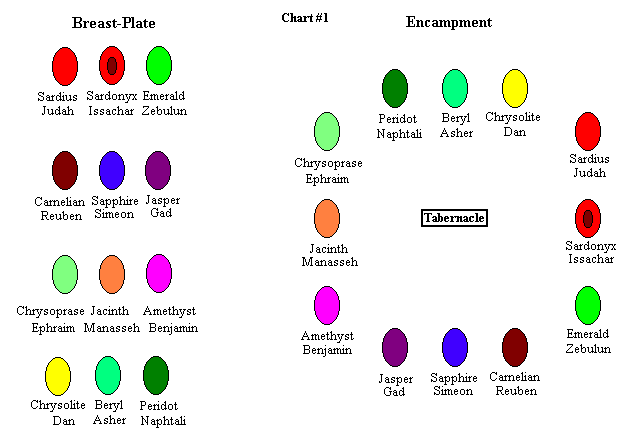
a) There is no parallel in the original angelic divisions for
the three additional tribes represented by the third row of the high priest's
breast-plate (i.e., the double-portion referred to above): 1) Chrysoprase (Heb. שבו, shebho) for Ephraim; 2)
Jacinth (or hyacinth; Heb. לשם,
leshem) for Manasseh; 3) Amethyst (Heb: אחלמה,`achalamah)
for Benjamin. In the encampment order of the twelve tribes (Num.2:3-23), this group of
three is stationed behind the tabernacle (i.e., on the west), or the third position in
terms of rank (corresponding to the third row on the breast-plate). The positional order
of rank in encampment is identical to the ranking of the rows on the breast plate, and
represents the priority order of appearance before the Lord God Almighty on His heavenly
throne (which the mercy seat above the ark of the covenant in the tabernacle represents):
1) first in rank: to the front of the throne (tabernacle): east (the group led by Judah, the tribe of our Lord).
2) second in rank: to the right hand of the throne (tabernacle): south (the group led by Reuben, the first born).
3) third in rank: to the rear of the throne (tabernacle): west (the group led by Ephraim, the tribe specially blessed by Joseph ahead of his brother Manasseh, even though younger). The rear rank is symbolically superior to the left hand in that it indicates the special place of the guardian (in the place of [symbolic] vulnerability: Satan was the "guardian cherub" who attacks Christ's "heel": Gen.3:15).
4) last in rank: to the left hand of the throne (tabernacle): north (the group led by Dan, from whom antichrist is destined to arise).(36)
b) Comparing the angelic order to that of the breast plate, one finds that Ezekiel's entire second row has been demoted to fourth place on the breast-plate (i.e., the gemstones tarshish-chrysolite [Heb. תרשיש], shoham-aquamarine/beryl [Heb. שהם], yashepheh-peridot [Heb. ישפה]). It is likely that, in the angelic order, this row represents the three rebel clans which removed themselves from God's family and authority to follow Satan during his pre-historic coup d'état. The fourth position is not only last in order on the high priest's breast-plate, but the three Hebrew tribes represented thereby are also in the least prestigious position in the encampment order of the twelve tribes (i.e., the north side of the camp, representing the left hand position, where Dan, Asher and Naphtali encamped). Demotion from second place to last place (and in the angelic scheme of things, really to no place) is also a significant occurence, for second place is inevitably the "jealousy" position, that is, the place most likely to stir up envy in its occupants who believe that they should, in fact, be "number one". This, after all, is the basis of Satan's rebellion, who, although he was highest ranking among the creatures, found himself in "second place" to the Angel of the Lord, the pre-incarnate Christ, and so coveted His position that he dared the fatal rebellion against God (which ironically is destined to result in his complete replacement as well as that of all his followers). Other indications that this last row is also least in status (corresponding the demotion/expulsion of the three angelic orders which cast their lot with the devil) are:
1) the fact that this grouping of Dan, Asher and Naphtali eat the dust of all the other divisions on the march (Num.2:31).
2) the fact that they are the only one of the three groupings which do not maintain contact with any portion of the tabernacle when the nation is on the march (the ark going before the first division; the tabernacle proper going before the second division; and the tabernacle furnishings going before the third division).
3) the fact that Dan, Asher and Naphtali are the last three tribes mentioned in Moses' inheritance blessings (Deut.33:1-39).(37)
c) A rearrangement of the ranks of the six angelic orders which remained faithful to God may also be posited from the realignment of the gemstones from Ezekiel's description of the gems worn by the guardian cherub as they are reordered on the high priest's breast plate. This rearrangement (see the chart immediately below) is doubtless the result of varying degrees of merit demonstrated by those six faithful angelic divisions in the wake of Satan's attempted coup d'état:
1) the two highest ranking orders [`odhem-sardius, corresponding to Judah, and pitedhah-sardonyx, corresponding to Issachar] retain their positions.
2) order number three [yahalom-jasper, corresponding to Gad] moves down three places to sixth (last) position (absolute and relative demotion by row and rank).
3) order number seven [sappir-sapphire, corresponding to Simeon] moves up two places to fifth position (relative promotion by row by virtue of the expulsion of three orders; but lower in rank by one position in relation to the remaining orders).
4) order number eight [nophekh-carnelian, corresponding to Reuben] moves up four places to fourth position.
5) order number nine [bareqeth-emerald,
corresponding to Zebulun] moves up six places to third position (most impressive
promotion, from dead last to first row).

While we are not given the names of the six surviving and three expelled angelic
orders, we can at least glean something about the course of events during the devil's
prehistoric attempt to replace God as ruler of the universe. The fact that several orders
defected to him is clear enough, but it is interesting to observe that the degree of
commitment and energetic, meritorious service on God's behalf on the part of those orders
that remained faithful was relative. Some (sardius and sardonyx) fulfilled the
expectations of their preeminent rank. Others (emerald preeminently, but also carnelian)
exceeded the expectations their positions suggested. And still others (most dramatically
jasper, but also sapphire in a relative sense) displayed an underwhelming lack of zeal.
Thus is it ever so. We shall have occasion in the near future to study the seven
historical eras of the Church represented by the seven churches of Revelation and shall
note the several separate trends that have (and presently are) playing out in history. But
as with the various responses of the angelic orders who chose for God, so with individuals
in the Church: some match, some exceed and some fall short of the expectations and
opportunities which God provides.(38) All are
rewarded with inclusion in the family of God, but great reward attends those who meet and
exceed the grace opportunities God has given:
Many who are first will be last, and the last first.
Mark 10:31
3) Archangels: "Archangel" is a Greek word, a combination of the two roots arch- (rule/ruler) and angel- (angel), and is almost certainly a rendering of the Hebrew word sar, meaning prince or chieftain.(39) Although scripture only mentions one archangel by name, i.e., Michael (Jude 9), the mention of other unnamed sariym ("princes") in Daniel chapter ten indicates a plurality of archangels (Dan.10:13; 10:20-21; 12:1).(40) We can also glean from the usage in Daniel chapter ten (as well as from the use of the word sar for human leaders elsewhere in the Hebrew Old Testament) that sar ("prince" or "archangel") is a martial office. The situation outside of the book of Daniel confirms this impression:
a) the archangel of 1st Thessalonians 4:16 shouts a command for the dead to rise (followed by a military trumpet blast commanding assembly).
b) Michael in Jude 9 fights with Satan over Moses' body.
c) in Revelation 12:7, Michael leads "his angels" in battle against the devil and his forces, successfully driving them from heaven down to the earth.
As the last two examples indicate, Michael, as the archangel associated with Israel (Dan.10:13: "Michael your [plural = Israel] prince"; Dan.10:20-21; 12:1; Jude 9; and see Rev.12:7, where the description of his victory over the devil is sandwiched inside the allegory of the "woman" Israel), holds a unique position among the unnamed number of archangels (or "princes"), both elect and fallen:
a) he is the protector of God's preeminent people (into whom we gentiles are grafted by grace: Dan.12:1; Rom.11:11-24).
b) he is the only named sar/archangel (Dan.12:1; Jude 9).
c) he is not only called "one of the great princes" (Dan.10:13), but also "the great prince who stands over your people" (Dan.12:1).
Finally, we should also understand the angelic "rulers" or archai of the epistles of Paul to be archangels (1Cor.15:24; Eph.1:21; 3:10; 6:12; Col.1:16; 2:10; 2:15; also the "angels" of 1Pet.3:22, where, conversely, the arch- part is left out), the -angelos part of their title being omitted as unnecessary (and potentially confusing) since in all of the instances cited, they are mentioned in company with other angels and angelic ranks.(41)
4) Authorities: Along with the two following categories, the majority of scriptural mentions of these angelic offices are references to fallen angels, but the designations are valid for elect angels as well (e.g., Eph.1:21; 1Pet.3:22), so that they may be taken as part of the original hierarchical structure. "Authority" (Greek: ἐξουσία, exousia) is a somewhat lower rank than that of archangel, but, as their name implies, these angels are invested with significant spheres of operational authority. We may take them as high-level commanders, subordinate to the archangels (indeed, the archai are usually only mentioned in tandem with the exousiai: 1Cor.15:24; Eph.1:21; 3:10; Col.1:16; 2:10; 2:15; 1Pet.3:22 [where angeloi = {arch}-angeloi]), but with significant numbers of subordinates of their own. It is probable that the four angels of Revelation who restrain the winds and administer the first four trumpet judgments are of this rank (Rev.7:1-3; 8:7-12).
5) Powers: In three places (1Cor.15:24; Eph.1:21; 1Pet.3:22), a third category of ranking angel is mentioned: that of "power" (Greek: δύναμις, dynamis). These are angels of some considerable ability and command authority (undoubtedly with a significant number of subordinates), higher in importance than the rank and file, yet considerably lower than the superior "authorities". In Ephesians 6:12, these angels (at least in the Satan's order of battle) are referred to as "world-powers" (Greek: κοσμοκράτορες, kosmokratores), emphasizing their control as limited to the devil's "cosmos".
6) Spirits: Rank and file angels, that is, angels of no special rank or position, are often referred to simply as "angels" or "spirits" (the term "demon" being reserved for rank and file angels of the devil's forces; this is also true of the term kyriotes, or "lord[ship]",on which see below, section III.4.6). The vast majority of angels, elect and fallen, belong to this category. Of the elect rank and file we must observe that, just as is the case in the Body of Christ, these "private soldiers" are no less significant in God's eyes or less important in the accomplishment of His plan (cf. 1Cor.12:12ff.). This becomes even more obvious when we consider some of the special functions and general services entrusted to individual spirits often designated simply as "angels":
Special functions of elect angels:
1) Restraining (as agents of God): e.g., of the Winds: Revelation chapter 7 (cf. Michael in Dan.12:1).
2) Watching (as agents of God): the horsemen watchers of Zechariah chapter 1, and four chariot watchers of Zechariah chapter 6 who observe events on earth on behalf of the Lord (this function is also referred to in Dan.4:13, 17, 23, under the Aramaic title of "watcher": 'iyr).
3) Judgment (as agents of God): the seven angels with the seven trumpets (Rev.8:6ff) and the Bowl carriers of Revelation chapters 15-16 are prime examples of angels who carry out the Lord's decreed destructions (cf. also Gen.19:1ff; Ezek.9; Rev.7:3; 14:18; 16:5).
General service of elect angels:
1) to Local Churches (as ministers of God): We know from Revelation chapters 2-3 that local churches have individual angels assigned to them, for oversight, guidance and protection (as the context of the seven churches indicates).
2) to Believers (as ministers of God): Much extra-biblical speculation exists on the topic of "guardian" angels. What we can say for certain is that scripture does indicate a definite role for angels in the protection, guidance and oversight of individuals (see especially Gen.32:1; 2Ki.6:16-17; Ps.91:11-12; Dan.6:22; Matt.4:11; 18:10-11; Lk.16:22; Act 12:15; Heb.1:14).
3) for Special Tasks (as ministers of God): As servants of the Lord God (Ps.103:21; Heb.1:7 & 14), angels are entrusted with a variety of tasks in the accomplishment of His will. Some of those recorded in scripture include:
a) escorting the spirits of believers to heaven [currently; prior to Christ's ascension, escort to the subterranean paradise of Abraham's Bosom] (2Ki.2:11-12; Lk.16:22).
b) escorting believers to their resurrection-rendezvous with Christ at His return (Matt.24:31; compare Lk.17:35 with 1Thes.4:16-17).
c) escorting of inspired believers in visions (Rev.17:3; 21:9-10; cf. 2Cor.12:4; Rev.4:1-2).
d) providing manna during the years of the Exodus (Ps.78:25).
e) rescuing believers (2Ki.6:16-17; Dan.6:22; Acts 5:19; 12:1ff.).
f) making proclamations and communicating with believers on God's behalf (Matt.28:5-7; Lk.2:8-15).
g) praising God (Neh.9:6; Rev.5:11ff.)
Despite the wealth of information scripture provides about angels, elect and fallen, the Bible's treatment of that subject is neither exhaustive nor comprehensive. There is much more that we would like to know and many questions we would ask if we could. There are certainly grounds for the Bible's lack of full disclosure on the topic. Non-scriptural speculation throughout the ages has been responsible for many a full-blown system of angelic worship. From ancient Gnosticism to modern, more "respectable" religions, there has always been a tendency outside of true Christianity to glorify angels and so, for all intents and purposes, to worship them (exactly the result which the quondam ranking angel, Satan, has always craved for himself). Much of the Pauline epistles of Colossians and Ephesians are devoted to refuting gnostic teachings (e.g., Col.2:8-10; see also Eph.1:23; 3:19; 4:10; Col.1:19; 1:25ff.; 2:2; 2:20-23; 1Tim.6:20-21), and the epistle to the Hebrews goes to great lengths to emphasize Christ's superiority to angels (see esp. chapter 1-2). In short, as fascinating as the topic may be to some, we must never forget that angels, despite their present superiority to us, are creatures too, and that all glory belongs to the Creator (Rom.1:25):
4. The Organization of the Fallen
Angels:
The first point to be made about the devil's angels is that in terms of their substance they do not seem to differ in any way from the elect angels. Whatever properties, whatever abilities, whatever general characteristics are possessed by the one class seem to be entirely similar in the other. The notion that the devil and his demons are horrible in their appearance is a fancy for which there is no trace of biblical support. On the contrary, scripture tells us that it is the devil 's practice to try and pass himself off as a true minister of God whenever possible, and that it should come as no great surprise that his minions do likewise (2Cor.11:14-15). Where the two groups do differ – and this is no small point – is in their moral character. For while the elect have chosen to remain faithful to God and serve him, the followers of Satan (usually referred to as "fallen" angels) have chosen to rebel against God and serve Satan instead. And as it is certainly the case in human kind, the gulf between those who have chosen to reject the good (inherent in both the person of God and also in the moral law that permeates His creation) and those who have chosen to respect, to follow and to embrace it is very wide indeed. The difference between the ministrations of a holy angel and the attacks of a reprobate demon are entirely a matter of allegiance, the former to God, the latter to the devil.
Therefore just as there are great similarities between the elect and fallen angels in basic characteristics, yet a huge divide in the area of behavior (toward God and thus as well toward mankind whose hearts constitute the present battleground between the two opposing sides as we shall discuss in detail below), so also we see on the one hand a considerable degree of similarity in organization between the two groups, and yet significant differences as well. These differences can be attributed not only to the sharply disparate missions of the two camps (serving and opposing God respectively), but also to definite imperfections in the devil's reorganization of his forces (versus the perfect, original organization of God).
Satan, it will be recalled from our discussion in Part 1 of the present series, used a two-fold strategy to build a following in his attempted coup d'état against the Lord God, offering not only pseudo-incarnation to all who followed him (against the natural order and specific orders of God), but also promising a share in his rule. This second element, promotion in rank and realm, is no doubt being honored by him, at least in form, under his present organizational scheme. We may therefore posit a significant increase, indeed, an inflation of ranks and ranking officers in the devil's hierarchy partly as a result of Satan's desire (and need) to reward powerful and/or influential members of his following with suitable plums, much in the same way that a liege lord would entitle a useful subordinate. To carry the analogy a step further, a useful expedient in such cases has always been to assign newly promoted lieutenants of this sort a particular territory to administer, especially when said territory was not entirely (or not at all) under the lord's present control.
The devil seems to have divided up planet earth in a similar way. Therefore, when we hear in the book of Daniel (Dan.10:13 & 20) about "the prince of Greece" and "the prince of Persia", clear references in the context to adversarial angelic beings (see below), we are doubtless dealing in the main with tangible (if loosely held and impermanent) rewards bequeathed by Satan on some of his more prominent subordinates. The kingdoms and territories of this kosmos have been divided up by Satan and portioned out to his minions (no doubt in a highly political and therefore less than perfect way). Retention and degree of domination over individual areas of the globe will then be dependent on a number of factors, not the least of which will be the ability, resourcefulness and determination of the devil's followers. That is why Satan's statement to Christ to the effect that all the kingdoms of the world have been "handed over" to him and that he is free to give them to whomever he wishes (Matt.4:8-9; Lk.4:5-7) is, like so many of the devil's lies, in some sense true (though in its totality it is a clever lie): Adam's fall did indeed leave the door open for Satan to usurp his God-given rule over the earth, and the devil has done so to a large degree, so much so that our Lord would call him "the prince of this world" (kosmos: Jn.12:31; cf. 2Cor.4:4). However, the degree to which the devil is able to exercise this rule, as we have by now pointed out many times, is far from absolute. For it is limited by the over-arching will of God, the free will of mankind (ever protected by God through His multifarious grace) – and also by the imperfections of the devil, his followers, and their overall organization, tactics and strategy. Created perfect by a perfect God, the devil and his angels have corrupted themselves through rebellion against God, and the arrogance, jealousy and avarice under the influence of which they are now operating (to name but a few of the sinful trends manifest in their collective behavior), make for serious imperfections in all three of these areas. The devil's overall strategy (and how it matches up against God's plan) will form the main thrust of Part 5 of this series. The tactics employed by the devil are the subject of sections IV and V below. His organization, as best we can reproduce it based upon the biblical evidence is as follows:
1) Satan (cherub level): The devil was originally a cherub, first in rank among the elect angels, and second only to the theophanic manifestation of the second Person of the Trinity, that is, our Lord Jesus Christ appearing as The Angel of the Lord.(42) In God's system, Satan has now been replaced by the four cherubs who continually attend God. In his own system, the devil represents himself as being God – this is clear from all his words and deeds, from his original coup d'état which attempted to replace God (see Part 1 of this series), to his present representation of himself as the god of this world (2Cor.4:4; cf. Jn.12:31; 14:30; 16:11; Eph.2:2), to his predicted appointment and direction of antichrist, the beast who will temporarily rule the earth representing himself to be God (2Thes.2:4; cf. Ezek.28:2). In terms of his followers, the devil is very clearly "the ruler of the demons" (Matt.12:24), and "father" of those who reject the truth of our heavenly Father (Jn.8:44). Satan, it seems, always has a headquarters on earth. In circa 67 A.D., that headquarters was in Pergamum (Rev.2:13). We might have expected Rome, but when one considers 1st century Pergamum's prominence as a site of emperor-worship as well as pagan idolatry, the choice is more understandable. As we have already mentioned (and will consider in greater detail below), the devil's power over humanity stems almost exclusively from influencing human behavior. Key to his success has always been and will continue to be the especially deadly combination of worship of himself (all false religion) coupled with the worship of live human beings (to culminate in antichrist). Scripture is not specific about previous satanic headquarters (Babylon at the time of the tower of Babel seems a likely guess), and we can only conjecture about the centuries since, but suffice it to say that wherever men are worshiped as gods and the spirit of idolatry runs high in any of its forms (Eph.5:5; Col.3:5), the devil is likely to be near.
2) Thrones (elder level): These “kings” are apparently the heads of Satan's world-wide network for administering his realm. These highest ranking of the devil's subordinates are likely much more numerous than their elect equivalents, the elders.(43) For rather than sitting enthroned before God Almighty (and rendering Him appropriate worship before His throne: Rev.4:4-10; 5:6-14; 11:16;19:4), these "kings" sit enthroned throughout the nations of the world posing as gods. In the guise of pagan deities, these high ranking members of Satan's inner-circle receive worship from men (instead of giving it to God). As the plural number in Daniel 10:13 makes clear (plural in the Hebrew as KJV; NIV is incorrect), pagan nations inevitably possess a plurality of such "kings".(44) 1st Corinthians 8:5 also states that there are many of these so-called "gods", confirming for us the fact that high-ranking demons stand behind pagan religious practice. Amos 5:26, for example, equates false gods, idols and "kings" in this sense. Given that any worship besides that of the true God is idolatry (Ezek.14:3ff.; Eph.5:5; Col.3:5), we may expect the full complement of these "thrones" to be numerous indeed, and present in an authoritative and influential capacity wherever excessive human enthusiasm approaches an idolatrous pitch.
3) Princes (archangel level): These are the sarim discussed above. Daniel 10:13 and 10:20-21 mention the "prince of Persia" and the "prince of Greece", from context not only demons, but probably of equivalent rank to the angel who speaks with Daniel, and certainly of comparable power to the archangel Michael, whose help is necessary for Daniel's interlocutor to disengage and come to his help (Dan.10:20-21). Like the elect archangels, these "princes" are high ranking military officers with significant numbers of subordinates. It is likely that Abaddon-Apollyon also falls into this category (Rev.9:11).(45)
4) Authorities (authority level): This is the only rank level for which both elect and fallen angels share a common scriptural designation. The best explanation for this fact is that authorities are high enough in rank to be uncommon, but not so high as to attract special attention in the biblical account. We only find them mentioned in combination with other demonic officials, most commonly right after the archai, or "princes", the demon equivalent to archangels, whose deputies the exousiai or "authorities" are (1Cor.15:24; Eph.1:21; 3:10; 6:12; Col.1:16; 2:10; 2:15; 1Pet.3:22).
5) World-rulers (power level): These are the demon equivalent to the dynameis or "powers". They are actually called "powers" in the majority of passages in which reference is made to them (1Cor.15:24; Eph.1:21; 1Pet.3:22). The exception is Ephesians 6:12, where they are called kosmokratores (κοσμοκράτορες). The implication of their name, "those who exercise power in the kosmos" is that, beyond any mid-level command authority they may hold, they also exercise special powers of some kind. We may note in passing that they would likely be the type of demon behind the exercise of pseudo-miracles and satanic demonstrations of power (cf. Rev.13:13). The restriction by name in Ephesians 6:12 to this world shows that their originally God-given powers/authority are now limited to doing the devil's work in his present realm.
6) Lordships (spirit level): This is both the rank and file of fallen angels and the common name by which all of them are described (indicative of the “rank-inflation” in Satan's system). Known by a variety of names, demons (Lev.17:7; Matt.9:34), evil spirits (Lk.7:21; Acts 19:13), unclean spirits (Matt.10:1; Mk.1:27), and devils (Jn.6:70), the term "lordship" (small "l") is employed for them at Colossians 1:16 and elsewhere (cf. Rev.17:14; 19:16), because they exercise angelic, or "lordly" power, a basic function common to all angels vis-à-vis humanity until the resurrection changes the situation.(46) Jesus Christ, in addition to being King of the kings of the earth, is also Lord of all angelic lords, elect and fallen, from the highest to the lowest (Rev.17:14; 19:16).
Additional Issues
1) A large number of the demons are currently not at liberty: One third of angelic kind followed Satan in his rebellion against God (see the discussion under the subject of the elect angelic elders above). At present, however, the devil is operating with less than this full complement of his original supporters. As a result of their pre-flood attempt to pollute the purity of the human line (an activity which violated the parameters God had set for Satan's attacks on mankind, and a subject we shall treat in depth in Part 5: cf. Gen.6:1-13; Jude 6), a large number of demons are presently being restrained below the earth in a compartment of Hades variously called Tartarus and the Abyss (Lk.8:31; 2Pet.2:4; Rev.9:1; 20:1). Some of these are destined to be released temporarily during the Tribulation (Rev.9:1-12). Judging from the request of the demon "legion" to our Lord not to throw them into the Abyss, we can say that incarceration in the Abyss for conduct out-of-bounds is an ever present possibility that prevents Satan and his followers from overstepping the limits of behavior God has set for them (Lk.8:31).
We also know of one additional large contingent of demons presently restrained: the four demon generals and their horde of some two hundred million (Rev.9:13ff.). These sarim (and their army) are presently "bound" within the Abyss (as opposed to being unchained yet locked in the Abyss like many of their compatriots). The river Euphrates is the site of their future release evidently because of its proximity to Babylon (the symbolic successor of which is most significant throughout the Book of Revelation). The reason for their double imprisonment or this point of eventual release is not specified, but, on the Genesis chapter six analogy, some egregious violation of God's ground rules for putting humanity to the test must be the root cause. Now the most significant anti-God action recorded to have taken place on the Euphrates is the building of the tower of Babel. This one-world scheme was designed to accomplish politically and socially what the demon-infiltration of Genesis six was meant to do biologically, namely, to destroy any possibility for mankind to seek God. Josephus in his Antiquities of the Jews represents the tower of Babel as a ramp to heaven whereby Nimrod sought to storm the dwelling of God Most High, and it is interesting to note that Jacob's "ladder" is really a rising set of stone steps, that is, a ramp, whereby the (elect) angels make their way from heaven to earth and back again.(47) The tower of Babel was clearly the "mother of all ziggurats/pyramids" and the inspiration for these later manifestations of the form. But in regard to the tower of Babel, its purpose truly was megalomaniacal. If not to storm heaven (as Josephus suggests), at least it was meant to replace God's Name with a name mankind had – with demon help – manufactured for itself and immortalized with the greatest structure the world had ever seen (Gen.11:3-4). The inspiration for this blasphemous idea, its undertaking and its near completion were certainly demon-inspired. God's judgment upon humanity was to disperse us by confusing our (at that time) universal language (Gen.11:5-9). God's judgment upon the demon armies supporting this operation was to imprison them securely until their release at this site for the future events of Revelation chapter nine. That is, until the time when a new "universal" Babylon (the kingdom of antichrist) will be similarly in the process of attempting to forcibly unite the entire human race for evil purposes (cf. Dan.2:42-43).
2) The demons differ from one another in terms of degree of wickedness: In our discussion of the elect elders above, we noted that the degree of performance of the faithful angelic orders differed (as different individuals and orders demonstrated everything from zealous to lukewarm support for the Lord in the face of Satan's attempted coup). A similar situation obtains in the case of the fallen angels in that they too are subject to personal differentiation. There are apparently varying degrees of depravity among the demons (Matt.12:45; Lk.11:26), and varying degrees of persistence in that depravity (Matt.17:21). The point should be made in this connection that the "less evil" demons are in no wise less subject to the judgment of eternal damnation because of their lesser evil: evil is evil. In the same way, eternity will find not only the Caligulas and the Hitlers in hell, men who are remarkable for the exceptional evil they committed (relative "goodness" is nothing; only the righteousness that comes through faith in Christ brings salvation). No, all who have rejected God (by rejecting His Son) are unfit for the kingdom of heaven, regardless of their manner of life. In the angelic realm, eternal security is based upon the decision to choose for God rather than for Satan; in the human realm, it is based upon choosing Jesus Christ over the devil's world.
5. God's Employment of Evil Spirits: Satan and his demonic forces can do nothing apart from the permissive will of God. For His own purposes, purposes having to do with His own glory and the principle of free will, human and angelic (which we have discussed in detail in Part 3 of this series), God allows the devil to operate within certain specified parameters. What, then, if He should use Satan and his minions in the furtherance of own His plan? In one sense, everything that happens is part of the plan of God for the ultimate possible good (Rom.8:28). It is thus of no great moment if He should choose to make specific use of evil spirits to accomplish His own perfect will. As Christ gave instructions not to hinder those doing God's will whatever their motivation (Lk.9:50; cf. Phil.1:18), and as the apostle Paul on occasion made use of the inclinations of demonic forces for divine ends (1Cor.5:5; 1Tim.1:20), so there are a number of instances in scripture where God clearly employs the devil's minions for His own perfect purposes, by allowing them to perform mischief that would otherwise be denied to them:
a. God's permissive testing of Job (Job 1:12; 2:6).
b. The evil spirit sent by God to Abimelech and the citizens of Shechem (Jdg. 9:23).
c. The evil spirit from the Lord who vexed Saul (1Sam.16:14; 18:10).
d. The Lord inciting David to number the people through Satan (2Sam.24:1 with 1Chron.21:1).
e. Micah's story of the evil spirit who volunteers to deceive the king (1Ki.22:19-23).
f. The unleashing of demonic forces to warn and to punish the earth during the Tribulation (Rev.9:1-19).
Every action Satan and his subordinates have ever taken has been fully anticipated by God and, indeed, has been fully incorporated into His plan. The fact that God can, in the furtherance of that plan employ at will even His sworn enemies is indicative of the complete degree of control He has over all the events that are transpiring in the world (or ever have, or ever will).
6. Angelic Combat: Open warfare will not break out in heaven until mid-way in the (future) tribulational period when Satan and his angels will be ejected from heaven and hurled to the earth (Rev.12:7-9). At the present time, there is an uneasy truce in the heavenly realms. Although angelic conflict is apparently incessant upon the earth (consider Daniel chapter 10) with elect angels and fallen angels struggling with each other in an invisible warfare (2Ki.6:17), Satan and his followers are at present free to appear before God (and the devil makes full use of this opportunity to accuse believers: Job 1:6-12; 2:1-7; Lk.22:31; Rev.12:10).
The actual course of Satan's rebellion and God's defeat of it are the subjects of Part 5 of this series, but it will be helpful at this point to note what scripture has to say about the manner of angelic combat. In the first place, angels, as non-corporeal beings, cannot be "killed" in the way that human beings can. Our earthly perspective on such things is entirely (if understandably) at odds with the way God's universe actually works. All men and all angels will continue to exist from the point of their creation on for all eternity. In the case of angels, they will continue as spiritual beings. In the case of human beings, we will continue as corporeal-spiritual beings, but with our bodies passing through an interim stage (be it in heaven or hell) before final resurrection when we shall possess permanent bodies that will not be capable of destruction (a fact true for unbelievers, destined to inhabit the lake of fire forever, as well as for believers, destined to inhabit the New Jerusalem with God forever).(48) Human beings can be wounded (with obvious temporal effects) and even killed in battle. Yet in the context of God's progressive conquest of the devil, the event that forms the back-drop for all human history, death is a transition for us from one phase of our existence (time – where we make our critical choices vis-à-vis God and His Son) to the next (eternity, an existence either of eternal life or of the second death). We do not cease to exist after death, even if we have rejected God in life (although the horror of eternity apart from God is something that should motivate every believer to personal evangelism). After death, like the angels, we will no longer be subject to the kind of bodily damage that is ever a concern here on earth. This is how it is with the angels. In all their warfare and conflict, they cannot be destroyed, and there is no scripture to suggest that they can be damaged or wounded.
Angelic combat consists, therefore, not in destroying or damaging each other, but rather in hindering each other from certain actions or, alternatively, compelling one another to certain actions. The angel who visits Daniel in chapter 10 of that book is at first kept from coming by demon opposition (Dan.10:13a), then helped (i.e., the hindering demons are forced to relent) by Michael (along, no doubt, with forces under his command: Dan.10:13b; 10:21). The actions of the unseen angelic forces supporting Elisha against the king of Aram (2Ki.6:17; cf. Dan.11:1), the (unrealized in this instance) actions of the legions of angels at our Lord's disposal (Matt.26:53), or any of the many actual angelic appearances and operations documented in scripture (and the innumerable instances not recorded in the span of human history; cf. Ps.91) all suggest the continued necessity of such combat by elect angels against satanic forces wishing to oppose God's will. Michael, for example, was not allowed to collect the body of Moses without a fight (Jude 9).(49) Earth and, more precisely, mankind is at issue now, with Satan and the demons vying with the elect angels of God for control of the hearts of men. Jacob's vision of the angelic siege ramp or military highway (see note 47) stretching up to heaven to the presence of God (Gen.28:10-19; cf. Jn.1:51) makes the situation very clear: it is the earth (not the heavens) which is being contested.(50) While the world may, in the sense of gross diabolical influence, be in the power of the devil, God's overarching control is absolute (see section III.2 above), and He keeps a close watch on the earth by means of His angelic servants (e.g., Ps.91:11-12; Zech.1:9-17; 6:1-8; Rev.7:1-4; see also section III.3 above: General service of elect angels). Mid-way through the tribulation, Satan and his followers will be forced out of heaven (and restricted to earth) by elect angels under Michael's command (Rev.12:7-17).
At present, being incarcerated is the worst fate that can befall Satan's angels. The "legion" of demons about to be ejected by our Lord from the demoniac at Gadara frantically begged Christ not to have them confined in the Abyss (Lk.8:31: the imperfect tense connoting repeated action). As we have seen, a goodly number of demons are now imprisoned (in the Abyss), and will be joined by Satan (along with his followers) following our Lord's return at the Second Advent (Rev.20:1-3). Ultimately, all of God's enemies will come to occupy the lake of fire (Rev.20:10). Like reprobate human beings, the devil and his angels will not be destroyed, but will be relegated to this terrible place forever.
Our Lord, in His victory at the cross and in His resurrection, has become in His humanity superior to all angels in every way (cf. Eph.1:20-21; Col.1:16-17; 2:9-10; 2:15; 1Pet.3:22; Heb.1:1-2:18). As His body, the Church, we believers share in this superiority positionally and, in the resurrection, will do so experientially. This superiority is not only one of rank, but also of abilities. In terms of our future superior abilities, we shall "sit in judgment" over individual fallen angels (1Cor.6:3; cf. Rev.20:4; Matt.19:28), by physically depositing demons in the Abyss at Christ's return. Elect angels also do this where such activity is elsewhere recorded (Rev.20:1-3; cf. Rev.9:1-3; 12:7-9). Given the superior properties of our resurrection bodies, it should come as no surprise that we will certainly be capable of this as well (see the link in CT 6 for more):
7. Believers vs. Unbelievers: Finally, included in the devil's order of battle are a vast number of living human beings. We have noted above (and will consider in greater detail below) that the primary way the devil and his minions exercise their power in the world is through their influence upon its inhabitants. Absolute dominion over certain persons by way of demon possession is certainly one extreme form of control, but an even more insidious and widespread method of swaying the will of individuals and thereby affecting the course of events is that of demon influence. Demon influence (covered in section V below) is the propagation of demon doctrine (covered immediately below in section IV). Such influence need not be direct. Whether Satan and company wish to promulgate grossly and obviously anti-God thinking (e.g., pagan religion), or merely subtle disinformation (e.g., humanistic philosophy), it matters little whether the object has had a demon whisper in his ear or has simply read a book or watched a television show. The result, in both cases, is the same for all who believe the lie, whatever the source: enlistment into the devil's auxiliaries. Often, the battle lines are not so clearly drawn. Unbelievers, for example, to the extent that they are moral, law-abiding citizens (see section II.7 above), are in large measure useless to the devil. He can only hope to keep them from Christ, and to use their example and influence to hinder the salvation of others as well. On the other hand, nominal believers, to the extent that they have bought into one-world politics, or self-generated solutions to societal ills, can be very useful to Satan indeed. We can be sure of only one thing in regard to Satan's human auxiliaries: however long their enlistment and however vehement their loyalty, the devil will use anyone he can to the greatest degree that he can, and has absolutely no loyalty to those who serve him or compunctions about the destruction of those who have benefitted him:
You are of your father the devil, and the lusts of your father you desire to do.
John 8:44
As soldiers in the army of the Lord, we also need to keep it in mind that these captives of the devil are our fellow human beings, men and women for whom Christ died, and whom God desires to be saved (Ezek.18:23; Matt.18:14; Jn.12:47; 1Tim.2:4; 2Tim.2:24-26; 2Pet.3:9). Unlike purely human conflicts, where one side is out to destroy the other, God's desire is (and our desire must also be) the winning over to the love of Jesus Christ of all those who have been drafted by the devil:
We beg you on Christ's behalf: be reconciled to God!
2nd Corinthians 5:20
Satan's world-system is an administrative philosophy designed to secure and increase his control over human kind for the purpose of opposing God's plan to replace him and his followers. The working out of God's plan in time and the devil's counter-strategy will form the subject of Part 5 of the current series. In this section, we will be concerned with the specifics of Satan's world-view for mankind, an all encompassing system of lies, carefully crafted for maximum seductive effect, a mesh of doctrines, teachings and ideas that the devil has employed since the expulsion from Eden and designed to delude and enslave humanity. We have termed this system "Satan's world-system" in order to better correlate the idea with the Greek word kosmos ("world"), the term that most frequently references in the Bible the devil's system of anti-truth.
As Christians, we are to have as our focus in this life the Word of God, both the living Word, Jesus Christ (Jn.1:1-5), and the written Word, the Bible (2Pet.1:19-21). Truth, therefore, is at the very center of our earthly lives (Ps.119), and we walk according to what our God tells us is true, not by what our eyes see (2Cor.5:7), for everything in this life is passing away, but God's Word is forever (Is.40:6-8; 1Pet.1:23-25). Satan's world-system is predicated on the principle of opposing this basic tenet of all orthodox, Christ-centered thought. For it is the primary objective of the devil's system to reverse this perspective, to turn humanity's focus completely around and fix it firmly instead on this earthly life. For Satan, every human being who looks away from God and towards this world instead is a triumph, just as for God, every person who turns his gaze away from the devil's dark world unto Jesus Christ is a victory:
Stay sober, stay awake! Your adversary the devil roams about like a roaring lion searching for someone to devour.
1st Peter 5:8
As he proved in his cunning seduction of so many of his fellow angels, Satan has a tremendous grasp of how best to prey upon his fellow creatures. He understands his subjects (angelic and human alike) and does not shrink from boldly exploiting any and all weaknesses. A common theme in his approach is his focus upon whatever it is that one of his intended victims lacks: the angels lacked physical bodies, so he promised these to them (the fact that engineered, possessed bodies would never have amounted to the real thing doesn't concern the devil, only that the lie he is selling be believable: see Part 1 of this series). Adam and Eve lacked detailed knowledge of good and evil, so he tempted them to acquire it (no matter that it meant their ultimate physical death: see Part 3 of this series). Following the fall, human beings are, in many respects, much easier targets for Satan. Instead of a narrow window in which to attack (where the temptation is in no way connected with necessity: i.e., physical bodies for angels; knowledge of good and evil for perfect humans in paradise), human beings outside of the garden of Eden face a wide range of potential shortages and needs (as a result of our now universal mortality and the curse God has placed upon the ground). Add to this the fact that the devil has a natural ally on the inside of each and every one of us (i.e., the sin nature), and it is not difficult to see how Satan's system of false promises and lies has been able to make so many converts throughout the course of human history – the vast majority, in fact, of all human beings who have ever lived. Yet God has never left Himself without a witness; all have had a choice; in every generation there have been those who have heard the small still voice of truth and have turned away from the devil's system unto God (1Ki.19:12; Acts 14:17; 17:27).
Even for believers, however, temptation emanating from the devil's system continues to be an issue throughout life for obvious reasons: 1) pressure from the sin nature: salvation brings forgiveness for sin but does not eradicate the sin nature resident in our corrupt flesh which will continue to remain a source of spiritual vulnerability for us throughout this earthly life (Gen.8:21; 1Ki.8:46; Ps.130:3; Rom.7:18 & 24; Jas.1:13-15); 2) pressure from the now corrupt world: our physical mortality (the ultimate result of our internal corruption) coupled with the inherent nature of the world outside of Eden (prone to shortages and requiring hard labor to provide sustenance as a result of God's curse in sharp contrast to the garden: Gen.3:17-19) are urgent vulnerabilities which keep up a constant physical and psychological pressure.
Just on the basis of these two primary factors that largely drive human behavior in this life, much of the depraved and godless conduct that is human history would no doubt have come about even without the devil's help. But, inasmuch as it is in his interest to oppose divine influence in his realm, Satan has developed a tactical scheme and philosophy for administering this world calculated to maximize the blinding of mankind so as to 1) lead us away from truth, away from God; and 2) lead us to do his will instead of God's. While the present section will be concerned with the devil's system per se, the following part of this series (section V) will deal with the implementation of that system.
The devil's main tactical aim is to increase his influence and control over humanity (individually and collectively), and he mercilessly exploits any opportunity, any weakness to do so. The essence of his approach, the premier weapon aimed at the battleground of the human heart (the mind-spirit interface: see Part 3) is the lie. Satan is the deceiver of the whole world (Rev.20:1-3), and the father of lies (Jn.8:44). These titles are suggestive of his central tactical objective: to obscure the truth in any and every way. Satan's world-system, however, is no mere disinformation campaign. The devil is (and always has been) out to win the "hearts and minds" of all human beings. He is very well aware that we can be influenced, pressured, and tempted physically and emotionally as well. Much of his system is directed toward the body with the purpose of affecting the heart thereby. The satanic world-system is thus a network of interconnected lies, emotional appeals and physical pressures which, at their most effective, are difficult to disentangle.
Satan's world-system is the lie writ large, extending like a spider's web into every corner of the globe, into every area of human activity, and thus making its way into every single human heart (as far as the devil can bring that to pass), blocking, denying, opposing God's truth however, wherever and whenever it can. It is important to note at the outset that the satanic world-system encompasses not only behaviors that anyone and, indeed, almost everyone would view as satanic, and areas that are generally acknowledged as sinful, but also very many areas that are normally deemed "good" (see section IV.3 below). Tactically, the devil has no scruples. He will encourage any and all behavior – what men may see as good or what they may see as bad – in order to block God's truth and thus increase his own influence in the world.
Since the fall, three facts have stood at the very foundation of human experience:
1) Universal mortality: the reality of death for all (Gen.3:19b).
2) Universal depravity: the reality of sin in all (Gen.2:17 [spiritual death – see Part 3]).
3) Universal temptation: the reality of the devil against all (Gen.3:15).
Because of Adam's sin, we shall all die physically. Because of Adam's sin, we are all born with the physical presence in our bodies of inherent sin, that is, the "sin nature" (which in every case – except that of the virgin-born Jesus Christ – works its way out in the practice of sin). Because of Satan's usurpation of Adam's rule over the earth, we are all subject to the attacks of the evil one.
These three essential realities of human life, made clear even as Adam and Eve were being expelled from Eden (Gen.3:14-19), are the basis for three all-important corollary principles that establish the ground rules for restoring and building our relationship with God.
1) We need God (we cannot turn death into life).
2) We are not God (we cannot expiate our own sin).
3) God does not need us (we cannot substitute anything for His Word so as to help Him).
This basic calculus of human existence was made clear to our first parents at the fall, and there is every indication that they accepted the truth of it. In His awesome grace, God promised, and has since provided in the flesh, a substitute to wipe away death by carrying our sins – and there is no substitute for Him. Adam and Eve knew 1) they needed God, 2) recognized immediately their own inability to atone for what they had done, and 3) accepted the promise of Him who would die in their place rather than attempting to solve the problem by their own actions (evidenced, among other things, by their acceptance of the coats of skin provided through symbolic sacrifice: Gen.3:21).
Nevertheless, most of humanity has in fact lived their lives as if the opposite of each of the three basic principles listed above were true. The reason for this is the system constructed by Satan to turn these essential truths of human existence on their head, and to replace them instead with a system of lies to blind mankind to the truth, a world-system designed to capture and ensnare as much of human kind as possible. Satan's kosmos is thus based on a complex system of propaganda which he and his demons foster throughout the world, a clever and elaborate network of lies that at their root are simple refutations of the basic truths 1) We need God; 2) We are not God; 3) God does not need us:
(Link to Synoptic Chart of Satanic Lies:
[Adobe PDF file, courtesy of Dr. Charles Johnson])
1. Satanic Lie #1: "I don't need God":
Synopsis of the devil's propaganda lie #1:
truth: We need God.
lie: I don't need God.
analog truth: Yours is the power.
analog lie: Denying and doubting the power of God.
denial: Of death and mortality.
impetus: Worry.
manifestation: Greed.
scriptural referents:
Lord's testing: Man does not live by bread alone.
Lord's prayer: Give us today our daily bread.
1st John 2:16: Lust of the flesh.
counter-virtue: Faith (counter-vice: faith in possessions, not God).
object of worship: Things.
main issue: No earthly gain solves the mortality problem.
Truth #1: I need God. God is the only thing, the only Person we really do need. He made us to need, to appreciate, to worship and to enjoy Him. Apart from Him, there is no real fulfillment, no true joy, no lasting peace. By acknowledging our need for God to deliver us from the power of death, we are led to eternal life through faith in Jesus Christ. And when we, as believers, fully acknowledge our continuing need for God in this life, He becomes our focus and our rock, our fundamental source of strength and joy.
Lie #1: I don't need God. Those who fail to acknowledge their need for God become vulnerable to this most fundamental satanic lie. In the post-Edenic world, sweat and effort are necessary to sustain life. Independence from God (a reality only in the mind of those who turn away from Him) starts when in this struggle to provide the necessities of life one doubts God's faithfulness in provision and turns instead to trust in oneself. Christ told us to seek first His kingdom and righteousness, and that then everything else would be provided for (Matt.6:33). If we first seek God, He will take care of us (Matt.6:26 & 30). Indeed, in His matchless grace He provides for the entire world, sustaining the ungodly along with the righteous in order that they too may have their chance for repentance (Matt.5:45; cf. 1Tim.2:4; 2Pet.3:9). Hypocritically, the devil would destroy us if he could, but puts it out that God is unreliable. The first step in believing that one does not need God is believing that God will not provide what is needed, so that one must rely on oneself instead. "I don't need God; what I need is money and/or (fill in the blank)". When one says "I need this thing, irrespective of God", it really is one and the same with saying "I don't need God". For when we put our perceived need for things before our true need for God (and in quick succession our desire for them, since need is more often than not relative), we buy into the devil's first lie.
Analog Truth #1: Yours is the power. We would not last a minute on this earth without God. He created us. He gave us life. He is the one who sustains us, who upholds us with His righteous right hand (e.g., Ps.3:5; 18:35; 37:17; 37:25; 41:3; 54:4; 63:8; Is.41:10). He loves us so much He sacrificed His only Son, Jesus Christ, on our behalf (Jn.3:16). Will He not, therefore, freely give us everything we have need of (Rom.8:32)? Cannot the one who made the heavens and the earth provide for our relatively meager needs? The issue is beyond any doubt: our omnipotent God has the power; nothing is impossible for Him (Lk.1:37).(51)
Analog Lie #1: Denying and doubting the power of God. When Jesus addresses this issue in the gospels, He reproaches those who will not accept the sufficiency of God's provision with the epithet "O ye of little faith" (e.g., Matt.6:30). Recognizing our need for God and trusting in Him and His provision is the smallest act of faith; failing to trust Him and His provision for us in this life and for our eternal life (in Jesus Christ) may start with doubt, but ultimately leads to denial of God's power and ability to sustain us in this world (in practice if not explicitly so). Once this mind-set is embraced, self-effort becomes the new focus, and as with the gentiles who frantically seek after the things of this life (Greek epi-zeteo: Matt.6:32), material acquisition now takes precedence over seeking God (cf. Heb.11:6).
Denial #1: Death and mortality. Staring the reality of death in the face without any rationale whatsoever is something we human beings by virtue of our God-given nature are not capable of doing. Mortality is the ultimate issue of life, and death the ultimate concern.(52) Consciousness of our own eventual death is one of the most important phenomena that separates us from the animals, and, for unsaved people living in the midst of the devil's world, it is a clear manifestation of the grace of God. For this realization of our own mortality is a powerful force that drives us (or should drive us) to seek out God as the only solution – only He holds the solution to the problem of death, only He possesses the key to eternal life as all human beings inherently are aware (at least initially, as we saw in section I.2 above: cf. Eccl.3:11; Acts 17:26-27). But despite His breath-taking grace in providing forgiveness for all mankind, in providing a way of eternal life for all people (through faith in the One who bought us, our Lord Jesus Christ), the terrible, awful, inexplicable truth is that most human beings are unwilling to turn to God and seek Him. Most of the seed of God's Word sown in this world falls upon hardened hearts, and the devil is quick to snatch away the words of truth (Matt.13:19; Mk.4:15; Lk.8:12).(53) And for all those who fail to respond to this clearest possible appeal and warning from God's grace, Satan has plenty of ready-made propaganda to help twist and distort the uncomfortable truth into a more palatable lie. Indeed, once God has been rejected as the only true solution to the universal problem of death, the fear of death becomes Satan's number one weapon for manipulating the human race and for bending it to his will:
As the context of Hebrews 2:14-15 makes quite clear, the devil's "power of death" is wholly vested in the "fear of death" felt by the majority of human beings who have opted not to trust in God for deliverance from death. Fear of death without solution (once the divine alternative has been rejected) is a powerful manipulative tool indeed. Fear of death (without God) helps the devil keep the human race in slavery. As all of Satan's "solutions" are necessarily fraught with sin, once God is rejected as the only hope for deliverance from death, the devil's alternatives become like quicksand into which his victims sink deeper at every turn (Job 18:14; Is.14:17; 61:1; Lk.4:16-21; Jn.8:34; Rm.6:16; 1Jn.3:8; Rev.1:5). Many of these pseudo-solutions to death and mortality will be covered in more detail below (this list does not make any claims to be comprehensive: the rationalizations of the human heart are manifold and often complex):
1) Ignoring the issue: Total or partial denial of the problem is a common way of "coping" which Satan enthusiastically supports. This "backing into death" becomes more difficult in times of extreme stress or danger and as one draws nearer to the end of life as well. Nevertheless, the ability of the hardened heart to "compartmentalize" this ultimate concern of life is a truly amazing thing (and a horrible one for those of us who appreciate the reality awaiting the unsaved after death).
2) Oblivion: Eternal oblivion was a hallmark of Epicureanism, and is still a favorite in many cultures and philosophies. There is no need to fear death, according to this lie, because there is "nothing" after death. Whether the departed person joins a "world-soul" or somehow takes his place in a broader cultural or biological whole is immaterial. The twofold fiction that death holds no terrors (denial of God's coming universal judgment: cf. Acts 24:25), and that in some manner, no matter how unbelievable, the departed person will be remembered or will continue in some collective fashion, provides pseudo-comfort for those who have accepted this version of Satan's lie.
3) Pseudo-eternal life: If a person is not saved God's way – and unadulterated faith in Jesus Christ is the only way to true eternal life – then what is being followed instead is one of Satan's false alternatives. No matter how "good" the organizations, personae, or religions may seem (they may even claim to be "Christian" or throw in something about Christ along with their own salvation-by-works agenda), there is no eternal life apart from God's provision of salvation through pure faith in Jesus. In our own society, the pseudo-alternative often takes the form of "making a deal with God", that is, doing something "for Him" that is somehow supposed to open heaven's gates after death. In any case, whatever form the pseudo-eternal life offered by the devil's alternatives (e.g., higher spiritual planes; reincarnation; etc.), eternal life without Jesus Christ is just another satanic lie, formulated to keep the devil's victims satisfied with their (in reality) untenable situation in this life, lest they turn, repent, seek God and thus escape Satan's power.
As far as fear is concerned, the reality of life on this earth is that if we truly fear God (Ps.19:9; Prov.1:7), we have nothing to be afraid of, but if we don't in truth fear God, then we have every reason to be afraid (Heb.10:31; 12:29; 1Jn.4:17-18).
Impetus #1: Worry. For those who have rejected God's provision of eternal life, choosing instead one of Satan's security-blanket alternatives, their perspective on this ephemeral life becomes completely warped. Since none of the comforting alternatives the devil offers can completely convince (they are lies, after all, and leave rumbling doubts in the depths of every heart so affected), concerns about the nuts and bolts of everyday life become exaggerated out of all proper proportion. It is difficult enough as a believer to suppress the sin nature's incessant and insistent protests and heed our Lord instead: He told us not to worry, for God cares for us and God will take care of us (as indeed He always has: Deut.31:6; Ps.37:25; Matt.6:25-34; Heb.13:5-6; 1Pet.5:7; cf. 1Cor.7:29-31):
For this reason (i.e., v.24) I say to you, stop worrying about your life, that is, [worrying about] what you'll [have to] eat. And stop [worrying] about your body, that is, [worrying about] what you'll [have to] wear. Isn't your life more [meaningful] than food? And isn't your body more [meaningful] than clothing? Look at the birds of the sky – they neither sow, nor reap, nor gather into granaries. And [yet] your heavenly Father feeds them. You're more important than they are, aren't you? Now which of you can add a foot and a half to his height by worrying? Why then do you worry about clothing?(54) Consider well the wild lilies – how that they grow, though neither toiling nor spinning. But I tell you that not even Solomon in all his glory was attiring himself like one of these. And if God dresses the wild plants in such a way – here today but thrown into the oven tomorrow – will He not all the more do so for you, O you of little faith? So don't worry, saying "What shall we [have to] eat?" or "What shall we [have to] drink?" or "What shall we [have to] wear?" After all, these are the things that the gentiles (i.e., the unsaved) are frantically pursuing. Now your heavenly Father knows you need all these things. Therefore seek first the Kingdom and its righteousness, and then all these things will be given to you in addition. So don't worry about tomorrow, for tomorrow will worry about itself: there is [already] sufficient evil in any given day [without you adding to it ahead of time].
Matthew 6:25-34
Manifestation #1: Greed. Money cannot provide security. There is no true security apart from God. But the prime manifestation of buying into the devil's lie that God will not provide you with the necessities (and therefore that you don't need Him) is the drive to provide the necessities apart from God, and to provide an abundance for tomorrow in the vain hope that such activity will in fact provide security. For in spite of the curse upon the ground, the post-Edenic need to wring a living out of life by the sweat of one's brow, God has left Man and the earth suitably well-endowed to accomplish this essential task. Indeed, only in exceptional cases of divine judgment (cf. Deut.28:15ff.; 1Ki.17:1) does this prove a severe difficulty, if one judges from the point of view of true necessity. Nonetheless, the foolish, secular drive to provide for superabundance is endemic among those who trust in possessing the things of this world in lieu of trusting in God who made and supplies them (cf. the parable of the rich fool: Lk.12:14-21). Now while it is true that much acquisition lust is aimed at (or consumed in) the luxuries of life, the grinding fear of being reduced to the point of necessity (or below) stands at the heart of greed. And there is never, can never be enough to so completely sate greed that the gnawing fear behind it is quenched. That is impossible, for below the surface of greed is the fear of death and the insane hope that if only "enough" can be acquired, then death itself can be forestalled.
But man, though he be rich, will not live forever. He will come to his end like the animals do.
Psalm 49:12
What profit will a man have if he gains the whole world but loses his life?
Matthew 16:26
Christ illustrated this principle with the parable of the foolish rich man who, blessed with abundance, planned for the far distant future, little knowing that God would take his life that very night (Luke 12:13-21). The mind-set of trusting in material possessions instead of God inevitably results in covetousness and greed, and the effects of success upon this basic lust are almost counter-intuitive: the more material wealth and pseudo-security those who have turned away from God attain, the more insecure they often feel, or, at the very least, the more they seem to think they must possess in order to feel secure (witness the phenomenon of the super-rich greedily scrambling for ever more). It is for this reason that our Lord told His disciples, on observing the reluctance of the "rich young ruler" to part with his possessions (Matt.19:16-22), that it is next to impossible for a rich man to enter the kingdom of heaven (Matt.19:23-24). God is not a "respecter of persons" (Acts 10:34; Rom.2:11; Eph.6:9; Col.3:25), and the possession of wealth is not sinful in and of itself, but it is certainly true that the more one possesses the greater the tendency to rely on those material possessions rather than on God. It is just for this reason that Jesus told this rich young man to give away all that he owned and then to follow Him: i.e., to demonstrate the dominating allegiance that material wealth can command (to the detriment of one's allegiance to God). The Bible has much to say about the issue of greed and its root cause (i.e., trusting in material possessions instead of God, and ever lusting for more in search of mythical security), and it is worth sampling a few passages here:
1) You cannot truly give your allegiance to God while at the same time trusting in and lusting after material gain – you can't worship both God and "Mammon" at the same time (Matt.6:24; Lk.16:13).
2) We brought nothing into this world and will take nothing out of it (1Tim.6:7).
3) Lust for material gain makes us vulnerable to the devil's attacks, and threatens our salvation (1Tim.6:9).
4) The love of money is a source of all sorts of evils, turning us from the faith and causing us much anguish (1Tim.6:10).
5) Greed is essentially idolatry (Col.3:5), and its practitioners idolaters (Eph.5:5).
6) Covetousness lured Balaam into sacrificing his relationship with God for the sake of money, so that his actions are proverbial for the deceptiveness of wealth (2Pet.2:15; Jude 11).
7) Envy is the true root of acquisition lust (Eccl.4:4).
8) The lust for wealth can never be satisfied by any success (Eccl.5:10).
9) Wealth can be a severe disadvantage, keeping us from God (Lk.18:23-25).
10) Where your treasure is, there is your heart also (Matt.6:19-21; cf. Lk.12:32-34).
11) What does it profit a man to gain the world but lose his life? (Mk.8:36; Lk.9:25)
12) Your life does not depend upon an abundance of possessions (Lk.12:15).
13) Storing up material things rather than striving to be rich towards God is folly (Lk.12:21).
14) Discipleship requires the willingness to put God before possessions (Lk.14:33).
15) Wealth can distort one's perspective, choking spiritual growth (Mk.4:19).
16) Nothing is permanent, not even great wealth; great wealth merely subjects the possessor to greater temptation and a higher standard of judgment (Jas.5:1-6 and Lk.12:48).
17) Covetousness is forbidden by the 10th commandment (Ex.20:17; Deut.5:21).
Scriptural Referents #1:
Lord's Testing #1: Man does not live by bread alone. The most basic material need is for food, so that filling one's mouth is at the root of most of mankind's striving. And yet, no matter how much wealth one amasses, this need and desire must remain a daily concern (Eccl.6:7). But it is the Word of God that is our true bread, our true food (Deut.8:3). God humbled the children of Israel, then fed them with manna in order to teach them this lesson (Deut.8:3). And our Lord demonstrated His complete mastery of this lesson by enduring 40 days without material sustenance, then responding to the devil's temptation by replying "Man will not live by bread only, but [he will live] by every word that comes forth out of God's mouth" (Matt.4:4). For it is God's mouth and the words of life that come forth from it that ought to be our primary concern, not the problem of filling our own mouths. Testing and temptation in the area of material needs is the most basic and most common of all the trials we as human beings must undergo in the devil's world. But our Lord showed us the way. He had not chosen to go out into the wilderness and suffer this extreme privation: the Holy Spirit had led Him to do so (Matt.4:1; Mk.1:12; Lk.4:1). This was a test from the Father that not only demonstrated Christ's willingness to put the will of God before His own physical well-being, even in extreme circumstances, but also to prepare Him for the ministry ahead: there would be many times in the next three years when our Lord would often be "without" material security (cf. Matt.8:20; Lk.8:3; 9:58) – and in the midst of an intensely draining ministry and while surrounded by unprecedented opposition (Mk.8:31; Lk.2:34; Jn.15:18; 15:25). He had to be completely and perfectly ready to put the Word of God before everything material, and, in the end, even to sacrifice His life for it, for us (Rom.5:8). If we are slaves to material things, it is them that we shall serve (Rom.6:16-18), but if we follow in the footsteps of our Lord and Savior, the living Word, we will put what God has to say first (Ps.138:2 KJV), and in so doing will never need to fear any lack of provision on His part, for He is faithful (Deut.7:9; 1Cor.10:13; 1Thes.5:24; 2Thes.3:3; 2Tim.2:13; Heb.10:23; 13:5-6).
Lord's Prayer #1: Give us today our daily bread. For forty years in the wilderness, God faithfully provided the children of Israel with manna to eat. This manna came with complete regularity, relieving their hunger and fulfilling their needs. It could not be saved up (except for the double portion to be gathered on the day before the Sabbath: Ex.16:4-5). For the Exodus generation, there could be no anticipation of future need – they had to trust God every day, and He was faithful, every day. When our Lord taught us to pray this prayer, "Give us today our bread for the day to come" (Matt.6:11; cf. Lk.11:3), He was reminding us that though we may think we have resources beyond the day at hand, only God knows what will come to pass. In God's reality, we are given only one day at a time, and we need His provision every day in the same way. Manna stored up for use beyond the day at hand rotted immediately (again, with the exception of the Sabbath portion: Ex.16:20). In the same way, all earthly wealth will rot (not immediately, perhaps, but ultimately: Jas.5:2-6; 2Pet.3:7-13). What we need, what we truly need, is not a superabundance of wealth and the physical means of life – God knows we have need of these things and freely supplies us with them on a day by day basis. What we need is to remember Him who is the source of all our provision. Moreover, as important as literal bread is for sustaining life, as followers of Jesus Christ our need for Him, the true bread of life, is greater still. Even more than food, we need the daily bread of the Word of God that teaches us about and brings us into ever closer fellowship with the Bread of Life Himself, our Lord Jesus Christ (Jn.6:32-58). God rained manna upon the children of Israel, but they did not learn to love the One who gave it (Ps.78:32). Jesus fed thousands with a few loaves and fishes, but those who ate did not appreciate the One who provided the food (Jn.6:60-66). For the Maker of heaven and earth, providing for our physical life day by day is a very easy thing. Though He may need to command the ravens to bring us meat, nothing is impossible for Him (Gen.18:14; Job 42:2; Jer.32:17; Matt.19:26; Lk.1:37; 18:27). More than this, He has given us the true Bread of Life, Jesus Christ, through whom we have eternal life. What is problematic is our response. Will we learn that we need Him more than bread? Will we learn to trust Him to be faithful in fulfilling all our needs? Will we finally learn that spiritual sustenance is far more important than the material things of this world?
1st John 2:16 #1: Lust of the flesh. Our body has needs, and it is not shy about communicating them. As possessors of a sinful nature, which indeed we all are, there will always be pressures from our sinful flesh that, unchecked, would drive us into covetousness and greed in all their manifold expressions (Rom.6:11-14). Satan is well aware of all our sinful tendencies and his system is constructed to maximize the temptations to the all-too-natural lust-reflex in everyone of us. Using both the carrot of seductive temptation and the stick of fear of privation, he and his agents tailor their attacks against us hoping to inflame this basic weakness.
Counter-Virtue #1: Faith (counter-vice: faith in possessions, not God). While the devil would have the world believe that possessions are the true foundation of security and the basis for personal satisfaction, as Christians we recognize this lie for what it is. No amount of wealth can bring security, for all die. No abundance of material acquisition can truly satisfy, because as creations of God we are spiritual as well as material beings, and only God, His truth, His Son, can satisfy the spiritual need deep down in our heart of hearts. Without God, even super-wealth only brings frustration, precisely because, at least on some level, its possessors are aware that their bounty is a short-lived thing, not transferable beyond the grave, and that even riches on the grandest scale have not been able to fill the hollowness in their hearts. This we know by faith, and by faith we have appropriated the most valuable possession of all: God, through faith in Jesus Christ, the Word of God, the Bread that never crumbles, that always satisfies, that sustains not only life in the short-run, but gives life for all eternity (Jn.20:31).
Object of Worship #1: Things. God made us to worship Him (Is.43:7; Jn.4:23; Eph.1:6 & 12), and worship Him for all eternity we shall, all of us destined for eternal life. But the devil, personally having turned his back on God, wants us to worship him instead. Satan knows how we are built, knows about our deep inner-need for some object of worship, so he provides a substitute. Call it Mammon, money, possessions, wealth, or, simply, "things", the transfer of our natural praise and worship from our God to mere material items is the essence of idolatry, for greed is idolatry, the worship of the material creation over Him who is the author of our spirits (Col.3:5; Eph.5:5; cf. Rom.1:25; Heb.12:9).
Main Issue #1: No gain solves the mortality problem. Satan's #1 lie is "given the lie" by our universal mortality. We do need God. The fact that we die shows unequivocally our need for someone to deliver us from death – obviously, no one else but God can. So at the end of the day, when all is said and done, the means of life, no matter how superabundant they may be, are not life. No sum of money, no amount of possessions, can deliver us from death, much less vouchsafe for us eternal life. Only God can do that. We may have little money. We may have few possessions. But if we have God's gift of eternal life in Jesus Christ, then we are truly rich indeed. For, like the world they set in motion, money and possessions will decay, but he who has embraced the Savior of the world will not lack a place at the table in God's eternal kingdom forevermore.
2. Satanic Lie #2: "I am like God":
Synopsis of the devil's propaganda lie #2:
truth: We are not God.
lie: I am like God.
analog truth: Yours is the glory.
analog lie: Seeking your own glory while denying God's blessing.
denial: Sin and sinfulness.
impetus: Subjective arrogance.
manifestation: Rejection of God's authority.
scriptural referents:
Lord's testing: Worship God only.
Lord's prayer: Forgive us our debts.
1st John 2:16: Lust of the eyes.
counter-virtue: Love (counter-vice: love of self in place of love of God).
object of worship: Self.
main issue: No accomplishment makes you God.
Truth #2: We are not God. It is quite a comment on the human condition that such an obvious truth in principle is so little taken to heart in the application of daily life. For if we really do accept the obvious fact that we are not God, it should have a serious impact upon our behavior. In the first place, since we are not God, beyond any doubt we have no right to question or challenge His authority. Behind the devil's initial rebellion, it will be remembered, was the desire to be free of God's authority, to be an authority unto himself, and, ultimately, to replace God as ruler of the universe. But before attempting to replace God in respect to his fellow angelic creatures, Satan replaced God in his own mind, he became a god unto himself. This is really the essence of what we shall call in this section "subjective pride", that is, the inner arrogance that eliminates God from one's thoughts, that removes Him from the universe as far as the proud are concerned (Ps.10:4 [NASB, not NIV]). Such thinking, of a certainty, borders on insanity, but is not for that reason any less common in the devil's world. Indeed, the majority of humanity throughout history have rejected Him and followed Satan's dark path in this respect. It matters little that they have embraced substitute "gods", whether expressly or not. Once the true God has been replaced in the heart by self, His authority has been overthrown in that person's thinking. When we decide to "go our own way" in this life, to ignore and reject God's will for us, to pick and choose what truths we will accept or reject by our own will, what commandments we will choose to obey or not, we have, in effect, set ourselves up as the arbiters of truth and have begun to replace God – at least in our own minds. This is subjective pride, the arrogant abuse of the free will that is the common heritage of all mankind. Instead of using our free will to respond to the grace of our merciful Lord, accept Christ, and strive to serve Him in this life, being careful to follow all He commands, we soon find that this willful rejection of God's authority plays right into the devil's hands. Once we begin to question and reject what God has to say, we truly do find ourselves on a slippery slope headed straight for destruction. Pride, the devil's original sin, is so terribly devastating precisely because it is the equivalent in physical terms of turning our back to God and marching straight away from Him and what He wills for us (in our best interest though it is). And, ironically, this subjective arrogance of choosing self-will over God's will far from being truly liberating only leads to complete enslavement to sin, and, of necessity, to Satan and his will. For we are not our own, no matter how we may deceive ourselves: if we will not serve God (ignoring His existence, His will), but become instead gods unto ourselves in our own minds, we inevitably come to serving the devil in the end.
Lie #2: I am like God. This sentiment, to whatever degree, however expressed, is deadly to any relationship with Him. Our power is in no way like His power. Our glory cannot be compared to His glory. Our will cannot in a plethora of lifetimes match His will. His power, His glory, His will are what matter in this life, not ours. We are very limited creatures, of extremely limited means. What makes us think that we are like Him in any respect? We may claim that we do not in truth think this, but when we disobey Him, when we ignore Him, when we set up our opinions as superior to His, when we arrogate to ourselves choices that are not ours to make, when we, in effect, live life as if there were no God, we are setting ourselves up as gods (at least in our own minds).
Analog Truth #2: Yours is the glory. We are fragile, ephemeral creatures (Ps.144:4). The grandest of our accomplishments are as dust – in time they, like we, corrode to dust. Moreover, there is nothing we have, nothing we may accomplish, the glory of which is not rightly to be attributed to God. For He gave us life and breath, He provided whatever talents, whatever physical power, whatever personality strengths we may have. He has kept us alive in the midst of an unseen warfare that would quickly blot us off the face of the earth except for His merciful provision. There is no accomplishment, no success, no acquisition, however great or small, that we could ever bring about apart from God's original and continuing grace provisions – and this is equally true for unbelievers as well as believers. Even the devil's continued existence is dependent upon God's gracious forbearance and sustenance of the universe (Heb.1:3a); and the talents he now marshals against the Lord were given by Him (Ezek.28:12-15). No creature, therefore, has any basis for boasting – our only proper boast is to boast in the One who made us (Ps.44:8; Jer.9:23-24; Rom.4:2), for His and His alone is the glory, forever and ever, Amen.
I am the Lord. This is my name. And I shall not give My glory to another or My praise to idols.
Isaiah 42:8
Analog Lie #2: Seeking your own glory while denying God's blessing. Given our limited means, our evanescent accomplishments, and our complete dependence upon God (both for our initial abilities and continuing existence), it should be clear that, not being God and not possessing any of His abilities or attributes, we are certainly not worthy of praise, honor and glory – these things are all rightfully His. If we do accomplish anything outside of His will, that is in actuality to our great shame, and whatever we accomplish within His will is, in reality, because of His gracious provision, seen and unseen. All glory, therefore, belongs to God alone. When we attribute success, accomplishment, or natural endowments to ourselves, we are robbing God of the glory that is His by divine right. What makes us think we have any right to take credit for what God has done? This is really corollary behavior to ignoring His will and doing what we please. We are not God, but to reject His authority and then claim the glory for our godless acts is really to behave as if we were. There is very little fear of God in seeking to promote our own glory while denying the fact that His contribution is the basis for everything we do, whether we have used His grace for good or abused it for evil. Now the fear of the Lord is the foundation of all wisdom (Prov.1:7), so that when we seek to magnify ourselves in celebrity, power, fame, success and or any of the various accomplishments of life, when we seek to promote ourselves, we engage in the most foolish of activities, equating ourselves with Him, in effect, whether we put this name to it or not. Scripture is very clear on this issue. All that we are (apart from our evil), all that we have (which is good in any way) comes from God, so that we have no basis for boasting before Him:
Whoever exalts himself will be humbled, and whoever humbles himself will be exalted.
Matthew 23:12
Thus has the Lord spoken, "Let not the wise man boast in his wisdom, nor let the strong man boast in his strength. Let the rich man not boast in his riches, but let the one who boasts boast in this: in understanding and in knowing Me. For I am the Lord, the One who renders mercy, judgment and righteousness upon the earth. For these are the things in which I take delight.
Jeremiah 9:23-24 (cf. 1Cor.1:31; 2Cor.10:17)
Denial #2: Sin and sinfulness. A necessary first step in the megalomaniacal assumption that Man is a god unto himself is the denial of human sinfulness. For, obviously, inherent sin and the universal practice of evil exclude by any definition the possibility of true divinity.(55) As human beings, we possess self-awareness, and are aware of the freedom God has given us to respond to Him, to seek Him and serve Him.(56) But to take this freedom and use it to serve ourselves instead of God, and to magnify ourselves instead of God, requires deliberate ignorance of our true situation: as sinners by birth, by practice, and (if we turn from God to ourselves) by occupation, we are completely unworthy of worship. Not that we would be in any sense "gods" if we should somehow be returned to Adam and Eve's pristine state (an impossibility, of course), but the fact that we are not only not divine in any way but rather steeped in sin makes the devil's second strategic lie all the more breathtakingly appalling: God is holy – how can sinful, corruptible flesh even contemplate coming into His presence, let alone comparing themselves to Him? Denial of sinfulness (in fact, despite possible lip-service to the principle) is, therefore, a necessity and a powerful first step in the devil's plan to involve humanity in self-worship. Along with mortality, cognizance of sin should lead us to seek God, demonstrating beyond all doubt that we are in desperate need of help that only God can provide (Rom.3:19-20; 7:24-25; Gal.3:22-25). But subjective pride, the arrogance of self-awareness turning its back to God and directing its gaze toward one's own self instead, the insane belief that we are somehow on an equal footing with God, rejects the unpleasant notion that we are sinful, and this rejection, this denial, opens the way for a deeper involvement in Satan's world system (beyond the frantic search for material things instead of seeking God as treated above). Pride, after all, was the devil's original sin. He was never under the pressure of physical necessity (the impetus behind his first lie treated above), but the desire for self-elevation, self-glorification, power and control, yes, even the replacement of God Himself, was the object of his presumptuous sin. To think this way, God's authority, God's will, must be rejected, and the sinfulness of one's own defiance of that will disregarded, for to accept one's action as sin is the first step in repentance. As God's creatures, we are all made in such a way that truth must attract us – or repel us. Defying God, considering ourselves equal to God and gods unto ourselves, – the reality, in effect, of the self-glorifying lifestyle – is completely at odds with owning up to personal sinfulness. There are, to be sure, varying degrees of involvement with this the second of Satan's strategic lies. But common to them all is the serving of sin at the same time that one denies that fact (Jn.8:34; Rom.6:16; 7:14; 2Pet.2:19). This behavior introduces an especially destructive progression which has three particularly dangerous effects:
1) Spiritual blindness results from the denial of this basic truth of our inherent sinfulness (Matt.6:22-23; Mk.4:12; Lk.8:10b; cf. Jesus' use of this metaphor: e.g., Matt.15:14; 23:14-26; cf. Jn.12:40).
2) Reluctance to turn back to God increases concomitantly as entanglement with (often increasingly gross) sin worsens (Eph.5:6-14).
3) Denial of personal sinfulness inevitably follows, resulting in the denial of any need for a personal Savior (Jn.7:7).
If we say "I haven't sinned!", we make Him out to be a liar and His Word isn't in us.
1st John 1:10
Denying our sinful nature, our past sins, and our continuing need for God's cleansing cannot help but alienate us from God. Accepting the uncomfortable reality that we are sinners is the first step in spiritual recovery, but failing to accept this truth leads to blind arrogance.
Impetus #2: Subjective arrogance. We want to feel good about ourselves – that is a natural human tendency. There is great satisfaction in walking in a way pleasing to God, for it is for this purpose that we have been made,(57) and the Lord is a delight far beyond anything else in this life and beyond (Ps.37:4; Phil.1:25; Col.1:9-12; 1Thes.4:1; 1Pet.1:8; Jude 24). However, just as our need for God can be twisted into a greed for things (according to Satan's first cosmic lie), so in this second lie the devil seeks to pervert our natural joy in God and our owed obedience to Him into a false delight in self. Following in the devil's footsteps, internal conceit and desire for recognition misdirect our subservient happiness in following God to a hollow, unfulfilling focus on following our own lead, esteeming our own selves, seeking and striving for our own glory, and measuring joy in terms of approbation accruing to our own persons instead of delighting in the Person and works of the Lord. We are here on earth to seek God, not to seek our own aggrandizement.
Manifestation #2: Rejection of God's authority. The essence of arrogance and, indeed, of all sin, is the rejection of God's authority, God's Word, God's will, and the replacing of what God wants with what we want. It should come as no surprise, then, that if we don't care to know and appreciate God, but are instead only concerned to seek our own glory, then we will have very little regard for His will. Rejection of the Lord's sovereign authority, throwing off this our Maker's essential right over us, is an inevitable result of buying into Satan's lie that we are "like God". For if we are equal to Him, then it is not important to be concerned with anything He might have to say. As "gods", we can do what we like. This really is the essence of the situation for the bulk of mankind, even if the logic is often expressed in reverse: "I can do what I want; I'm not subject to any authority but my own". Law, circumstances, physical limitations and the like may keep this essential sentiment of cosmic lie #2 in check to a degree, but the thought is always there, ready to break forth given the opportunity.
Scriptural Referents #2:
Lord's testing #2: Worship God only. Satan's offer to Jesus of rulership over all the kingdoms of the world (provided He would worship him) was met by this response from our Lord: "You shall worship the Lord your God and serve Him alone" (Matt.4:10; cf. Deut.6:13). Our Lord was looking forward to the day when God would promote Him to world rule, just as we should look forward to the day when we will share in that rule (cf. Rev.3:21). Desiring to promote oneself according to one's own time-table and in one's own way necessarily falls afoul of God's plan and leads inevitably to serving the devil. Jesus would face similar tests during His years of ministry, most notable of which among those that occur in scripture is the attempt of the people (who had experienced His miraculous provision of bread and fish) to place Him at the head of a rebellion against the Roman authorities (Jn.6:15). In doing God's will, Jesus not only declined this offer of a crown, but, in the end, had to give up everything – even His life – in order to accomplish God's will. In doing so, He made it abundantly clear that He came to worship, follow and do the will of God, not to glorify Himself (Jn.12:28; 13:32; 17:1).
Lord's prayer #2: Forgive us our debts. Far from being independent "demigods", we creatures of the Living God are in great need of His help, for we are in bondage to sin. Without His forgiveness of sins through the blood of Jesus Christ, we would be entirely and irretrievably lost. Even more important than our daily bread is God's continuing mercy and cleansing based upon what Christ did for us on the cross. If we view life and our own personal lives in truth, we understand just how desperately and completely we need Him, how dependent we are on His redemption through our Lord Jesus Christ. For God has not only created us, He has also bought us back from the power of death and hell through the sacrificial death of His only Son our Lord. When we pray this part of the Lord's prayer every day, it should call to mind our weakness and frailty, and our complete impotence to deal with sin apart from what God has done for us. Only blind, subjective arrogance can minimize the problem of sin or trivialize God's gracious solution.
1st John 2:16 #2: Lust of the eyes. Just as the sin in our flesh provides a natural drive toward material covetousness, so also, in response to the world we see, it provokes us to desire approbation from the world. Everyone naturally wants to be well thought of, but this sin nature tendency is easily coaxed by the devil out of appropriate and godly channels. As sinful human beings, we are very much prone to want to be attractive, famous, influential, powerful, sought-after by others in all sorts of ways. When this lust takes hold and begins to influence our behavior, it is a very simple thing for Satan to suggest all sorts of evil means to achieve these ends. We should desire God's approbation above all else. Does it really matter what people think? To fulfill God's will, our Savior had to run a course that in the end alienated everyone – except His Father. It is the height of presumption, it is blind, subjective arrogance to wish to redirect the glory rightly belonging to God towards oneself instead.
Counter-Virtue #2: Love (counter-vice: love of self in place of love of God). Loving God (and then reflecting that love into the world) is the premier Christian virtue (1Cor.13:1-13; 2Pet.1:5-7). Focusing on Him and appreciating Him is what we were created to do.
Object of Worship #2: Self. Shifting the proper focus mentioned above (i.e., love for God) to ourselves instead and, in effect, loving and worshiping ourselves in God's place is exactly what the devil would have us do. For once we have begun to esteem ourselves above all else, we are easily led into sinful behaviors in an attempt to gratify that self-love (striving to achieve the fame, recognition, accomplishment and approbation to which we feel entitled). When we travel down this path, we not only become vulnerable to Satan's tricks and traps, but, potentially, very useful to him as well.
Main Issue #2: No accomplishment makes you God. No matter how successful we become, no matter how much power, how much celebrity we achieve, we will never "be like God". Though we pride ourselves on what our hands have wrought or on the notoriety we may win, we human beings are in reality impotent to affect the course of events. Nothing in the history of the world has ever happened (or ever will) apart from God's all-inclusive plan and overarching will. Fame, celebrity, success fade – often right before our eyes. Only spiritual success and spiritual accomplishment is of any true worth, because only what is done in the power of God and according to the will of God will withstand the test of time. His glory abides forever, but human glory is as transient as the morning mist. For this reason, the promise of self-glorification, to be "like God" in this life, is an illusion, and, indeed, a terrible deception.
Lord, you establish peace (i.e., prosperity) for us; all that we have accomplished you have done for us.
Isaiah 26:12 NIV
3. Satanic Lie #3: "God needs me":
Synopsis of the devil's propaganda lie #3:
truth: God does not need us.
lie: God needs me.
analog truth: Yours is the kingdom.
analog lie: Bringing in the millennium is possible.
denial: Denying and seeking to replace God's control of history.
impetus: Objective arrogance.
manifestation: Self-righteousness.
scriptural referents:
Lord's testing: Do not put God to the test.
Lord's prayer: Lead us not into temptation.
1st John 2:16: Boastful pride of life.
counter-virtue: Hope (counter-vice: hope in human solutions versus God's deliverance).
object of worship: Satan.
main issue: Bringing in the kingdom only brings in Satan's kingdom: the ultimate evil.
Truth #3: God does not need us. Beyond the fear-induced lie that seeks to deny our need for God, and beyond the subjectively arrogant lie that seeks to claim an equality with God lies a third, subtle step in the progression of falling prey to the propaganda system Satan has established to bend the human race to his will: seeking to "help" God. Subtlety, it will be remembered from the previous installments of this series, is a hallmark of the devil's strategy. It is, of course, right and proper for every Christian to want to please His Lord as we have just affirmed in the previous section – but only according to His will. When Paul went to Damascus with every intent to have the leaders of the Christian community there arrested and brought back to Jerusalem for trial and what amounted to judicial murder, on some level, at any rate, he felt that he was "doing good" and "helping God" by working to eradicate this blasphemous sect. In reality, of course, he was persecuting Jesus Christ and His Church (Acts 9:5; 22:7-8; 26:14-15; Gal.1:13), the cause to which he would later devote his life and for which he would ultimately lose it. During the Tribulation, things will come to such a pass that similar evil, done "in the name of God" will be universal:
The reader can easily supply other examples of evil called good taken to similar extremes, but what concerns us most in this section is the more common, much less obvious, more subtle behavior of "helping God" in general. Such a mind-set is, in and of itself, offensive to God. God does not need any help – He is God! Whenever someone thinks in this way, they overlook the obvious truth that God does not need us. He is omnipotent, perfect in every way. No one can oppose Him or His plan – although that is exactly what the devil is trying to do. As we saw at the beginning of this series, Satan's entire rebellion was predicated on the vain hope that God would not be able to find a way to justly eliminate His opponents and restore the completeness of His creation, so that He would be forced to allow the devil to remain in charge as the new de facto ruler of the universe. In this "cause" Satan portrays himself as a hero, providing benefits to his followers that God would not, – "doing good" in effect, and so "helping God". Does it seem absurd to describe in such terms one who has actively taken up arms against the Lord of the universe in an effort to depose Him? How much more absurd should it seem then for pitiful mankind to think that we can "help Him" and to arrogantly strive to do so against His will? This is the issue: God wants us to do true good according to His will – that is what He wanted from Satan, and what Satan had every opportunity to do in great blessing and satisfaction. God is not, however, going to tolerate the devil (or us) deciding for Him what is good to do. It is, admittedly a subtle point, a point that turns entirely on the will of God. Doing God's will is good, and is "doing good" in truth. Doing what God does not will is not good, and is "doing evil" in truth. And it does not matter if every single human being on the planet thinks something is good. God's opinion is the only opinion that matters. Yes this is certainly a subtle point: if God says something is good, it is good; if He says something is evil, it is evil; if God desires us to do something, it is good and right that we do it; if He wills us to refrain, it is sinful and evil to persist. Everything turns on what He wills. Therefore if we are wise as Christians, if we truly fear God as we should, what God wills, what He wants us to do (and wants us to stay away from) should really be the only issue. It is bad enough to reject His provision and trust in things instead, bad enough to seek our own glory instead of His, but what is truly the height of arrogance, objective arrogance, is when we take the attitude of not needing God past feeling ourselves equal to God all the way unto thinking that we can somehow help God. For now we have not only expressed lack of need and lack of respect, now we have reduced God in our thinking below our own status. We must have done. For we can help Him, though we don't need Him. And He is – in this blasphemous mode of thought – not smart enough to figure out what is truly good. Has God not told us of His will? Certainly He has, as Paul reminds us:
Their voice has gone out into all the earth, their words to the ends of the world.
Romans 10:18 (Ps.19:4)
Through his prophets and apostles, through the witness born to Him by His creation, through the Holy Scriptures, vast and deep enough to occupy every waking moment of our lives, God has made His will in Jesus Christ perspicuously clear. If we have chosen to ignore it, if we have chosen not to seek it out, that is, certainly, nothing that can be charged to His account.
Lie #3: God needs us. Failure to seek out God, failure to seek out His will, inevitably leads to making faulty assumptions about what He is like and what He wants from us. Satan counts on this tendency and makes great use of it. For example, the world and its history are filled with pseudo-religions and religious movements that have absolutely nothing to do with the true Living God (though if any single person who bought into such lies had ever expressed a desire to know Him, He would have – and has – made Himself and His ways known). Ignorance of God, of His truth, of His Word, is one of the devil's most powerful weapons. For almost everything that Satan hopes to accomplish on this earth must come through human beings who have been molded to his diabolical will. And the best way to induce people to follow the devil's will is to first misinform them about God's will. In most cases, this is not a difficult problem for Satan, since the majority of mankind in any given period of human history has had absolutely no use for God or anything He might say. Once the true will of God is removed from the picture, replacing the true good of God with a fabricated, satanic replacement "good" is a relatively easy thing for the devil to accomplish. With this third lie, Satan sucks unwitting humanity completely into his world system. Rejecting any need for God, for truth, for seeking God and obeying His will, human beings, blinded by their fear and self-centeredness, buy into the devil's propaganda that tells them they can produce good apart from God, as if God were incapable of accomplishing all His will.
Serving Him, and, in the process, accomplishing the good He has pre-formed for us to do according to His will is one thing, but deciding on the basis of our own arrogance what is good – regardless of what the Lord thinks about it – is not really "helping God" at all, but is helping the devil maintain and strengthen his control over the world.(58)
Analog Truth #3: Yours is the kingdom. At the proper time, God will bring in His kingdom as He has promised.(59) When Jesus Christ returns, the millennial kingdom of heaven ruled by the Messiah's iron rod will be a realm in which good and evil are very carefully distinguished. But we do not at present see this hope fulfilled (along with the concomitant hope of our resurrection), because Christ has not yet returned (Rom.8:22-25).(60) God will bring perfect environment back to the earth in His own good time, at the proper time, and with no help from us.
Analog Lie #3: Bringing in the millennium is possible. Adam and Eve were evicted from the perfect environment of the garden of Eden both because of their willful rebellion against God and also because of the inevitable after-effects of their sin. As we saw in the last part of this series, continued existence in a perfect environment, with continued access to the tree of life, was the last thing fallen mankind needed. For only the reality of mortality and the harsh life they now faced would bring Adam and Eve and their progeny to God. Few things could be worse than sinful human beings living on forever in a world where no effort was required, no death imminent. Expulsion from the garden was necessary for God's plan of redemptive history in Jesus Christ to progress (and for mankind to be motivated to partake in the repentance He offers). It is a most significant part of the devil's counter-plan to offer mankind the hope of a new, pseudo-Eden here on earth, to be achieved by human effort. But this lie is an impossibility (and one which the devil is not really at all interested in bringing to pass). Sinful mankind will never be happy, never be satisfied, and certainly never achieve "victory" over poverty, crime, disease, or any other of the multitudinous manifestations of the sin nature within us all. And Man will beyond question never "conquer" death. Trying to make the world "a better place" apart from God and God's will is an effort that is not only doomed to failure because of the nature of man and of the devil's world, but buying into this satanic lie in this way and energetically embracing it is subtly yet completely anti-God. This is not a brief against charity or good works. As Christians, doing the work that God has given us to do, fulfilling the promise of the spiritual gifts He has given us, is the right and proper focus of our mature spiritual lives, the fruit, the crop that God looks for from us. All our legitimate production as Christians, however, is wrought in the power of God by the Spirit of God according to the will of God. If either our means or our ends are out of God's will, then any resulting "production" is compromised. If we look to God, to His Word, seek out His true will, He will prepare us spiritually and lead us into legitimate, righteous good works that He has prepared for us to do according to His will. A good litmus test for discerning the legitimacy of purported "good works" is to ask whether the ultimate goal of the ministry is truly to help bring people closer to God, for the glory of God and the benefit of the people so helped. Feeding the hungry for Christ's sake is very much different from feeding them for one's own personal satisfaction and glory – God may use both efforts (His ways are truly undiscoverable and marvelous: Rom.11:33), but let not the person who has "done good" in his own energy apart from God think to have gained approbation from God. We cannot "help Him" – as if He could not make earth an indescribable Eden in an instant! It is entirely a gift from Him that He has given us the opportunity to share in His good work. But if we take the credit for otherwise legitimate work, or, worse still, if we do things against His will and call them "good", we are only deceiving ourselves and embracing the devil's lie.
Denial #3: Denying and seeking to replace God's control of history. Jesus Christ is the only true good – the center and focus of all God's solutions, the Person that the devil desires to supplant and replace. "Doing good" apart from Jesus, worse yet, "doing good" while denying Jesus subverts the entire purpose of the plan of God for history and for the lives of every individual. For only in Jesus Christ is there any solution to the quandary we sinful human beings find ourselves in. Only through faith in Him and His work on the cross are we saved and delivered from the sin, the evil, the disease, the death that characterize this world. Claiming to be able to do good apart from God, to be able to improve a world that God has long ago marked for complete destruction in order to burn the evil out of it entirely, is, in essence, to deny the need for a Savior, to deny the need for God's help, to proclaim arrogantly instead that we are somehow able to "help God" by these paltry activities.
Impetus #3: Objective arrogance. The attitude that one can help God fix this world is really part and parcel of a mind-set that God really needs to be replaced. "After all, God is not doing the job. Isn't there still poverty and ignorance and suffering in the world?" Along with proclaiming that he would be "like the most high", Satan had boasted that he would "sit enthroned" on high (i.e., in God's place: Is.14:14). After we have no need of God we become like God. After we become like God, we replace God. This twisted thinking is just what the devil fell into, and he now peddles it to the human race (with frighteningly great success). This is objective arrogance, that is, a pride that has moved beyond inordinate self-esteem outward, and is now mentally reducing the true Sovereign of the universe to a subordinate role. But the truth is that He made us all, and there is absolutely nothing that we can "do" for Him.
For who has known the mind of the Lord, or who has become His counselor, or who has given Him anything, that He should repay him?
Romans 11:34-35
Manifestation #3: Self-righteousness. When we believe in Jesus Christ, God justifies us by faith (in the same way that Abraham was justified by faith: Rom.4).(61) In this way all who believe come to possess God's righteousness – not as a result of anything we have done, but strictly on a grace basis through what Christ did for us (Tit.3:5). Therefore God is not helped or aided (and we are not in anyway commended to Him) by virtue of any righteousness that we have developed on our own. Seeking to make the world a better place apart from God and His directive will can often make people feel good about themselves and their actions – and these actions (especially in the case of charitable activities) may be perfectly fine and even commendable Christian ministries (in the case of believers who are truly serving God in what they do). God's will is what divides a righteous response to God from a self-righteous insult against God. Both Cain and Abel offered sacrifice to God. Cain's efforts were rejected because they were not what God wanted, not what God had required: Cain offered fruits and vegetables which did not speak of God's coming sacrifice of His Son. Abel's efforts were accepted because they were exactly what God wanted, what He had required: Abel's animal sacrifice foreshadowed the death of Jesus Christ, the price God would pay on our behalf. Abel followed the Word and the will of God in what he did. Cain, on the other hand, ignored what God had said and decided for himself what would be good to do. He decided to "give God something", to help God, in effect, instead of realizing that God doesn't need any help, but that we very much need His help. No doubt to the uninformed observer, Cain's offering of the works of his own hands would have seemed "a good thing", and God's rejection of them may seem shocking (Gen.4:6-7). But behind this self-made good lurked the evil of self-righteousness, and when challenged it burst forth into sin and murder. In murdering his brother, Cain showed that he was not at all interested in God's will but only in furthering his own will, and when he was first "crossed", he immediately set to destroying the object of offense, the one who had righteously done God's will (namely, his own brother) and had thereby shown up his own self-righteous intent.
Like Cain's righteousness, many people in this world "do good" entirely apart from God, seeking in reality to promote their own righteousness by what they think to do "for God". But like Cain's sacrifice, such works are not acceptable to the Lord. Instead of "helping Him", anything done apart from His will, apart from His Spirit, is not really done for Him at all, but for self (and so plays right into the devil's hands). God knows who are truly His, but in the devil's world it can often be difficult for the rest of us to tell when otherwise legitimate good deeds are, in the case of the individuals in question, merely fig leaves donned over self-righteousness and evil.
Scriptural Referents #3:
Lord's Testing #3: Do not put God to the test. The devil's suggestion that our Lord throw Himself down from the pinnacle of the temple was cleverly meant to sound like a "good thing" to do. After all, as Satan pointed out, scripture promised God's deliverance for the Messiah. Doing as the devil suggested would prove 1) that God's promise was valid; 2) that Christ was indeed the Messiah; 3) that He was not afraid, but trusted in the Father's promises completely. For you or I, this would not have been much of a temptation, but for our Lord, this was a very subtle test. He most certainly did believe, as He looked down at the rocks far below Him, that His Father would rescue Him from such a fall. In fact, only someone with a complete and perfect understanding of scripture who also possessed Christ's faith would be capable of passing this test. Our Lord understood that to do as Satan asked would be unnecessarily doing a right thing in a wrong way. No one would be helped (Satan was not going to become a follower of Christ, after all). But it must have been very tempting for Christ to "prove it" to the devil, thus vindicating God (and Himself). Jesus understood the issue and was not even budged by the request. But how tempting for us, when we are asked to "prove it" on terms of someone else's making. It is important for us to follow our Lord's example, and avoid the temptation of vindicating ourselves under the guise of vindicating God. He does not need our help. We have to understand that if we "look bad" in the eyes of the world, God can and will vindicate us and Himself in His own way and at His own proper time. Christ would have to face the issue of the world's approbation (and lack of it) many times. He was praised when He healed them and fed them, but when He told them the truth, as He invariably did, they hated Him for it (cf. Jn.6:66), and when He died for them, they rejected Him.
Lord's Prayer #3: Lead us not into temptation. Satan's pseudo-good is so subtle and all-pervasive in his world system, that Christ advised us to pray every day for God's guidance and protection "from the evil one" and his systematic temptation. It all started with the devil's temptation of Eve: wouldn't it be a good thing to have knowledge, to be knowing good and evil? The fig leaves with which Adam and Eve clothed themselves after their fall are now proverbial for this sort of arrogant "God-helping" mind-set. What our first parents needed was a Savior to die for them, not a superficial cover for their sin. In all too many instances, actions which, in the fulfillment of a legitimate Christian ministry might well be truly good, are nothing more than fig leaves that cover deep and treacherous evil. Nazism, Communism, and antichrist's future political movement all put on a fine face to the world, but behind the facade lie only the bones of the dead. As Christians, we need to be particularly careful about sharing in the sins and evil of others (Eph.5:11; 1Tim.5:22; 2Jn.11), and be on the alert daily that we might be "delivered from the evil one" and his most clever trap: the snare of pseudo-good that enslaves us to his will (Matt.6:13; cf. 1Tim.3:7).
And [in hopes that God may grant them] to wake up from the devil's trap, when taken captive to do his will.
2nd Timothy 2:26
1st John 2:16 #3: The boastful pride of life. Beyond the excessive lust for recognition for what we do, or have, or are in life (the lust of the eyes) there is another level of sinful activity addressed by this third element in 1st John 2:16, namely, actively boasting about the accomplishments of satanic pseudo-good. Desire for fame, recognition, admiration on whatever sinful basis is a passive thing, subjective arrogance. But actively parading what you have done to help God, like the Pharisees who hired trumpeters to announce their almsgiving, is even worse, an objective arrogance that reaches forth in a boastful way to proclaim just how good you really are, to prove your righteousness to the world (and to God). Christ made it abundantly clear that true service is a humble response to God (Matt.6:1-18), not a boastful act of self-promotion aggressively published before men – ostensibly "to help God", but really only to satisfy this supreme type of arrogance, the arrogance of assuming that your will is God's will, that, whatever you think is good, God will have to accept as truly good, that, although this lust of yours to establish your own righteousness has nothing whatsoever to do with God, God will somehow be forced to honor it anyway.
Counter-Virtue #3: Hope (counter-vice: hope in human solutions versus God's deliverance). True Christian hope looks beyond the veil of tears that is this life into the blessed future that God has promised to all who trust His Son and follow Him. We look forward to the resurrection of this corruptible body, to the end of toil and tears, and to the return of our Master, who will rule the world with a rod of iron, crushing every evil enemy under foot. When Christ returns, things will be wonderful. Until Christ returns, there will be "wars and rumors of wars" (Mk.13:7). The very notion that mankind can accomplish what God tells us explicitly in scripture will only be accomplished through the direct intervention of His Son is thoroughly blasphemous. Even worse, this idea of "a better world, a good world" by the planning and implementation of sinful human beings is precisely the devil's most cherished plan – not the actual accomplishment of it, for Satan has no regard for us at all, but it is the acceptance of this lie itself for which the devil so energetically works. The idea of a perfect world by Man's own hand has historically (and will to an even greater degree in the future) mobilize more aggressive pseudo-good, anti-God "good" (otherwise known as evil) than any other scheme the devil has ever devised. For the dream of the tower of Babel, that is, of unified mankind working together for one "good" purpose inevitably has a single, horrible purpose at its base: freeing oneself from God – the original proposal of Satan to his fellow angels. For those who see no hope in God (the true viewpoint of all who have turned aside to put their hope in Man instead), throwing off the chains of divine restraint comes naturally (cf. Ps.2:3). True hope looks beyond this life, but pseudo-hope looks to human solutions to bring in a "heaven on earth" through blasphemously arrogant acts of pseudo-good that invariably trample justice and true good under foot (the inescapable consequence of all causes that disregard God).
Object of Worship #3: Satan. When he led a large number of his fellow angels in rebellion against God, the devil did so by promising freedom from God's restrictions, a promise, in effect, to bring about a better world. He did and still does categorize his actions as "good", and all those who accept this sort of pseudo-good, good not from God or according to the pristine and righteous standards of truth as set down in the Bible, but a type of self-made, self-righteous good that emanates from the individual concerned according to his whim, are not only not worshiping God in so doing, but have actually exchanged their Creator for Satan as the new object of worship (Rom.1:25). For this has always been the devil's method: i.e., to do whatever he pleases, and to call it good. Rejecting God's law and God's true good of necessity makes one a pawn and vassal of the devil.
Main Issue #3: Bringing in the kingdom only brings in Satan's kingdom: the
ultimate evil. There is really no such thing as true "good" apart from God.
As His creatures, we are incapable of being truly independent of Him. We can obey, or we
can rebel (at different points along the scale in each category), but, whatever we do, the
relationship is there. Doing what we proclaim is good, totally apart from His counsel and
His Word, without regard to His plan or His will, is really not good at all, but evil. We
cannot bring in God's kingdom. He will bring it in at the proper time. He has given all
Christians gifts and the opportunity to use them in proper, humble response to Him.
Arrogantly going our own way does not result in the production of divine good, no matter
how many people may praise us, no matter how much money or effort may be expended. And it
is pointless. Satan has a vested interest in making sure that none of the reform efforts
he sponsors are ultimately successful. His control of the kingdom of this world thrives on
division and competing visions, aggressively implemented with no thought of God. Satan
supports pseudo-good on all sides and in all places, however that pseudo-good may be
defined. In all this, the only sure way to tell true, divine good from satanic,
pseudo-good is to seek God's will and pursue God's Word. Certain rules of thumb apply – that which is organized is even more likely to be suspect than that which is individually
motivated, for example, but there is really no way to be safe from the bane of pseudo-good
apart from a humble walk of faith, informed and nurtured by the Word of God.
4. The Integrated Satanic World-System:
The three basic lies treated above form the essential propaganda system for Satan's implementation of his rule over the world. The three are progressive (in the order listed above) and, when accepted, serve to mutually reinforce each other:
lie #1: The devil turns need to greed (the fears and pressures of life are at its root).
lie #2: The devil turns self-awareness into self-worship (subjective arrogance is at its root).
lie #3: The devil turns our desire for God into a desire for pseudo-good (objective arrogance and self-righteousness are at its root).
The lie is the basis for Satan's world system. He gained a following through the lie that seduced many of his fellow angels. He re-gained control of the earth through the lie that corrupted Adam and Eve. He exercises control over his cosmos through the lie that seeks to ensnare all of mankind. Our common human responses to the devil's propaganda, namely greed, pride and self-righteousness, culminate in an integrated system of organized sin and evil that is better known as the chaos called "human history". Human history (as opposed to the plan of salvation which God is carrying out in the course of history) is not really progressive at all from the divine point of view, but actually and inherently regressive. Without organization and help from the evil one, this would not necessarily have been the case. Given active divine restraint of gross evil (the flood being one prime example), and given the internal mechanism for evaluating right and wrong empowered at the fall from the tree of the knowledge of good and evil (that is, the conscience), the sensible efforts of good and just men may well have moved humanity "forward", or at least have retarded its decline. As it is, however, human kind and human civilization are accelerating on the downward spiral that has been our track since being expelled from the garden of Eden. The wide-spread fallacious assumption that we are now somehow better off than mankind of ages past certainly does not proceed from a divine or even a humanistic, moral point of view. True faith in God is in shorter supply and in more diluted form than ever before in the history of the world, and the progression of evil, one may even say the astounding invention of new and more elaborate forms of evil and their widespread distribution and availability, is in greater supply and in more concentrated form than ever before. This trend will continue, through the dark tribulational period ahead, until the return of our Lord. How is it then that though our present world boasts less self-discipline and self-control than ever before, and at the same time more crime, more sin, more demonstrable evil, and more opportunity for the exercise of these vices (along with an ever greater ability to rationalize them) that we can even think in terms of progress? The answer, of course, is that in terms of "human achievement", things are surely different. We do live in an era of change, technological-economic, socio-political, even religious change. And, indeed, though most Christians would rightly see some of these things as obviously bad (increase in occult activities, dilution of genuine faith in and adherence to the Bible, for example), many more of the changes that masquerade as advances are anything but benign.
To cite but one example, recent reports indicate that more time is logged on the Internet in pornography and sexually deviant activity than any other single use. Many readers access these studies at Ichthys via the Internet, and there are other positive uses for the medium, not to mention morally neutral ones, but there is no question about the fact that this technological "super-highway" for information is being used by Satan in a most aggressive fashion. Technology is a tool, but a tool in the hands of a sinful person is at best a morally ambiguous thing. Add to this equation a world system constantly influencing us toward sinfulness, self-love, and, finally, active evil, and technology becomes merely a means of accelerating the devil's implementation of his will. We are not Luddites. We cannot stop technology nor do we wish to try. Indeed, we use technology for God's work and our own. But we would be foolish to bestow too much praise upon it, for, like almost all "progressive" forces in history, it is in truth helping to cement the devil's hold on his world and advance his plans for the enslavement and destruction of the human race.
Dearest to the devil's heart, as we mentioned above, is the establishment of a one-world state for "good" (wherein all of God's built-in restraints to protect human freedom could be abolished – a phenomenon which God will not allow to happen until the dark days of the Great Tribulation). Thanks in great part to this materialistic "progress", the realization of this wicked dream is closer than ever before. Part of the reason for this is that such techno-cultural progress is inevitably coupled with a corresponding spiritual regression. The reason for this is simple. The more we depend upon ourselves and our human abilities, the less we are interested in God and all that He does for us. Technological and scientific "progress" require no moral progress at all. Indeed, all our collective accomplishments on this score (minuscule from the standpoint of all that is in the universe, not to mention from the true point of comparison, the Creator of the universe) have helped to alienate mankind from God, creating a false sense of mastery over the material world (though death remains and suffering has, in some cases, intensified). If we are not careful to take the true spiritual realities of life into consideration (the forgiveness of our sins through the blood of Jesus Christ, first and foremost), it is all too easy to let this dependence upon our technology undermine our reliance upon God.
Plunging headlong into the myth that scientific, technological, social, cultural human progress is the ultimate value is merely helping the devil to build the new tower of Babel.(62). Faith in technology (instead of faith in God), hope in political solutions (instead of God's solutions), and love for human cultural accomplishments (instead of for God and the sacrifice of His Son) are common variations on the devil's theme of working to make heaven on earth. But cutting God out of the equation is not only impossible – it is foolhardy. For only God can satisfy the true needs of humanity: forgiveness, spiritual peace, and eternal life. Satan's offer of a re-won paradise here on earth is insanely laughable for sinful, mortal creatures. Or it would be, if so many had not bought in to this myth. It is the height of absurdity to openly flaunt a disbelief in God (despite the limitless witness He has reserved for Himself in every aspect of His creation), while at the same time proclaiming unreserved faith in sinful mankind's "progress". The pseudo-trees of life offered by the devil merely hold out false hopes. In worshiping progress, we are merely establishing a new system of idolatry here on earth behind which has a new god: the devil.
Satan's integrated world system has inserted its tentacles into the entire warp and woof of human life. For our purposes, however, it will be helpful to concentrate on three well-recognized categories of human experience where the devil's influence bleeds through most perspicuously.
1. Religion and Occult: This area is perhaps the most obvious of Satan's infiltrations of influence into the world of mankind, since it is in the field of religion and the occult where the devil opposes the truth of God most directly.
I am the way: the truth and the life. No one can come to the Father except through me.
John 14:6
Jesus Christ is the only way of salvation. Before Christ, those who sought Him looked forward to the promise of the cross, from Adam and Eve and their coats of skin onward (bespeaking Christ's work through symbolic animal sacrifice). After Christ, we look back to His saving work for us on the cross (commemorated in the ceremony of communion). But before or after the cross, Christ has always been the only way to God. All other religious, occult systems, doctrines, groups, cults and the like are false paths. To approach God, we have to do it God's way, and His way is a narrow way, the only true Way, His Son Jesus Christ. Only pure and unadulterated faith in the Son brings salvation, forgiveness of sins, and the promise of resurrection. This cannot be achieved by good works, by self-sacrifice, or by ritual. It cannot be achieved by membership in any organization. Salvation comes through faith in Christ alone.
Despite the hyper-materialistic nature of the world in which we live, human beings have a spiritual side and a deep and abiding need to satisfy this essential part of their makeup. Only a true relationship with God through Jesus Christ can truly satisfy this need, but the devil, recognizing the drive for spirituality in mankind, has developed a kaleidoscopic variety of alternatives. These run the gamut from staid and traditional religions to outlandish, mystical or cabalistic activities. The devil is anxious to find something for everyone, anything to intrigue the spiritual side of man, anything but the truth of Jesus Christ. Any and all religious activities which do not put Christ in the undiluted center of things put Satan there by default. For by helping to still the innate desire to seek their Creator, such activities merely perpetuate separation from Him.
Organization is one of the keys to satanic false religion. The devil knows well that people will do things in a group that they would never do on their own. Corollary to this and equally important is the principle that if enough people are doing something in a highly organized manner, then an air of legitimacy will be lent to the enterprise, a false patina of orthodoxy, in effect, that will help to blind initiates new and old to the fact that God and Christ may in reality be entirely absent and the organization subtly evil in every way. Once enough people become involved in such religious organizations, a momentum and critical mass is achieved that allows pseudo-groups to present to the world a false picture of spirituality (even though in truth God is not in their midst at all). It is also a common human failing that once we become involved in something, once we have "thrown good money after bad" long enough, we come to have a vested interest in believing the lie we have been sold. For if we admit we have "been had", we not only look foolish, but all our sacrifice has been in vain. For these reasons, organizations make good targets for the devil. Even legitimate, originally God-fearing Christian groups can and have historically succumbed to Satan's infiltration: succeeding generations of followers and leaders alike are almost never as dedicated and clear in their thinking as the original founders, and when tradition and organization come to be as or even more important than the Word of God, it becomes an easy matter for the devil to gain a foothold.
There are a number of common factors, present in varying combinations, that connect paganism, cults, the occult, and organized pseudo-religion. First and foremost is the fact that by denying the power of the gospel of Jesus Christ, they are fellow participants with the devil in the process of "blinding the minds" of potential believers (2Cor.4:4), "stealing the seed" of the gospel out of hearts which are seeking God before they can turn to God in Christ and thus be saved (Lk.8:12):(63) Some other derivative characteristics one often finds in Satan's substitutes for the true worship of God through Jesus Christ include:
- Emphasizing "secret doctrines", mysteries, and esoteric materials.
- Seeking to minimize the sting of death, denial of final judgment, denial of hell.
- Substitution of another god or gods, whether of a different name, or so perverting what the Bible says about the one true God that it amounts to the same thing.
- Promise of "becoming a god" or "like God" or otherwise transcending the mortal plane.
- Denial of the need for a Savior, substituting works or reincarnation.
- Focus on ritual and rote worship instead of true communion with God.
- Emphasis of feelings or ecstatic behavior over scripture.
- Odd, alienating, isolating behavior.
- Intolerance of other opinions and dogmatism not based upon true biblical authority.
False teaching within the flock of true believers in Christ
is a particularly perfidious satanic attack that requires special, individual treatment.
As the Body of Christ, the Church universal (those who genuinely follow Jesus Christ)
understandably comes under more severe pressure and more insidious attack than any other
segment of humanity. Often unable to persecute and destroy the godly outright, Satan
reverts to false teachers and false doctrines, hoping to turn believers in Christ from the
true path. Though in every age of the Church (and, indeed, since the serpent in the
garden) there have been false teachers and false doctrines ready to compromise pure faith
in the truth of God's Word, a trend toward intensification of this insidious
phenomenon in these last days is prophesied in scripture. It would be hard to
underestimate the importance for the believer of being forewarned on this critical issue.
The reader's careful attention, therefore, is sought in examining these pertinent
scriptures (see also Col.2:16-23; 1Tim.4:1-5; 2Tim.2:23-3:9; 2Pet. 2:1-22):
Certain essential characteristics of these false teachers can be summarized from the
passages above:
1) They have always been present, but as we approach the end of the Church age, will become more prominent, more numerous, and more influential.
2) They have a facade of righteousness, but are in truth steeped in sin under the surface (though this may be covered with the ascetic veneer of the white-washed tomb: Matt.23:27).
3) They are out for their own profit, advantage and pleasure, utilizing their followers as chattel rather than genuinely caring for them.
4) They teach things which are not biblical but have been manufactured to gain a following and to promote their own ends (though they may claim a scriptural basis).
5) They falsely pretend to be servants of the Lord (though in reality they only serve themselves, and Satan).
6) They deny Jesus Christ as Savior (though they may fill their speech with His Name, they deny salvation through faith in His Name alone).
This last characteristic, the "Christ test", is the most basic and most essential criterion for ferreting out false teachers, but its employment is also becoming an ever more subtle matter as charlatans increasingly try to make capital out of our Lord's Name. That the words "God" and "Christ" come easily to a person's lips does not guarantee that they are believers and followers of God and Christ according to the will of God as set forth in His Word.(64) As L.S. Chafer pointed out, "denying the Master who bought them" does not mean that false teachers will necessarily deny the person of Christ – they may only (surreptitiously) deny the work of Christ and the need for His death to cleanse us from sin (or deny His true humanity, or deny His deity, e.g.).(65) For it is true that there are many ways to deny Him in fact while giving the appearance of embracing Him. Wrapping their lies in cocoons of hypocrisy, giving their false teachings bright and shiny "white-washed" coverings, cleaning the outside of the cup, the outside of the tomb, but brimming with abomination within are all tell-tale characteristics of false teachers concerning which our Lord Himself warned us to beware (cf. Matt.24:4-28; Jn.10:1-18). Ultimately, only Biblical Christianity is of God – all else is of the devil. Between the false extremes of materialism and superstition stands the truth of the Word of God.
Occult practices (easily and normally separated from religion) are also becoming increasingly pervasive, accessible and influential in our world. All such acts and activities, no matter how innocent they may appear, are extremely dangerous. It is a much smaller step than people are generally willing to believe from the Ouija board, the horoscope and the tarot card to the destruction of one's faith and complete ensnarement by demon forces. Occultism is a more direct acknowledgment of and allegiance to Satan than even false religion is. For in such activities there is a relatively clear understanding that the devil and demons lie directly behind such blatantly anti-God practices. A partial list of such activities includes the aforementioned Ouija board, horoscopes, tarot cards, voodoo, angel worship, demonism, Satanism, chanting, magic, witchcraft, spells, potions, curses, amulets and charms, superstitious actions and behaviors, attributing anything to "luck", fortune telling, anything related to "seeing into the future", visions and dream-interpretations (apart from God), divination from any sort of "-mancy", any system of false taboos, secret wisdom, special day worship, mediums, seances, hypnotism, any ecstatics, mind-reading, psychics, false tongues, "channeling", trances, psycho-kinetics, drugs, all mind- or consciousness-altering substances or activities, anything to do with ghosts or vampires, graveyard fetishes and the like. The preceding list does not make any of being complete: forms of direct demonic involvement of this kind are becoming more numerous by the day (and more popular too). The fact that we human beings collectively seem to be losing our outrage, disgust, fear and suspicion of such activities merely heightens the danger, both of their expansion, and of the rapid ensnarement of those foolish enough to become involved with these things on even a seemingly superficial level. In reality, there is no such thing as superficial involvement with evil. All such dalliances amount to spiritual adultery:
Can a man take fire into his lap and not have his clothes burned up? Or can a man walk on [hot] coals and not have his feet scorched?
Proverbs 6:27-28
All such things are, for good reason, forbidden by scripture (cf. Deut.18:10-12; 2Chron.33:6; Jer.27:9; Mic.5:12; Gal.5:20), for behind them lie real and effective satanic influences (cf. the case studies of Jannes and Jambres: Ex.7:11; 8:7; Balaam: Josh.24:10; the witch of Endor: 1Sam.28:15; the man of sin: 2Thes.2:9). It is in this connection that we should note that occult activities are very closely related to pagan idolatry (a phenomenon on the verge of mounting a comeback). The Bible is particularly intolerant of idolatry, the out-and-out worship of demons by other names (Deut.32:17; Ps.106:37; Acts 8:9ff.; 13:6ff.; 16:16ff.; 19:19ff.; 1Cor.10:20; Col.2:18; 2Thes.2:9-10; Rev.13:14).(66)
2. Politics and Society: Scripture is clear in stating the importance of organized authority to suppress and punish lawlessness (Rom.13:1-7; Titus 3:1; 1Pet.2:13-17). Additionally, the very existence of separate nations promotes freedom and preserves the opportunity for mankind to seek and worship God (impossible under one-world rule: Gen.11:1-9; Acts 17:26-27; cf. also Dan.10:13; Is.14:16-17; Ezek.28; Ps.2; Rev.16). The new millennium is opening with a series of disturbing trends which see the basic purpose for government (protection of rights, punishment of evil-doers) being undermined, and government being used instead for the advancement of evil purposes. Relativism in law, reluctance to punish criminals, the increasing venality of justice, the intrusion of political and social agendas into the legal arena, the use of law and politics to address social issues in perverse ways with no regard to underlying principles of justice, the blanket application of faulty and un-biblical sociological principles by fiat without regard to individual cases – space does not permit an exhaustive treatment of the issue. It is enough for believers to read the "signs of the times" (e.g., Matt.16:3), and understand the gathering momentum of the satanic forces around them. It is also important for believers not to react to the point of being caught up in the devil's machinations. Satan is presently experiencing great success in captivating believers and honorable unbelievers with a number of modern socio-political "causes" that appeal to the self-righteous crusading instinct in us all. While it is understandable that believers should shudder to see many of the degenerate trends engulfing modern society, Satan in his crafty way makes use of this reaction too, and is always thrilled when he can persuade people (especially Christians) out of boredom or lust for an exciting challenge to attack the symptoms of social degeneration rather than being concerned with the root causes and the one true solution. Turning to Jesus Christ and deepening our relationship with Him through faith in Him and His Word (and the application of that faith to our lives and ministries) is the only way to have "impact" for God. Buying into Satan's propaganda lie #3 and trying to make the world a better place "for God" by one's own self-righteous efforts is not of God and therefore only furthers the devil's purposes.
As in our discussion of the occult, the number of bizarre and anti-God cultural aberrations sprouting up in modern society are too numerous and ubiquitous to mention comprehensively. One rule of thumb: anything touted on a bumper sticker probably should be included on any such list of what to avoid. Vegetarianism, animal rights, anti-meat, anti-fur, anti-almost anything, drug use of all sorts, gambling, sexual aberrance, celebrity worship, glorification of athletes and athletics, most (if not all) of what appears on television, fantasy of all kinds, most (if not all) of what can be heard on the radio – one could go on at length. To put it in perspective, the Bible has nothing good to say about any human cultural activities (with the exception of those related to worshiping God, almost exclusively related to the construction of and worship in the tabernacle and temple). Culture inevitably involves some sort of mimesis, that is, a mimicking of some aspect of life to entertain (whether the level be gross, sublime or somewhere in-between). All such mimesis is, by definition, not the truth, not really "real". Whether it be Disney or depravity we are "watching", there is an element of unreality there, an artificiality, a lie, to be specific, and attention to lies is anything but healthy from a spiritual point of view. It is, to be sure, very difficult to avoid exposure to such influences, but we should at least be aware that the influence is there. Science fiction, to cite one particularly egregious example, may be "fun", but it leads (especially in the simple-minded) to the horrendous and anti-God belief that there actually might be some other focus to the divine plan than the conflict in which we are presently engaged on this earth. Such speculations and beliefs are an insult to God and to His Son who came here to save us. In sum, political, societal and cultural contacts and associations can no more be avoided in this world than can the air we breathe or the food we eat (1Cor.5:9-10), but it is incumbent upon us as believers to be aware of the influence they wield and the threat they pose, and so to approach them with appropriate circumspection (1Cor.15:33).
3. Economics and Technology: For believers, economics and technology are, of all the areas of modern human activity, arguably the most difficult from which to maintain a healthy degree of separation. These all-pervasive forces are inseparably interwoven with the need for us to earn our daily bread by the sweat of our brow. And, in turn, these two powerful forces interweave with culture, politics and society, thus making Satan's integrated system a tar-baby of sorts, from which it is virtually impossible to stay completely clear (monastic movements failed in this in the past – how much more so today!). Ever since Cain (cultivation: Gen.4:1-18), Tubal-Cain (techno-crafts: Gen.4:19-22), and Nimrod (urbanization, specifically, his one-world ziggurat construction project: Gen.10:8-12 with Gen.11:1-9), satanic fostering of science, technology and "enlightenment" has paid the devil dividends. Modern rationalistic materialism has, in fact, reached such a pitch that any belief in the spiritual, non-material dimension is considered "ignorant". Mass communication, technological advance and economic globalization are moving ever more rapidly toward the diabolic dream of one integrated world – a world where there are no fire-walls to resist the implementation of the devil's will (a horrible prospect destined to come to full fruition in the Great Tribulation). Faith does not oppose development in these areas, but it is a fact that increased reliance upon and faith in techno-economic progress cannot help but undermine faith in God – it is impossible to serve two masters. Possibly the best example of this is the phenomenon of modern medicine. As believers, we understand that God's will is paramount (Matt.6:10), and that His plan has taken all the various circumstances of our lives into account (Rom.8:28). We know that He is a God who heals (Ps.103:3), and yet we also know that He gives us means to deal with the needs and problems of life (cf. Acts 10:15). For the believer firm in his faith, modern medicine presents less of a problem, but the issue is a subtle one. It is all too easy for the general public (and for the medical establishment itself) to see medicine as the new religion, hospitals as the new temples, and doctors as the new priests, even gods. For it is (obviously) in the sphere of and the fear of death (and, therefore, of life-threatening illness) where our mortality is most acutely felt, and it is exactly this fear of death that is one of the devil's main weapons for the enslavement of humanity (Heb.2:15). Just as excessive worry about the economic means of life (food, clothing, shelter) is used by the devil to induce fear and turn us away from trusting in God (cf. Matt.6:25-34), so also Satan makes use of excessive worry about threats to our health to persuade us to rely on medicine more than on God as the solution to our problems. But while these two worries are similar and have similar consequences when allowed to triumph over faith, fear for the loss of one's health is potentially more spiritually dangerous to the degree that 1) except in times of severe catastrophe, provision of the rudimentary means of life is far easier for the individual than retrieval of health is likely to be, and 2) the consequences of health-threats in normal times are also likely to be more immediate and more dire (not to mention more painful). Improvements in medical technology have only served to heighten this spiritual vulnerability, for in history past, the limitations of medicine made the issue much more clear, namely that without God's help there could be no healing. From a believer's point of view, the choice a mere century ago was rather more straightforward: seek what medical help was available – a means like any other – but trust to God for deliverance. Today, without question, this is still the issue (and the proper approach), but increases in medical effectiveness, increases in cost out of all proportion to results (the mortality rate, for instance, remains at 100%), morbid media preoccupation with health issues and concerns, and growing "options" available for the sufferer (with no guarantees) have all contributed to a climate of growing fear of illness, over-estimation of the worth of medicine, and a concomitantly increasing threat to faith – not from disease, but from an unhealthy reliance upon the magic religion of medicine. As believers, we know we are going to die, but we also know that this is not the end of the story – we look forward to the day of our release when we will be with Jesus forever (Phil.1:20-23)! We are not going to live forever in these corrupt bodies – we wouldn't want to. The resurrection bodies we shall receive after the pattern of our Lord are beyond anything we could ask or imagine (Eph.3:20-21).(68) So while there is certainly no harm in making sensible use of available medical technology to help deal with legitimate health concerns, we have faith in God's provision while we are in these bodies, and we know for certain that we will depart from them in the Lord's good time. What is harmful is to succumb to the very real pressures of the current medical climate (whether in the grips of disease or out of the fear of disease), and making the terrible mistake of trusting medicine more than God.
5. The Believer's Perspective: It is important for believers to remember that we are not "missing out" on anything by following God. It is important because everything in the devil's world-system militates against us exercising pure, uncompromising faith. In every place, in every sphere of life, the siren-song of Satan's kosmos seeks to draw us away from really believing God, from really seeking God, from really knowing God, and from really walking with Him day by day. By way of contrast to the devil's kingdom, there was a nation where belief in God, where deep abiding faith in Him was the rule, not the exception. The example of Israel (past and future) is the precedent which all present-day believers ought to emulate, for it is this cultivated olive tree into which we wild olive branches have been grafted (in company, of course, with the present-day remnant of believing Jews). This was an entire nation that (for many of its citizens during much of its history) really knew and trusted God! Close attention to the Psalms of David or the Law of Moses or the examples of Abraham, Isaac, Jacob, Joseph, Hannah, Elijah and Daniel (to name but a few) shows how real God was to these great believers of the past.(69) In this last generation of the Church, the influence of anti-"superstition" science and technology and the world-wide explosion of information has certainly engendered a "know-it-all" attitude and a general belittling of God, not just among the masses of unbelievers, but sadly among those who style themselves believers as well. This failure to recognize who and what God really is, the magnitude of Him, the glory of Him, is exactly the mind-set that the devil seeks to cultivate.
The coming Kingdom of God is so much more desirable than anything the kingdom of this world has to offer, the glory of God is so much more satisfying than any glory we could receive ourselves in this ephemeral world, the power of God is so much more real than anything the science and technology of this world can generate, that it behooves us as believers to be careful not to give undue attention to the cheap substitutes of this world, to worship them, in effect, instead of the One who possesses the true kingdom, the true power, and the true glory. As believers, we are warned not to love this present age (2Tim.4:10), not to love this present world (1Jn.2:15), and not to be conformed to it (Rom.12:2), but to love God instead and be transformed by Him (Matt.22:37-38; Rom.8:29). In keeping our focus on God (and off of the devil's world) there is great profit (1Tim.6:6). After all, what price, one might ask, can be put on eternal life? And, once we are secure in our salvation, can the most dramatic accomplishments, the most extensive acquisitions in this life really be put in the scales with even the slightest, smallest bit of eternal reward? The tiniest bit of praise from God as we stand before Him is without question more valuable than the most vociferous and widespread of accolades possible in this life. And if we believe all this, should we not then live as if we did?
V. Satan's Tactical Methodology
In this final section of our investigation of Satan's World System proper, we shall examine the actual methods and tactics used by the devil to manipulate humanity. By way of introduction, it will be helpful to give a quick overview of some of the most important scriptures concerning the devil and his activities in this regard:
Simon, Simon. Behold, Satan has asked to winnow you [all] like wheat.
Luke 22:31
Now the God of peace will quickly crush Satan under your feet.
Romans 16:20
[I grant my forgiveness] in order that we may not be taken advantage of by Satan, for we are not ignorant of his schemes.
2nd Corinthians 2:11
For men of this sort are false apostles, workers of guile, masquerading as apostles of Christ. And it is no wonder, for Satan himself masquerades as an angel of light.
2nd Corinthians 11:14
So do not give the devil an opening (lit. "place" to attack).
Ephesians 4:27
Put on the full armor of God, so that you may be able to stand firm against the tricks of the devil.
Ephesians 6:11
Therefore we wished to come to you – I, Paul did, not once but twice – but Satan impeded us.
1st Thessalonians 2:18
Among these [apostates] are Hymenaeus and Alexander, whom I have handed over to Satan that they might be taught not to speak blasphemously.
1st Timothy 1:20
Don't [appoint] a novice [as pastor], lest his head swell and he fall under the [same judgment as] the devil.
1st Timothy 3:6
For some have already turned aside to follow Satan.
1st Timothy 5:15
[A]nd that they may come to their senses, [escaping] from the devil's trap, though they have now been taken captive by him to do his will.
2nd Timothy 2:26
Therefore subordinate yourselves to God. Resist the devil and he will flee from you.
James 4:7
Stay sober and wide awake. Your adversary the devil prowls about like a roaring lion, looking for someone to devour.
1st Peter 5:8
We know that we are from God, but that this entire world lies in the power of the evil one.
1st John 5:19
1. Names for the Devil: Nearly all of Satan's scriptural names are descriptive designations which, in very straight forward fashion, reveal much about his character and his modus operandi:
a. Lucifer: This Latin name meaning "light-bearer" is a common translation for the Hebrew heylel (הילל) at Isaiah 14:12, and refers to the Morning Star. This is the only title for the devil which is not derogatory, stemming from his pre-rebellion status as the representative of God to the angels. As the One who brings God's light to the world (Jn.1:4-10), Jesus Christ has won the name "Morning Star" (2Pet.1:19; Rev.2:28; 22:16).(70) For the original "bringer of light" has become the "prince of darkness" (cf. Acts 26:18; Eph.6:12; Col.1:13).
b. Satan: The Hebrew word satan (שטן), connotes enmity and opposition. According to this primary name, the devil is the Enemy (cf. Lk.10:19), the Opponent (cf. 1Pet.5:8), or the Adversary (1Tim.5:14).
c. Devil: The Greek word diabolos (διάβολος) means "slanderer" or "accuser". According to this primary name, Satan is the one who accuses us before God and slanders God to mankind (Zech.3; Job 1-2; Rev.12:10).
d. Tempter: (Matt.4:3; 1Thes.3:5).
e. Liar: (and the father of it: Jn.8:44; cf. 1Jn.3:8).
f. Murderer: (from the beginning: Jn.8:44; cf. 1Jn.3:8).
g. Evil One: (Matt.5:37; 6:13; 13:19; 13:38; Jn.17:15; Eph.6:16; 2Thes.3:3; 1Jn.2:13f. 5:19).
h. Snake: (in any language, snake or serpent implies treachery, danger and guile: cf. Gen.3; 2Cor.11:3; Rev.20:2). Several other related terms should be noted. Dragon, Leviathan and Rahab add the notion of monstrous size and power to the snake's other characteristics:
1) Dragon (i.e., a very large snake-like creature: Rev.12:3-17; 13:1-4; 16:13; 20:2; cf. Job 26:13).
2) Leviathan (i.e., a sea-serpent: Job.3:8; Ps.74:14; Is.27:1).
3) Rahab (i.e., a sea-monster: Job 26:12; Is.51:9).
i. Belial: or Beliar"; the name means "without profit" or worthless (2Cor.6:15).
j. Beelzebub: the name means "ruler of the flies" and is formed from the Hebrew-Aramaic word for lord (bal, bel) and the onomatopoetic sound of the fly (zzzbhbh; cf. Matt.12:24-27). Flies, because of their pesky nature and disgusting habits, made a good analogy for demons.
k. Pseudo-god and world ruler: These terms describe the devil in his would-be role of master of the earth and human race, for example: "god of this age" (2Cor.4:4); "ruler of this world" (Jn.12:31; 14:30; 16:11); "prince of the power of the air" (Eph.2:2); "strong man" (Mk.3:27).
2. Demon Influence: the Tactics of Temptation: For most human beings in most instances, demon influence and demon temptation are enough to accomplish the devil's goals (i.e., without direct attack or possession). Not only that, but in the vast majority of instances, such influence and temptation do not even require direct demonic involvement. The world system which Satan has so laboriously constructed is by now so chock-full of ready-made temptation and institutionalized satanic influence that a sizeable, built-in momentum for perpetuating and deepening its influence on earth has already been achieved. Without divine intervention, one may hypothesize safely that no further direct demonic activity would be required for the world to continue in its degenerate direction until absolute corruption had been achieved. Satan, of course, is not satisfied with this. His only hope (and a false one at that) for avoiding the inexorable approach of God's judgment lies in the complete obliteration of faith from the earth (see Part 5 of this series). For this reason, continued and intensifying demonic influence (through his world system) and temptation (individual entrapment) can be expected as the devil makes every effort to strengthen his grip on the world. Having already covered his systematic strategy for control of the cosmos, we now turn in this section to the tactics he and his minions employ to trick, trap and tempt believers and unbelievers alike to do his will.
The devil's "will" for us may take many forms, but one point on which we can always rely is that in every case it is contrary to God's will for us (2Tim.2:26). As we have seen above, Satan has a built-in ally in each one of us: our sin nature (Jas.1:14). Luring us into sin is the basic approach. It must be remembered, however, that sin encompasses more than gross lascivious conduct. In terms of the devil's propaganda system, those who buy into the lie of self-worship (i.e., lie #2: "I am a god": subjective arrogance) and the lie of self-righteousness (i.e., lie #3: "God needs me": objective arrogance) are ultimately the most useful to him. And Satan is always recruiting "useful" human beings. We have already made the point that demons are not allowed by God to do everything they would like to do on the earth, otherwise they would long ago have extinguished the human race entirely (the one sure way to extinguish the lamp of faith). Demons do not have their own bodies and their ability to possess human beings has been restricted by God (see below). Their attempts to create a hybrid angel-human race was crushed by God through the flood (discussed in detail in Part 5). In short, their material influence on the earth and human beings is limited. The most effective way the devil has, therefore, of exercising control over his erstwhile domain is to have human beings do it for him. In the history of the world, Satan has found no lack of individuals who, actively or passively, in full or partial knowledge, embracing or merely being influenced by the system of lies he has established, have "joined his team", so to speak, and have thus contributed to his control and direction of the world. The world "lies in the lap of the evil one" in large part because the evil one has found so many volunteers to help him rule it (1Jn.5:19).
Beyond the influence of the world system already in place, the devil also actively tempts human beings he has targeted. Scripture is limited in what it has to say on this subject, but certain basic principles are clear enough.
a. Acquisition of Targets: In the same way that God employs angelic watchers to reconnoiter the earth (cf. Zech.1:11; 6:5ff.), we can safely assume that Satan too employs his extensive demonic assets to "keep tabs" on as many human beings as possible. It is important that we not underestimate the amount of intelligence that the devil possesses about us, but it is also important not to overestimate Satan's capabilities: unlike God, he is not omnipresent. About the fact that we are being observed by angelic kind, however, the scriptures are clear (Job 1 & 2; Lk.15:10; 1Cor.11:10; 1Pet.1:12).(71)
b. Targeting: From what we know of his methodology, we can also expect Satan to be opportunistic and efficient (according to his lights) in the employment of his resources. Temptation of human beings utilizes assets, and so we can safely assume that not every human being will come under the same degree of direct, demonic temptation. Highest on the devil's priority list will be those who might serve him most effectively in extending his influence (the rich, powerful, prominent, or those possessing potential in these and other important areas). Particularly important targets from Satan's point of view are any and all individuals who are on the point of becoming believers in Christ: the devil makes every effort to remove the seed of the gospel from their hearts before they can believe (Matt.13:19; Mk.4:15; Lk.8:12). Believers are perhaps the most tempting targets, and, in corresponding fashion, we may expect that the more useful we are to God, the higher on Satan's list we will be (cf. Job 1:8; Lk.22:31). Timing is also a key issue in the devil's selection of targets for active temptation. We should not underestimate his ability to discern either the temptations to which we are likely to be the most vulnerable or the best time for him to set the temptation in motion. Common sense tells us that if we could observe someone (even ourselves) for an unlimited time in complete secrecy, we would easily come to know (or at least be able to guess with some assurance) his or her specific areas of weakness and the best time to put said person under the pressure of temptation (1Pet.5:8). On the other hand, it is also important not to overestimate the devil's abilities in this regard. Only God is omniscient. The devil, for example, can only guess what is going on in our hearts.
c. Tempting: Satan does actively employ a strategy of temptation against human beings, especially believers, in order to distort the truth, disrupt proper behavior, disrupt the environment for learning and applying the truth, prevent us from coming to God and following Him, disrupt our faith, destroy our witness, degrade our usefulness to God, and create a usefulness for himself (1Thes.3:5). We know from scripture that even great believers sometimes succumb to these methods (e.g., David was moved by Satan to number the people: 1Chron.21:1). It is important to remember, however, that the devil is not omnipotent. And we have it from God that He will not allow Satan to bring more pressure to bear upon us in this regard than we are able to bear (1Cor.10:13). We can summarize the most important aspects of the devil's methodology of temptation as follows:
1) Deception: At the heart of all direct temptation from the devil lurks the lie. Deception is the true key to effective temptation (Gen.3:13; Jn.8:44; 2Cor.2:11; 11:3; 11:14-15; Eph.6:11; 2Thes.2:9-12; Rev.12:9; 19:20; 20:3 & 10). For, if we knew the truth, feared God as we should, and appreciated the consequences of succumbing to temptation, we would appreciate how counterproductive, how devastating to our faith and to our lives every defeat at the hands of the devil truly is. In short, we would never do it. Satan (through his demonic servants) makes a point of masking the truth in all his efforts at temptation. This is obvious from the first case study in human experience, Adam and Eve, where we have seen (in the previous installment of this series) that the fall of our first parents into sin would never have occurred had not Satan deceived them into a false appraisal of the situation. The devil may deceive us by suggesting that some sin isn't sin at all, that some sin is necessary, or he may simply present us with an offer that is "too good to pass up", but even in this last case, we have been deceived as to the hollowness of the prize before us and the painful consequences certain to follow from turning away from God.
2) Verbal Suggestion: One of the best ways to tempt someone to sin is through suggestion and encouragement from others (cf. 2Pet.2:18-19). There is something about the human heart that leads it to eagerly embrace a suggestion from another person that it would never adopt (or perhaps even conceive) on its own. Peter's suggestion to the Lord that He put out of His mind the idea that He must suffer death is an example of the devil trying to use another human being as a lever to induce sin (as our Lord remarked: Matt.16:23).
3) Visual Suggestion: Sometimes the mere appearance of an object of temptation (or something closely related to whatever one lusts for) is enough to start the wheels of the sin nature rolling. In our mass-media world, where sin-inducing images abound (consider that advertising, for example, is almost completely directed towards stoking our natural covetousness), it is no great matter for the devil to probe our resistance by supplying the most tempting images at the most opportune time (Job 31:1; Ps.101:3; 1Jn.2:16).
4) Subconscious Suggestion: Subtle suggestion below the conscious level is also a weapon in the devil's arsenal (1Chron.21:1; cf. Matt.16:23). It is important to note that we no more have to take any heed of sinful and evil "ideas" that occur to us (only some of which are from any demonic source – our sin nature is quite capable of generating a sufficient dialogue in this regard) than we do the overt verbal suggestions of others enticing us to leave the path of truth. At some point along the spectrum of increasing openness to sin and evil, however, receptivity to such communications increases and this direct channel to demonic doctrine widens (Eph.2:2; 1Tim.4:1).
5) Coercion: Satan does not "play fair". He uses any and all means available to him. One particularly effective means of temptation is the pressure of circumstance. Fear, of loss, of embarrassment, of inconvenience, of injury, of unpopularity, of death, of anything in the face of which we feel fear, is a powerful tool in Satan's hands. By suggesting to us the terrors that may result from doing what is right (or abstaining from what is wrong), the devil is often able to manipulate us into sin and evil (and away from God's will: Rm.8:15; 2Tim.1:7; Heb.2:14-15).
6) Reassurance: For every potential wrong action, there seems to be no lack of examples of those who have acted similarly without serious consequence. Such observations are faulty, for God is a judge of perfect righteousness (cf. Ps.37 & 73 for the eventual recompense of the wicked). In addition to such apparent (though only apparent) case studies ready at hand that seem to cast doubt on the principle of divine punishment for sin and evil, the devil is always quick to supply those who are only too willing to give us verbal reassurance that what we are doing is "O.K.". After all, everybody does it, just about. And who can say whether it's "really" wrong. And, anyway, it's not really your fault – you just found yourself in a situation. Such false reassurance has a powerful tendency to undermine the resolve of those who receive it. However, such rationalizing, relativism, avoidance of responsibility, and blaming God for the circumstances in no way absolves us from sinful or evil conduct. As believers, we ought to take great care not to be guilty of subverting the resolve of those for whom we care (a thing which is all too frequent and often done out of misguided love: we ought not to condemn the sin of others from self-righteous motivation, but we also ought not to give them false information about its consequences).
7) Sin: Temptation does not have to result in sin. When it does, it is because of our own free will choice to take the wrong path. James (Jas.1:14-15) tells us the mechanics: after being tempted, lured and baited (by our own lust), that lust then comes to fruition in sin (i.e., we succumb to the temptation), and sin in turn alienates us from God (death in a spiritual sense). The devil, being "a sinner from the beginning" (1Jn.3:8), is well-acquainted with this process. Instead of succumbing to temptation (or, if we do succumb, instead of refusing to confess our sin, change our ways, and so recover from our lapses), we ought to remember that Christ died for these sins of ours precisely to rescue us from this present evil age (Gal.1:4)
8) Reinforcement: Failure to seek
God's forgiveness and face up to our errors (through repentance, confession, and reform of
our sinful ways) tends to reinforce bad behavior. As a result, we become more and more
reluctant to come to the light of God's love and grace (Jn.3:19-21). Left unchecked,
complete spiritual blindness (2Cor.4:4), and total negativity toward God (Job 21:14-15)
can result. In the end, we become fit only for the devil's use.
d. Case Studies (Satan's two most significant temptations):
1) Adam and Eve (Gen.3): Satan's deception in the garden of Eden concentrated on heightening the desirability of the unknown by means of cleverly concocted lies (see Peter #27, and Part 3 of this series for a more detailed treatment).
2) The Temptation of Christ (Matt.4; Lk.4): The three temptations (also treated above and in Part 3 of this series) of Christ, the Last Adam, present a view of the devil's strategy of temptation in outline:
a) stones to bread: the temptation to do a right thing in a wrong way (food is legitimate, but God's purpose was for Christ to abstain during this period).
b) kingdoms of the earth: the temptation to do something that seems right but is subtly wrong (Christ is certainly the coming King, but not through Satan's agency, and not in that way or at that time).
c) jump: the temptation to act impulsively in order to justify oneself (to put God in a position to have to rescue you, in order to prove something, is wrong on all counts).
3. Demon Attack: Within a restricted range, demons can occasionally make material attacks upon people and property. Although direct demon attack was widespread in times past (the era of lawlessness preceding the Great Flood: see Part 5 of this series) and will be again in the future (during the Great Tribulation: see the Coming Tribulation series), during the current period of the Church, this type of demonic activity seems to be fairly limited, or at least not overtly obvious. As indicated by the examples of Job (Job 1 & 2), Micah (1Ki.22:19-23), Peter (Lk.22:31), and Paul (1Cor.5:5; 1Tim.1:20), such attacks are apparently limited to instances where specific divine permission has been obtained. Demons cannot attack arbitrarily, for God is in complete control of His creation (Jer.27:5).
Disease constitutes an important sub-category of demon attack which is to be distinguished both from it and from demon possession. Clearly, much disease has no demon involvement at all (though some illness is in fact a result of demonic assault). Also, in those cases of disease which are attributable to the work of demons, many do not involve demon possession (Lk.13:11-16; Acts 10:38). Job and Paul we know for certain were afflicted (and definitely not possessed) precisely because of their superior spiritual status, and were not touched without God's specific knowledge and express purpose (Job 2:6-7; 2Cor.12:7-10). In the present post-apostolic pre-tribulational era of the Church – far from being able to state with certainty whether a demon-induced illness is divine punishment or an acknowledgment of superior spiritual achievement – it is impossible to say for certain even whether any given illness is a result of demon attack. The New Testament contains many instances of such cases, but it is important to remember that not only were special spiritual gifts operational at that time to deal with these unique problems, but also that a large part of the reason why such intense and visible demon activity was allowed was to demonstrate the power of God and the imminence of His Kingdom in the Person of Christ through its defeat at Jesus' hands (Acts 10:38):
4. Demon Possession: Demon possession is an especially virulent form of demonic attack that must be addressed separately. In demon possession, a fallen angel (or several) takes up residence in the body of a morally accountable human being. In so doing, the demon gains a large measure of control over the individual in question (through that person's body). It will be remembered from Part 1 of this series that the possession of bodies was a major selling point in the devil's enlistment of followers to rebel against God. Fallen angels crave the sensual experience that only a physical body can provide, and it is safe to say that without divine restraint, much more such possession would occur. Demon possession does not extinguish the personality or the will of the possessed, but it does repress it to a very great degree. The Gadarene demoniac, for example, was able to bring himself to Jesus in search of deliverance despite the resistance of a whole legion of demonic inhabitants (Lk.8:26-37; cf. also Acts 16:16-18). Judas, (possessed by Satan after becoming confirmed in his decision to betray Christ: Jn.13:27), later was able to express his (pointless) regrets. Soothsayers and oracles (the witch of Endor, for example: 1Sam.28:3-19) also exhibit greater or lesser ability to maintain some sort of joint control of their persons in company with the forces that possess them.
As with demon afflictions of all kinds (see above), demon possession is also subject to the permissive will of God. Unlike demonic attack and infliction of disease, however, demon possession also requires the willful acquiescence of the possessed.(72) A person has to "agree" to demon entrance in order for it to happen. This agreement need not be in the form of a conversation, but merely a conscious consent to allow an unnaturally great influence of supernatural forces into the life. Involvement in paganism, the occult and even some aspects of more "respectable" non-Christian religions obviously helps to advance this process and make possession a more likely possibility. Any activity that surrenders the will in a supernatural context (even "socially acceptable" practices like hypnotism, Quija board use, tarot cards, etc.) helps weaken resistance to demon entrance. The fact that spiritism (necessarily involving possession) is strongly prohibited in the Old Testament demonstrates the ultimate culpability of the possessed (Lev.20:6, 27; Deut.18:10-11; Is.8:19). Demon possession, inevitably regretted after the fact, is as much an individual responsibility as is getting "hooked" on drugs, alcohol, or any other destructive behavior. As temples of the Holy Spirit (1Cor.3:16; cf. 1Cor.10:21), believers are exempt from demon possession, a principle that makes much sense when one considers that opening oneself up to overtly satanic influences (a practice antithetical to following Jesus Christ) is a prerequisite for possession (see Eph.4:17ff.; 1Tim.4:1).
You can't drink the Lord's cup [of communion-fellowship] and the cup of demons. You can't share in the Lord's [communion-fellowship] table and the table of demons.
1st Corinthians 10:21
Ending demon possession is not a simple matter, but it must be kept in mind that God is still in charge of His creation, and that He is capable of terminating all such cases whenever and however He chooses. He is also a God who answers prayer, and the prayer of those who seek Him diligently is always highly esteemed (Jas.5:16b).(73) As to the issue of exorcism, the word itself does not occur in the Bible, exorcism being the noun form of the Greek word "adjure", as in, "I adjure you in the name of Christ whom Paul preaches" (Acts 19:13). In the case just mentioned, the "exorcists" were not believers, and the exorcism was ineffective. Examples of believers putting an end to demon possessions (not associated with disease) are few and far between in the scripture. Aside from the deliverances on this score wrought by the Lord (e.g., Mk.1:34, 1:39; Lk.4:41), we have the example of the 12 and the 72 sent forth by Him to proclaim His kingdom (Matt.10:1; Mk.3:15; 6:7; 6:13; Lk.9:1; cf. Lk.10:17), and Paul's command for the demon to come out of the slave girl with the familiar spirit (Acts 16:18). The first set of instances deal with the heralding of the kingdom of Christ (an offer that Israel of that day would reject). The incident in Acts 16 is part of an apostolic ministry establishing the Church of Christ. The spiritual gifts and abilities given to the 72 apostles of the kingdom and the spiritual gifts and abilities given to the 12 apostles of the Church were extensive and unique, wholly in keeping with the unique ministries they were to discharge. Extraordinary gifts and extraordinary events quite commonly precede important eras in the history of the world, that is, in the history of world from God's point of view (see Part 5). One can consider by way of comparison the exceptional events and exceptional miracles performed by Moses at the time of the Exodus from Egypt. We will next see a concentration of such events and miracles on the verge of Christ's return (in the tribulational period). At the present time, however, most such gifts and miracles are not functioning. Since "authority over the demons" is a power (or gift) only given to apostles and their associates, "exorcism" is not a valid activity for believers. The only weapon we possess to combat suspected cases of demon possession is prayer, but, as our Lord told us, this is the most powerful weapon of all (cf. Mk.9:29). Where the power of God is involved, anything is possible.(74)
5. Accusation of Believers: The last and most despicable method of demon attack is reserved entirely for believers. Satan, as we have mentioned, engages in intensive observation of human beings, especially believers, and makes the most effective use he can of the information gathered. In the case of believers, this includes accusing them before God. Now God, of course, is omniscient, and is well aware of all our failures (knew them, in fact, before we or the universe had been created). But the devil, whose name means "accuser", delights in pointing out to God the sins and errors of His followers, partly to imply that God is inconsistent (which is, of course, a blasphemous lie), partly to attempt to get God to do the devil's work for him by punishing the offending believers. Scripture records this particularly offensive habit of the devil in a number of places (Zech.3:1; Job 1& 2; 1Pet.5:8; Rev.12:10). We should not underestimate this venue of attack, for Satan and his minions are powerless in the face of God's defense of us, but who can oppose God? What a joyous day it will be when the devil no longer has access to the throne room of heaven to cast his accusations against us (Rev.12:10)! Until that time, it is a most salutary thing that we have as our advocates before God both the Holy Spirit (Jn.14:16, 26; 15:26; 16:7), and our Lord Jesus Christ, the righteous One (1Jn.2:1).
6. Resistance: It is helpful to consider that even during the early days of the Church, when the apostles operated with exceptional powers, "spiritual warfare" as it is often termed today, consisted of very limited direct contact and confrontation with demon forces. These great believers functioned on the whole in the same way that we do (read "should" do) today. They fought the good fight by seeking God, committing themselves to spiritual growth, and energetically setting themselves to the ministries God had given them. They were not overly concerned with details they could not know about a conflict they could not see (beyond certain physical manifestations, sicknesses and the like). If that was true during a time when overt miracles were frequently being empowered for the reasons discussed above, how much more is it not true today? We do gain great encouragement from the knowledge scripture gives us about the impending victory of God over the devil and our place in the struggle (cf. Lk.10:18). Many things are explained thereby, and in contemplating the unseen conflict we are guided to put this world and our lives in it into the proper, biblical, God-seeking, God-fearing perspective. But we must never succumb to a morbid fascination with such things. We must not "go beyond what is written" (1Cor.4:6), and must take care to give a wide berth to anything that smacks of the occult.
Direct demon interaction in the world seems less obvious today than ever before. In part this may be due to a strategic decision by the devil to concentrate on using science and technology to undermine faith for the time being. But part of the reason seems also to stem from God's sovereign decision to make it so through the restraining ministry of the Holy Spirit (2Thes.2:6-7). In short, when we believers are under pressure, we cannot know the precise source of the pressure (whether demonic or otherwise), but we should know that God is with us in any and every strait:
For I am persuaded that neither death nor life, neither angelic nor human authorities, neither things present nor things to come, neither heavenly powers, be they the highest [of the elect] or the lowest [of the fallen], nor any other created thing [on this earth] will be able to separate us from the love of God which is in Christ Jesus our Lord.
Romans 8:38-39
We can also take comfort in the many scriptures that assure us that along with an unseen enemy, there are many unseen allies, angels of God (too numerous to count) to fight this battle for us (Gen.19:11; 1Ki.19:5; Ps.91:11; Dan.6:22; Matt.4:11; Matt.18:10; Lk.16:22; Acts 5:19; 12:10-15; Heb.1:14). Unable to perceive the ebb and flow of the spiritual conflict around us, we become like private soldiers on the battlefield, only conceptually aware of what is going on beyond our individual fox-holes. Under such circumstances, the correct procedure is to walk by faith, not by sight, and to learn to trust God unfailingly (Ps.23; 2Cor.4:18; 5:7; Heb.11:1). The closer we move to God, the more we grow spiritually, the safer we shall be in this conflict, and the more effective our prayers to influence what we can see will become. The one thing that a solid understanding of the matters discussed in this study (and this series) should produce is the conviction that every single scrap of scripture, every small opportunity to improve our relationship with God, is of critical importance, because a much larger, all-inclusive battle is being waged just beyond what our eyes can see. In all circumstances, and especially touching our demonic foes, trusting God is our main line of defense:
The Lord is faithful, who will strengthen you and guard you from the evil one.
2nd Thessalonians 3:3
I do not ask You to take them out of the world, but that You guard them from the evil one.
John 17:15
But deliver us from the evil one.
Matthew 6:13
Conclusion: In summary, the knowledge that we are living out our lives on what amounts to a spiritual battlefield here on this vain earth should not be depressing, but liberating. Knowing this truth "sets us free" in great measure (Jn.8:32; Gal.5:1), because in this way we come to see clearly that all the pointless things of life, things after which the world runs with such gusto, things that in the end do not satisfy, are not the things that are really important. We come to see the world as it really is, looking with the eyes of faith to the things that are not seen (2Cor.4:18), the things that are eternal. And we have confidence that our personal victory over whatever part of the devil's world we now occupy will find its ultimate complement and fulfillment in Christ's complete victory over Satan and his cosmos when He returns.
Knowledge of the vanity of the devil's world is a clarion call to turn away from that world's evil and towards God for the only real answers there are in this life. The world and the devil supply handy false answers, but only God has the truth. The devil's realm is a vast desert in which there is nothing of value, nothing that lasts, nothing that satisfies, nothing but false directions, endless marching toward empty nothingness – only in God through Christ do we gain true direction. In this desert of a world, where almost everything else is a lie, in God, in Christ we find the cold, clear, refreshing water of truth.
In Part 5: Judgment, Restoration and Replacement, we shall trace historically the defeat of Satan's kingdom and its replacement by the Kingdom of God.
[Go to: The Satanic Rebellion part 5: Judgment, Restoration and Replacement]
Footnotes:
1. See the Peter series, beginning with lesson #12, for a detailed discussion of the parable of the sower and the issue of spiritual growth.
2. The seven churches of Revelation 2-3 and their relationship to the eras of Church history are covered in detail in part 2A of The Coming Tribulation series.
3. For more on the principle of the hardening of the unbeliever's heart, see Part 2 of the series Exodus 14: Hardening Pharaoh's Heart.
4. Even the brief "feeling of accomplishment" is largely illusory, because it is really the element of "time and circumstances" under God's direction which is paramount in all accomplishment, no matter how much men wish to attribute their success to their own efforts (Eccl.3:14; 9:11).
5. Solomon, the wisest sinner who ever lived, and a man who possessed greater means for the exploration of pleasure and met with more success in personal accomplishments than any man who has ever lived before or since, makes it quite clear that no level of progress and prosperity ever changes this essential equation (read: Ecclesiastes).
6. For more detailed discussions on the topics of spiritual growth and the Christian walk, see, respectively, the Peter series (especially lessons 10-14), and the upcoming Part 6B of Essential Doctrines of the Bible: Peripateology.
7. i.e., ever since the expulsion from Eden and the devil's de facto coup d'état, whereby he established himself as "ruler" over the earth in a manner very similar to his actions in the original, heavenly Eden before human history began: see Parts 1-3 of this series, and below, section II.
8. Sections IV and V below detail the devil's tactics and tactical objectives. Part 5 of this series, The Satanic Rebellion: Background to the Tribulation: Judgment, Restoration and Replacement, details his strategy and strategic objectives as employed over the course of human history.
9. L.S. Chafer's discussion of "cosmos diabolicus" elegantly elucidates this issue in his Systematic Theology, v. 2, pp. 77-78.
10. See Peter #27, Three False Doctrines that Threaten Faith.
11. On the biblical topic of suffering, see the Peter series, lessons 1-6 and especially lesson number 26.
12. This point is just one of many reasons why a firm grasp of the what the Bible has to say about God's nature and character is of critical importance to Christians. These topics are covered in detail in Part 1 of Essential Doctrines of the Bible: Theology: The Study of God.
13. See Part 3 of this series, The Purpose, Creation and Fall of Man.
14. See Part 3 of this series, The Purpose, Creation and Fall of Man.
15. See Part 3 of this series, The Purpose, Creation and Fall of Man.
16. Christ's sinless perfection, virgin birth, and hypostatic union is covered in Part 4A of Bible Basics: Christology (see also lesson #17 of the Peter series); the sin problem is addressed in detail in Part 3B of Bible Basics: Hamartiology.
17. On the fulfillment of the number of the gentiles (only part of this picture but very topical to this point) see Lk.21:24 and Rom.11:25 (cf. Gen.1:28).
18. See especially part 1 and part 5 of this series. Full replacement would have apparently happened – and even more quickly – had mankind continued in the perfect environment of Eden and without the devil's interference. The parable of the wedding banquet (though strictly applied to willing gentiles versus negative Israel) offers a good parallel on the mechanics of divine replacement (Matt.22:1-14; Lk.14:15-24).
19. See the discussion immediately below on inherent law and nationalism.
20. Contemporary culture, heavily influenced by the devil, is filled with this message, sometimes subtly delivered, but often overtly proclaimed.
22. The most notable exceptions to these general parameters occurring in scripture are the demonic destruction of Job's family and possessions, and the pre-flood attempt to destroy the human race in toto through infiltration (Gen.6 – an episode covered in detail in the next and final installment of this series). We also know that Satan visibly appeared to our Lord on the occasion of his tempting of Him in the wilderness (Matt.4; Lk.4).
23. See the extended discussion in the prior installment of this series.
24. For more detailed discussion of the hardening process, see the Peter series, lessons 21, 26, and 27, as well as the series Exodus 14: Hardening Pharaoh's Heart.
25. See also the discussion on the Restraining Ministry of the Holy Spirit in part 2 of this series, paragraph II.4.
26. Nations are made by God (cf. Gen.11:6-9; Deut.32:8; Job 12:23; Acts 17:26-28). The term "nationalism", however, is considered by some to be applicable only to comparatively modern times (i.e., the eighteenth century forward). But whatever term one prefers, the differentiation of peoples (according to language, culture, geography etc.) is a phenomenon which goes back thousands of years (specifically, to the post-Babel diaspora of the nations).
27. For more on the character and essence of God , see Part 1 of Essential Doctrines of the Bible: Theology: the Study of God.
28. The question as to whether there are female angels is not specifically addressed in scripture. However, in Zech.5:9, two winged woman take the woman "wickedness" away to Babylonia in a basket. While it is true that "wickedness" is a personification rather than a true person in that context, the two creatures who transport her seem to be angels, functioning in a typically angelic way, and they are clearly described as female. Jesus assures us that in the resurrection, we will not marry (Lk.20:36), but this does not mean that we shall no longer possess gender. Similarly, although angels cannot produce angelic progeny, this does not mean that they do not possess gender. And although they are commonly described as "the sons of God" (referencing the military assembly described below: cf. Job 38:7), this does not mean that there are no female angels anymore than the similar phrase "sons of Israel" implies that there are no Jewish women. In Genesis chapter six, verses 1-4, we have an occasion where some of the fallen angels do produce half-human, half-angelic progeny (a violation of God's order of things for which they are subsequently cast into the abyss, a subject we shall discuss in detail in the following installment to this series).
29. The apocryphal Testament of the Twelve Patriarchs is a particularly glaring example of ancient, non-inspired speculation on the subject, and by no means an isolated one (cf. also the apocryphal Book of Enoch).
30. For a full discussion of Christ's Old Testament appearances under the designation "Angel of the Lord", see section II.C.3 in Part 1 of Essential Doctrines of the Bible: Theology: The Study of God.
31. See Coming Tribulation Part 3A, section II for an overview of the Great Apostasy, and also Peter #26; for the process of apostasy see section IV.6 of BB 3B Hamartiology, and also Peter #27.
32. Robert H. Mounce, in The Book of Revelation (Grand Rapids 1998) 184-185, notes that the passage is deliberately reminiscent of the "falling star" angel of Revelation 9:1, and mentions other parallel passages: Lk.10:18; cf. Is.14:12.
33. In Daniel 7:7 and 8:7, throwing to the ground (the latter passage only) and trampling (both passages) indicates both destruction and assimilation at the same time. This would seem to be the case in both passages quoted, where fallen angels and apostate former believers join forces with the devil, thus losing their heavenly citizenship (= "cast down to earth") and suffering eternally for their association with the devil as a result (= "trampled" by him and his minion: cf. Rev.11:2).
34. See Part I of this series, section III, f.
35. On the principle of the double-portion, see the story of Hannah, the likewise beloved second wife who was also originally barren and also received a double portion: 1Sam.1:1ff. (cf. Gen.48:22; Deut.21:15-17; 2Ki.2:9; Job 42:10; Is.61:7; Zech.9:12; 1Tim.5:17). The issue of Israel as the central root of the family of God will be covered in the forthcoming Part 6B of Essential Doctrines of the Bible: Ecclesiology.
36. In the order of encampment, Dan and Judah occupy the northeast slots of their respective groupings, so that the tribe of the Messiah and the tribe of antichrist are geographically in direct opposition. The association of antichrist with the tribe of Dan is discussed in detail in Part 3B of the series, The Coming Tribulation, section II.1.a, "Antichrist's Maternal Origin".
37. In addition to this point and to the numerous negatives associated with Dan, the tribe of antichrist (see the previous note), there is also the fact that all of these three tribes are associated with materialism: Dan is represented by the "gold stone" or tarshish (a name that refers to Tyre, the commercial harlot, an alias of Babylon); Asher is blessed with "delicacies" and Naphtali with "beauty" in Gen.49:20 and Genesis 49:21 respectively (cf. also Deut.33:22-25). Additionally, these three tribes represent three of the four children born not of Joseph's legitimate wives, but of his wives' handmaidens (the fourth being Gad, the tribe that corresponds to the jasper, the angelic clan which suffered the most dramatic demotion within the loyalist clans).
38. The corporate expulsion of three angelic orders does not, of course, preclude the possibility of individual angels deciding contrary to the trend (analogous to the secession of states during the American Civil War – some individuals chose against their states). The three sons of Noah furnish another pertinent parallel: the second son, Ham, acted in a rebellious manner, while the third son, Japheth, acted meritoriously in company with the eldest, Shem (Gen.9:19ff.). Consequently, Japheth is blessed with increase and association with the heir of the spiritual blessings, Shem, while Ham's son Canaan is cursed (analogous to the expulsion of one third of the angelic orders). Needless to say, however, during the course of human history, believers (and unbelievers) come from all three bloodlines: God looks on the individual's heart.
39. In Daniel chapter 10, Michael is referred to several times in the Hebrew as sar, and this word is rendered in the Greek of the Septuagint alternately as archon and angelos.
40. Along with Gabriel (Dan.8:16; 9:21; Lk.1:19; 1:26), Michael is the only elect angel mentioned by name in scripture. For this reason and because in Lk.1:19 he is said to "stand before God" as do the archangels of Revelation 8:2, we may be sure that Gabriel is an archangel as well.
41. The Greek word arche (ἀρχή) is also used by Paul (and Luke) for human authorities (Lk.20:20; Rm.8:38; Tit.3:1).
42. The issue of Christophany is covered in Part 1 of Essential Doctrines of the Bible: Theology: The Study of God, section II.C.3.
43. Colossians 1:16, in mentioning first "thrones" and "lordships", gives the highest and lowest demonic ranks respectively (see below on "lordships").
44. cf. Molech and Milcom (Malcom) whose names are related to the Semitic root for king, malach (Heb.: מלך).
45. While it is true that Abaddon-Apollyon is called a "king" in Rev.9:11, in light of the fact that there never was a standard Greek translation for the Hebrew sar (the word is translated by literally dozens of different Greek words in the Septuagint including, at least once, "king" basileus), and, given the military context, it seems best to consider this particular demon commander a "prince" rather than a "throne" (where we should expect a religious, idolatrous context). Significantly, he is also called "the angel of the Abyss", though we know from Jude 6 and 2nd Peter 2:4, among other passages, that there are many angels in the Abyss. In the other scripture where "angel" means more than just some generic angel it is also shorthand for "arch-angel" (1Pet.3:22).
46. Along with the more common 'adon (cf. Ps.136:3), one poetic Hebrew equivalent to this word is 'el or "mighty one" (Ps.8:5; 82:1 & 6; 138:1; cf. Jn.10:34). The word can also mean "god", or, occasionally (mostly in poetic contexts), God. Just as there is a sense in which all human beings are "gods/mighty ones" because they have been entrusted with the words of God, so there is a sense in which all angels are "gods/might ones" because they have been entrusted with the power of God. The issue of what one does with the Word and with the power is all important.
47. Gen.28:12: the word sullam translated "ladder" is from the Hebrew root salal (סלל), and is close in form to the word solelah (siege mound). The "ladder" is thus most likely akin to the ramp used for besieging an enemy city (cf. the Mandaic semlah for a rising flight of stairs).
48. See Part 1 (I.3.b) of this series for the distinction between angelic and human constitutions. On the resurrection, see Peter #20.
49. Retention and preservation of Moses' body was essential for the eventual fulfillment of the two witnesses prophecy (Zech.4:14; Rev.11:1-12; cf. Deut.18:15-16 with Mal.4:5-6). Compare also the unearthly departure of the other witness, Elijah: 2Ki.2:11. Uniquely in Israel, Moses' and Elijah's bodies are "buried in heaven" since they will be called back into service during the Tribulation.
50. Compare Jacob's experience on his return to Palestine in Genesis 32:2. The angels of God meet him and he calls the place "Mahanaim", i.e., [military] encampments.
51. The omnipotence of God is covered in detail in section I.A.5 of Part 1 of Essential Doctrines of the Bible: Theology: The Study of God.
52. cf. section I.2 above: The Vanity of Life.
53. The parable of the sower is treated in detail in Peter #12.
54. Clothing was in shorter supply in the ancient world than it is today, wore out more rapidly, and required more effort, and/or a greater monetary output to secure. In a like fashion, the provision of essential calories in our culture is far less of an issue than in Jesus' day. Housing costs, or individual transportation, often considered a necessity for earning a living in today's world, would be closer analogies in terms of the percentage of income required in our contemporary economy. The point is, there will always be essentials that we are tempted to "worry about" (even if we are fortunate enough not to have to fret over food and clothing).
55. On the holiness of God, see section I.B.2 in Part 1 of Essential Doctrines of the Bible: Theology: The Study of God.
56. For the point that free will is that quality of our spirituality which allows us to respond to God's authority and exercise a delegated form of it, see the previous installment of this series, section II.1: "The Image and Likeness of God".
57. See Part 3 of this series, The Purpose, Creation and Fall of Man.
58. On the utter wickedness of all aspects of the cosmos, see L.S. Chafer, Systematic Theology, v. 2, pp. 59, 84ff., 100.
59. On the Millennium, see Part 6 of Coming Tribulation: Last Things: The Millennium and New Jerusalem.
60. On the time and manner of the resurrection see Peter #20. 2nd Peter 3:12 is often misunderstood in this context: "waiting expectantly for and being eager for [not "hastening" or "speeding"] the coming day of God". The Greek word speudo means to demonstrate enthusiasm for something (often resulting in speed), but the original text here in no way indicates any potential on the believer's part to accelerate the coming of the kingdom of God: we are to look forward to our Master's return and be ready for it to happen at any time.
61. The "justification by works" of James 2:14-26 has to do with production resulting from true faith demonstrating the depth and reality of that faith. What James says is in no way contrary to the scriptural truth that no one can be justified by the works of the law (Gal.2:16). In fact, the cases that James cites, Abraham and Rahab, are examples of individuals who believed God's Word (despite potentially doubt-inducing circumstances) and then acted upon it – in faith.
62. For more on this topic, see Part 5 of this series.
63. For a more detailed treatment of this topic, see "Cult Characteristics" in the special monograph, Read Your Bible: A Basic Christian Right and Responsibility.
64. See "The Christ Test" in Read Your Bible: A Basic Christian Right and Responsibility.
65. Systematic Theology v.2, p.106.
66. The association of stars and fallen angels in idolatrous worship can be found at Deut.4:19; 17:3; 2Ki.17:16; 21:3-6; Zeph.1:5; Rev.9:1.
67. On the nature and origin of the human spirit and human life see Part 3 of this series.
68. On the resurrection body, see Peter #20.
69. For example, Genesis chapter 42 or 1st Samuel chapter 2, where the assumed reality, power, nearness and involvement of God in day to day life is very foreign to the view of most moderns.
70. See part 1 of this series.
71. For more information on this point, see, in addition to Part 1 of this series, Peter #22.
72. The case of the "boy" with the unclean spirit is sometimes taken as an exception (Matt.17:14ff.; Mk.9:24; Lk.9:37ff.). When Jesus asks the time of his initial affliction, his father replies "since he was a boy", however this phrase translates the Greek adverb paidiothen which means here not "from childhood" but "from adolescence", based on the word pais (παῖς) which is often used to make this distinction in Greek.
73. It will be remembered that the most difficult case of possession encountered in the gospels brings the observation from our Lord that "this kind only comes out with prayer" (Mk.9:29).
74. Consider, for example, Christ's expulsion of one demon from a distance (Mk.7:29). Demon expulsion is no easy matter under any circumstances (cf. the implications of Lk.11:18), and not necessarily a once and for all thing. The restless spirit who brings seven more wicked spirits back with it reenters the victim (Lk.11:26), and in one case our Lord specifically commanded the demon not to reenter the formerly possessed person (Mk.9:25). Demon possession only happens by acquiescence, and, even after expulsion, there is no guarantee that without turning to Christ a victim of possession will not resort to his or her former behavior.